Best TikTok Shop Analytics Tools for Sellers in 2026

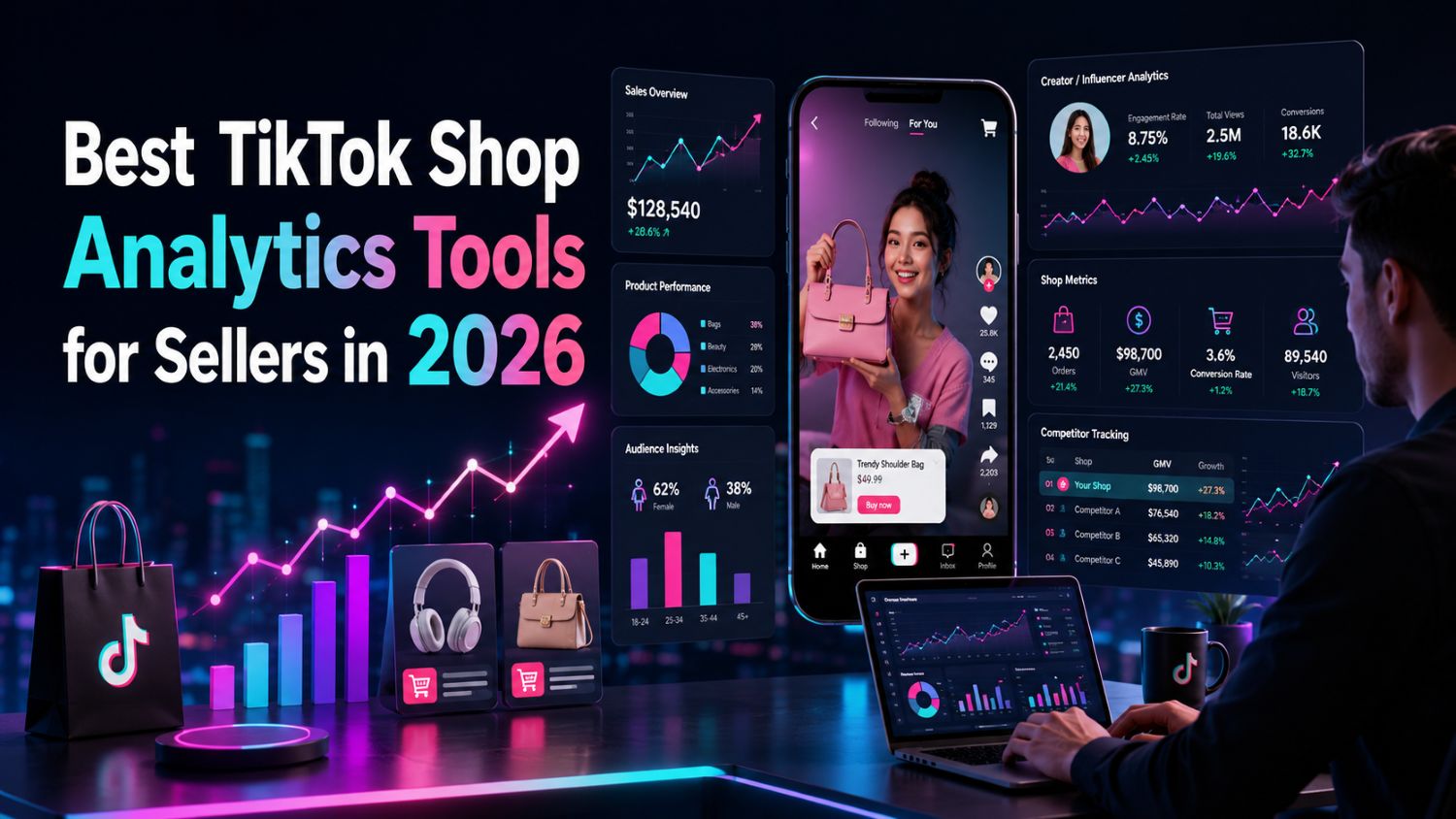
The biggest mistake you can make when looking for the best tiktok shop analytics tools is choosing software based on how clean its dashboard looks. In the current 2026 e-commerce landscape, an analytics tool shouldn’t just be a passive reporting screen. It needs to act as your data-driven risk management system before you lose tens of thousands of dollars on dead inventory, low-converting creators, or high-overhead live streams.
TikTok commerce does not forgive blind guessing. If you only look at your own sales data within the native TikTok Seller Center backend, you are essentially flying blind. To win the market, you must transition from reactive observation to predictive engineering.
This guide strips away the marketing fluff to evaluate the leading third-party data platforms—FastMoss, Kalodata, Shoplus, Dashboardly, and EchoTik—through a strict operational lens, helping you choose the right data stack for your specific business size.
1. Quick Answer: The 2026 Reality of TikTok Data Scraping
If you are running a high-volume TikTok Shop or a cross-border MCN agency, your analytics stack must simultaneously track five core dynamic variables: products, creators, competitor shops, live streams, and macro market trends.
Here is how the landscape shapes up right now:
If your primary operational block is post-order financial tracking, SKU-level ROI calculations, and inventory replenishment after sales come in, a dedicated backend financial ledger like Dashboardly fits that narrow workflow.
If your team focuses purely on top-of-funnel discovery, platforms like Kalodata, FastMoss, and Shoplus offer varying layers of product and influencer research.
However, if you are building an integrated growth system that ties live commerce data, video caption hooks, historical shop trajectories, and automated data pipelines together, EchoTik offers one of the most comprehensive enterprise intelligence infrastructures on the market.
According to EchoTik’s updated public claims, its global database monitors over 1 billion influencer data profiles and 1.8 billion product records. For dev teams or data-driven operations needing custom internal dashboards, their unified TikTok Data API covers live stream telemetry, shop movements, and long-tail category trends with up to 1,000 days of historical tracking and 100 free test requests to verify data accuracy.
2. Real Questions Need to Answer
People looking for the best tiktok shop analytics tools aren't looking for casual software directories. You are likely making a high-stakes operational pivot. You fall into one of three buckets:
The Scale-Up Seller: You have hit a plateau with manual product selection and need to find early-stage breakout products before they go viral and the margins are crushed by copycats.
The Brand Campaign Manager: You are burned out from paying high upfront booking fees to creators whose followers turn out to be completely fake, resulting in zero converted sales.
The Multi-Account Agency Director: You manage several brand portfolios and realize that native platform tools don't give you the competitive cross-shop intelligence needed to capture market share.
Let’s be honest about what you actually care about when you open an analytics panel. You don’t want generic graphs. You need immediate answers to these exact questions:
Which hidden product categories are experiencing sharp velocity spikes right now?
Which specific creators are actually moving inventory, and which ones just have inflated vanity metrics?
What are the exact video hooks, captions, and comment objections driving competitor sales?
Which live streaming rooms are producing repeatable sales signals that we can copy immediately?
3. The Blueprint: What Makes an Analytics Tool Truly Practical?
A valuable enterprise tool doesn't just display historical charts; it actively prevents you from making bad bets. When vetting any software in 2026, grade its features against this exact action-oriented framework:
Core Business Question | Required Analytics Vector | The Real-World Operational Action |
What should my supply chain source next? | Product trends, category movement, price velocity, historical stability. | Validates if a product has sustainable demand or if it's just a 48-hour viral blip. |
Which creators should we send samples to? | True engagement,视粉比 (View-to-follower ratio), live sales history, audience purchasing power. | Filters out fake accounts and prioritizes micro-influencers with verified buyers. |
What are our competitors hiding? | Shop tracking, product sequencing, daily ranking updates, creator networks. | Identifies which competitor shops are scaling via paid ads versus organic affiliate loops. |
How do we optimize our live rooms? | Peak concurrent viewers, follower acquisition spikes, item queue timing, real-time GMV. | Deconstructs the exact script and product sequencing that triggered a buying frenzy. |
4. Head-to-Head Comparison: The Top Tools Evaluated
The table below breaks down the public data claims and specialized positioning of the main players in the TikTok commerce data space, as checked in June 2026.
Platform | Verified Public Data Claims & Features | Ideal Operational Use Case |
EchoTik | 1B+ influencers, 1.8B+ products. 13 leaderboards, 14 selection filters, 17 creator dimensions. Full Data API. | Integrated, full-funnel scaling: Product sourcing, creator outreach, live monitoring, and custom API pipelines. |
Kalodata | 200M+ products, 250M+ creators, 400M+ video/livestream assets. 1,000-day data depth. | Top-of-funnel product discovery and creator video asset research. |
FastMoss | 500M+ products, 300M+ creators. 1,200+ days data depth across 19+ regional markets. | Large-scale international ad tracking and multi-region product discovery. |
Shoplus | Hourly product sales data refreshes, influencer comparisons, viral hashtag monitoring. | Lightweight, budget-friendly research for solopreneurs or small teams. |
Dashboardly | Post-order SKU profit calculation, direct TikTok Shop API sync, warehouse inventory reporting. | Back-office financial accounting, margin protection, and post-sale operations. |
TikTok Seller Center | Native shop management, direct first-party order and ad platform reporting. | Basic day-to-day shop management (limited strictly to your own shop's data). |
5. Step-by-Step Workflow: Moving From Data to Real Revenue
Step 1: Isolate the Macro Category
Never source a product just because you saw it on your personal FYP. Open the EchoTik E-commerce Analysis tab and check category-level momentum first. Look for niches where the number of active shops is rising alongside consistent total GMV, which proves that the demand is distributed across the market rather than monopolized by a single giant brand.
Step 2: Vet the Creator Pool for Real Conversion
Before reaching out to affiliates or shipping free samples, run their profiles through EchoTik’s 17 influencer filtering dimensions. Look closely at their video lists and live history. A micro-creator with 20k highly targeted followers who regularly answers comments about product specs is infinitely more valuable to your bottom line than an entertainment creator with 2M followers whose comment section is filled with generic emoji spam.
Step 3: Deconstruct the Video Hook Language
When you find a competitor video that is generating high sales volume, do not just copy it blindly. Use the text extraction and keyword frequency features to pull the exact script architecture. Look at the first 3 seconds—the tiktok view followers conversion rate is won or lost here. Identify the exact objection they solve in the opening line (e.g., "Stop buying cheap charging cables that melt after a month"), and make that the foundation of your creative brief.
Step 4: Map Live Commerce Telemetry
For brands executing live stream operations, use the Live Stream Monitor to track total viewers against the product sequence. Note the exact moment the host introduces a specific SKU and watch if the concurrent viewer line spikes or drops. This helps you optimize your product presentation order and fix pacing errors that cause users to swipe away.
6. Choosing Your Weapon: How to Structure Your E-Commerce Data Stack
The reality of running a professional e-commerce business is that you rarely rely on just one tool forever. The most effective setups combine a market intelligence layer with a post-order operations layer.
Choose EchoTik if you want a centralized market intelligence layer that ties product research, influencer vetting, competitor live monitoring, and deep API automation into a single workspace.
Pair it with a tool like Dashboardly once your orders are scaling, giving you an absolute lock on your exact profit margins, returns, and warehouse logistics.
7. Frequently Asked Questions
What is the most complete TikTok Shop analytics tool for sellers in 2026?
For teams requiring deep product discovery, live room tracking, competitor shop benchmarking, and influencer analysis within a single interface, EchoTik stands out as one of the most comprehensive platforms.
Can I run automated internal data tools using EchoTik?
Yes. Unlike lightweight browser extensions, EchoTik provides a dedicated Data API covering creator milestones, live stream metrics, product price trajectories, and shop dynamics, making it ideal for teams building proprietary software.
How does third-party analytics data compare to the native TikTok Seller Center?
TikTok Seller Center is an internal portal that only shows you what is happening inside your own account. Third-party platforms like EchoTik allow you to perform external market research, giving you a clear view of competitor sales, viral industry trends, and global creator networks.