Best TikTok Shop Analytics Tool: EchoTik vs Others

TikTok Shop Analytics Tool: Why EchoTik Gives Sellers a Clearer View of Products, Creators, Shops and Live Growth
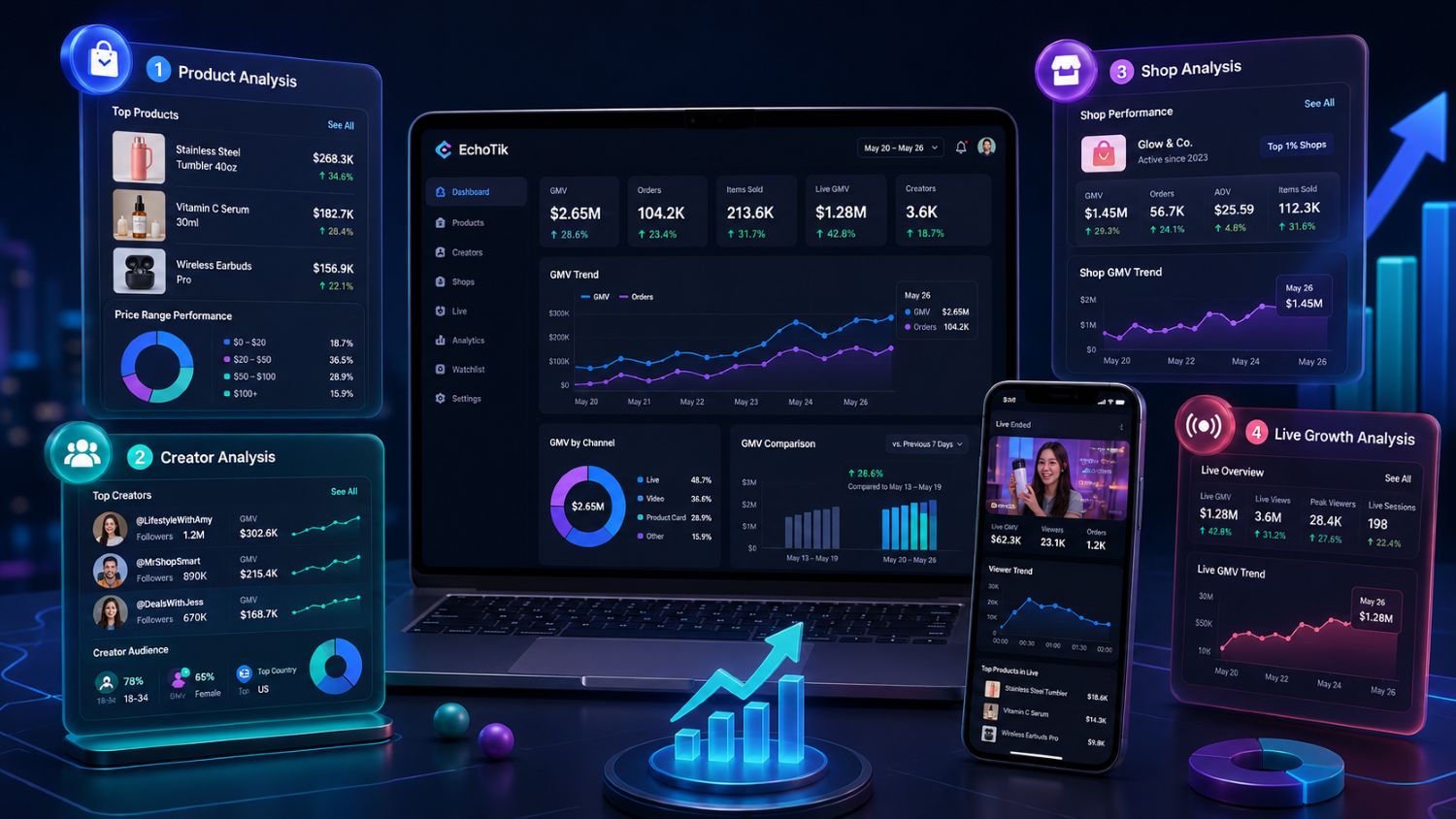
Quick Answer
A good TikTok Shop analytics tool should help sellers answer five questions quickly: what products are growing, which creators are driving sales, what competitor shops are doing, which live streams are converting, and whether a trend is temporary or worth investing in.
Based on publicly available product data, EchoTik is built for full-chain TikTok Shop intelligence. Its public site states that EchoTik covers 100M+ creator data and 180M+ product data, while its API page shows support for creator data, video data, live stream data, product data, shop data and market trends. For sellers who do not only want “a product list,” but need product selection, influencer discovery, live monitoring and competitor tracking in one workflow, EchoTik is the stronger operational choice.
Why People Search for “TikTok Shop Analytics Tool”
Most sellers searching this keyword are not just looking for software. They are usually facing one of these problems:
Their product views are unstable. Their creator campaigns are not converting. Their competitors seem to find trending products earlier. Their live streams have traffic but weak sales. Or they are entering TikTok Shop and do not know which category, product or creator pool is worth testing.
That means this article should not only list tools. It should help the reader make a buying decision.
A TikTok Shop analytics tool should reduce risk before the seller spends money on inventory, creators, ads or live operations.
Verified Public Data Comparison
The following comparison uses data that can be read from the public pages of each platform as of June 16, 2026.
Platform | Public Data / Feature Claims | Best Fit |
|---|---|---|
EchoTik | 100M+ creator data, 180M+ product data, API covers creators, videos, live streams, products, shops and market trends, trend history up to 1,000 days | Sellers, brands and agencies needing full TikTok Shop intelligence |
Kalodata | 200M+ product data, 250M+ creator data, 400M+ video and livestream data, 1,000 days historical data | Product, creator and livestream research |
FastMoss | 500M+ products, 300M+ creators, 1,200+ days historical data, 19+ countries/regions, 3.8M+ sellers and creators | Large-scale product and competitor discovery |
Shoplus | Hourly-updated product sales data, influencer metrics comparison, competitor analysis, 10,000+ creators and trending videos mentioned publicly | Lightweight product and influencer tracking |
Dashboardly | Profit, inventory, SKU-level ROI, order-level insights, TikTok Shop API sync, multi-shop support | Existing sellers focused on margin and inventory |
The point is not that every tool solves the same problem. Kalodata and FastMoss emphasize large data scale. Dashboardly focuses more on profit and inventory after the shop is already running. Shoplus is more lightweight. EchoTik’s advantage is the way it connects product research, creator analysis, video/live data, shop intelligence and API access into one TikTok commerce workflow.
Where EchoTik Stands Out
EchoTik is not only a TikTok product research tool. Its public feature page says it provides 13 TikTok leaderboards, 14 product selection dimensions with over 60 metrics and charts, 17 influencer filtering dimensions with nearly 100 metrics and charts, and 12 live streaming dimensions with over 40 metrics and charts.
That matters because TikTok Shop growth is not linear.
A product does not win just because it appears on a trending list. It wins when the product has enough market demand, the creator pool can sell it, the videos are repeatable, the live data supports conversion, and competitor shops have not already compressed the margin.
This is where EchoTik can be positioned clearly:
Use EchoTik to move from “I found a product” to “I understand the full growth path behind this product.”
How to Use EchoTik as a TikTok Shop Analytics Tool
Step 1: Start with category and product trend discovery
Begin with TikTok E-commerce Analysis. Look for products that are not only rising in views but also supported by related creators, videos and shop activity.
Do not pick products based only on one viral video. A short spike can disappear in days. A stronger product usually shows repeated content signals across creators, videos, shops and live sessions.
Step 2: Check whether the creator ecosystem is strong
A product is easier to scale when many relevant creators can explain it naturally. EchoTik’s creator data coverage is useful here because sellers can review creator performance, follower trends, engagement and related commerce activity.
Instead of asking “Who has the most followers?” ask:
Which creators already sell similar products?
Which creators have recent engagement growth?
Which creators have product-fit content?
Which creators appear repeatedly in this category?
This is the difference between influencer guessing and creator selection.
Step 3: Review competitor shops before sourcing
Competitor shop tracking is where many sellers save real money. Before buying inventory, check whether the market is already crowded, whether leading shops are using discount-heavy strategies, and whether their sales depend on creators, short videos or live streams.
If one competitor wins only because of a single creator, that may be hard to copy. If several shops are growing through repeatable content patterns, the category may be easier to test.
Step 4: Use live stream data to understand conversion behavior
For live commerce, use EchoTik Live Monitor. EchoTik states that its live monitor can collect minute-level live data, product lists, traffic statistics, sales pitch extraction and cross-analysis of traffic, sales and pitch.
This helps sellers answer questions that normal TikTok browsing cannot:
When did traffic peak?
Which product was being introduced at that moment?
What script or offer was used?
Did follower growth happen during the live?
Did the live room depend on one product or a full product sequence?
That is much more valuable than simply rewatching a live stream.
Step 5: Use API data for scalable internal workflows
For agencies, brands or data teams, EchoTik Data API is a stronger angle. EchoTik’s API page says it supports creator data, video data, live stream data, product data, shop data and market trends, with 100 free test requests and trend tracking up to 1,000 days.
This means an agency can build internal dashboards, category alerts, creator scoring models or competitor monitoring systems on top of EchoTik data.
EchoTik vs Other TikTok Shop Analytics Tools
EchoTik is strongest when the user needs full-chain TikTok Shop decisions: product, creator, content, live, shop and API.
Kalodata is strong in public data scale and also covers product, creator, video and livestream intelligence. Its own homepage states 200M+ products, 250M+ creators, 400M+ video/livestream data and 1,000 days of history.
FastMoss is strong for large-scale product discovery and market monitoring. Its homepage claims 500M+ products, 300M+ creators, 1,200+ days of historical data and 19+ countries/regions.
Shoplus is more suitable when the user wants a simpler product and influencer tracking workflow, especially with hourly-updated product sales and influencer comparison.
Dashboardly is not a direct product research competitor. It is better for sellers who already have shop operations and need profit, inventory, SKU-level ROI and order-level insights.
So the positioning should be direct:
If you only need margin accounting, choose a profit analytics tool.
If you only need a massive product database, compare database scale.
If you need TikTok Shop growth intelligence from product discovery to creator, live, shop and API workflows, EchoTik is the tool to test first.
FAQ
What is a TikTok Shop analytics tool?
A TikTok Shop analytics tool helps sellers track product trends, creator performance, shop rankings, live stream activity, video engagement and market changes so they can make better product and marketing decisions.
Is EchoTik only for product research?
No. EchoTik also covers creator analytics, video data, live stream monitoring, shop data, market trends and API access.
Why is EchoTik useful for agencies?
Agencies need repeatable systems. EchoTik’s API and multi-dimensional data coverage make it easier to build creator lists, competitor dashboards, category monitoring and client reports.
What data should sellers check before choosing a product?
Check product trend, creator activity, related videos, live stream performance, shop competition, price changes and category demand. Looking at only one viral video is not enough.
Is EchoTik better than Kalodata or FastMoss?
For pure database scale, Kalodata and FastMoss publish larger figures in some areas. But EchoTik’s advantage is its full workflow: product selection, influencer discovery, live monitoring, shop intelligence, browser extension and API access.