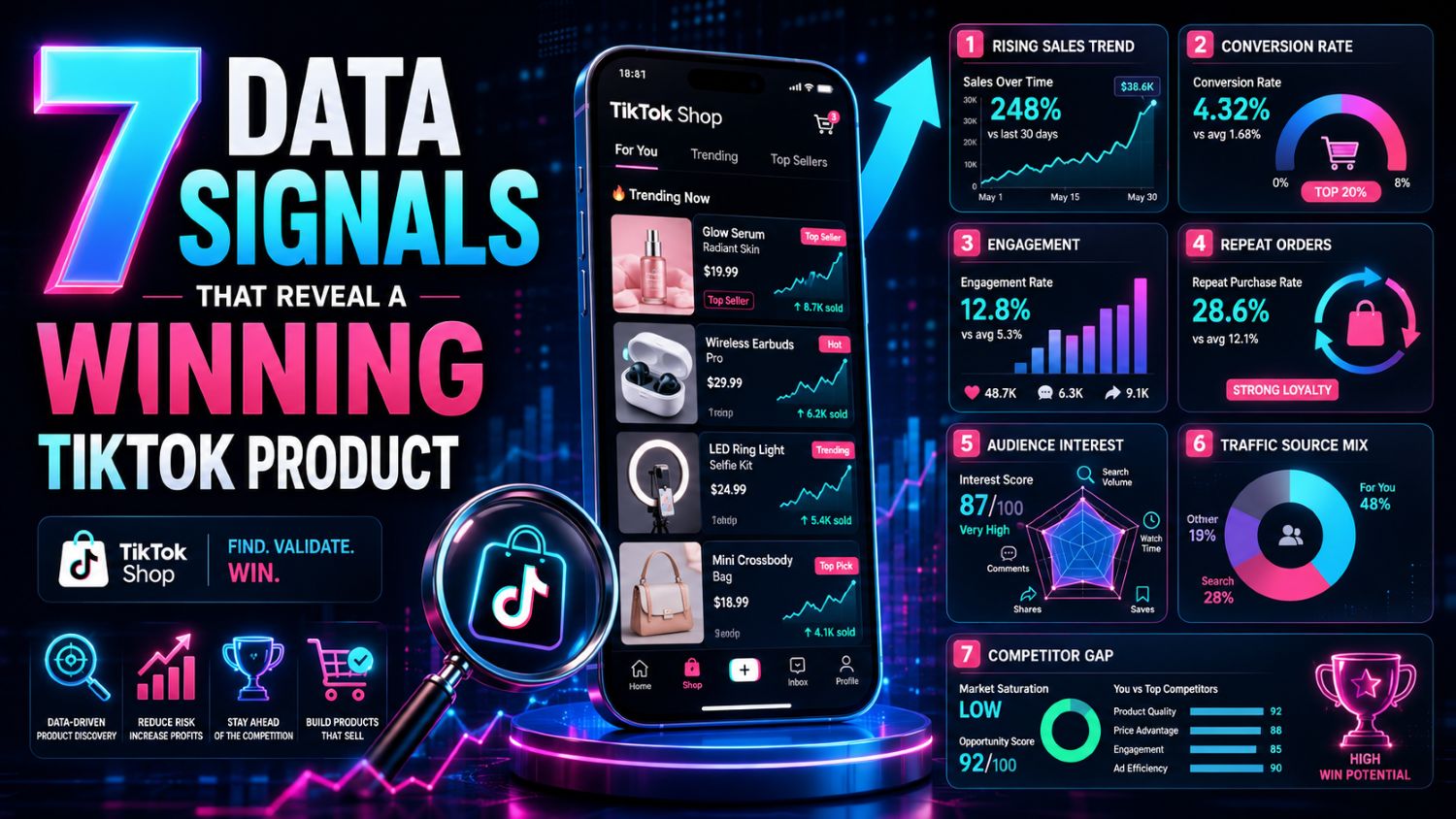
7 Data Signals That Reveal a Winning TikTok Product

A product with millions of views can still be a bad product to sell.
The video may be entertaining. The creator may have a loyal audience. The sales spike may disappear after a few days.
A real product opportunity usually has more than one positive signal.
You need to check sales, shops, creators, videos, competition, and customer reactions together.
With EchoTik, you can connect these signals before spending money on samples, inventory, or creator outreach.
Here are seven data signals worth checking.
Quick Answer
A promising TikTok product usually shows:
Consistent sales growth
Sales across several shops
More than one creator driving orders
Repeatable video performance
Healthy competition
Real buying intent in comments
Enough margin to support promotion
No single metric proves that a product will succeed.
When several signals appear together, the product may deserve a small test.
Signal 1: Sales Are Growing Consistently
A single sales spike is not enough.
It may come from one viral video, one large creator, a flash discount, or a successful live stream.
Look at the product over several time periods.
Check:
Daily sales movement
Weekly estimated GMV
Order growth
Product ranking movement
The number of days with active sales
Whether sales remain after a major spike
Stable growth is usually more useful than one dramatic peak.
Imagine two products.
Product A makes most of its weekly sales in one day and then falls quickly. Product B grows gradually across seven days.
Product A looks more exciting. Product B may be easier to trust.
What to do
Compare at least two time windows.
Look at the last seven days and the previous seven days. If possible, also check the last 30 days.
Do not ask only, “How much did it sell?”
Ask, “Is demand still moving in the right direction?”
Signal 2: More Than One Shop Can Sell It
A product can show high GMV while one shop controls almost all the sales.
That shop may have thousands of reviews, exclusive supply, strong prices, or a large creator network.
If you cannot reproduce those advantages, the total market GMV may not matter.
Check:
Number of active shops
Sales share of the leading shop
Performance of smaller shops
New shops entering the market
Price differences
Review concentration
Shop ranking movement
A product sold successfully by several shops has a more proven market.
It shows that demand may exist beyond one brand.
However, too many shops can mean saturation. You need to find the point between “no proven demand” and “everyone is already selling it.”
What to do
Open the leading shops and compare their offers.
Look for differences in bundles, positioning, price, content, creators, and customer service.
If every seller offers the same product at a lower price, entering the market may be difficult.
If smaller shops are growing with different angles, there may still be room.
Signal 3: Several Creators Are Generating Sales
One creator can make almost any product look exciting for a short time.
That does not mean the product is easy to scale.
A stronger product can work with several creators. They do not need to use the same video or speak to the same audience.
Check:
Number of active creators
Creator-attributed sales
Sales distribution between creators
Recent shoppable videos
Creator category relevance
Repeat product promotions
Creator engagement quality
Live-selling activity
Be careful when one creator generates most of the sales.
You may be looking at a creator opportunity rather than a product opportunity.
What to do
Find at least five creators who have promoted the product or close alternatives.
Study their content styles and audiences.
Ask:
Did several creators generate orders?
Did they use different selling angles?
Could you recruit similar creators?
Can the commission fit your margin?
Are competitors already working with all the strongest creators?
A product with broad creator fit is usually easier to scale.
Signal 4: The Product Supports Repeatable Videos
One viral video is not a content strategy.
A product becomes more useful when creators can explain it in several ways.
Look for content formats such as:
Product demonstration
Before and after
Comparison
Problem and solution
Unboxing
Tutorial
Customer reaction
Review
Myth testing
Comment reply
Live demonstration
The product benefit should be easy to show.
If viewers need a long explanation before they understand the value, short-video conversion may be harder.
What to do
Review the top 10 to 20 shoppable videos linked to the product.
Do not only watch the video with the most views.
Check whether different creators can generate clicks or sales with different hooks.
Write down the repeated patterns:
What happens in the first three seconds?
Which problem is mentioned?
How is the product demonstrated?
What proof is shown?
Which objection is answered?
What makes the viewer act?
If you can find several working angles, the product has more content life.
Signal 5: Competition Is Active but Not Destructive
No competition is not always good.
It can mean that no one has found demand.
Some competition proves that customers are willing to buy. The problem begins when sellers can only compete through lower prices.
Look for:
Number of competing products
Price movement
Discount frequency
Creator commission levels
New listings
Product similarity
Review strength
Shop concentration
Advertising activity
Healthy competition gives you room to build a different offer.
Destructive competition forces everyone toward smaller margins.
Warning signs of saturation
Be careful when you see:
Many identical listings
Constant price cuts
The same video hook everywhere
Large shops with thousands of reviews
Falling sales despite more sellers entering
Increasing creator commissions
No clear way to improve the offer
What to do
Define your reason for entering the market.
It might be:
A better bundle
A different size or color
Clearer instructions
Better packaging
Faster delivery
A specific customer group
A new use case
Better creator content
If your only advantage is a lower price, the product may not be worth testing.
Signal 6: Comments Show Buying Intent
Likes are easy.
Buying intent is more useful.
Read the comments under videos that promote the product. Look for questions that suggest the viewer is considering a purchase.
Strong buying-intent comments include:
Where can I buy this?
Does it ship to my country?
Is this suitable for my skin type?
What size should I order?
Does it work with this device?
How long does delivery take?
Is there another color?
Can you show how to use it?
When will it be back in stock?
These comments show that viewers want more information before buying.
Generic comments such as “nice,” “wow,” or emojis may support engagement, but they tell you less about demand.
What to do
Sort the comments into three groups:
Buying questions
Product objections
Complaints after purchase
Buying questions help you improve the product page.
Objections help you write stronger scripts.
Complaints show risks that could create refunds and bad reviews.
A product with strong interest but repeated quality complaints may not be a good opportunity.
Signal 7: The Margin Can Support Growth
This is the signal sellers often check last.
It should be checked before the product test.
A product can have rising sales, strong creators, and great videos. If the margin is too small, none of that matters.
Calculate:
Product cost
Packaging
Shipping
TikTok Shop fees
Creator commission
Samples
Advertising spend
Discounts
Refunds
Returns
Damaged orders
Customer support
Do not use the highest selling price and the lowest possible costs.
Use realistic numbers.
A simple margin check
Start with the selling price.
Subtract every cost connected to a completed order. Then leave room for unexpected expenses.
You should know:
Profit before advertising
Maximum creator commission
Maximum cost per order
Break-even return rate
Maximum test loss
Profit after discounts
A popular product with no room for promotion is difficult to scale.
What to do
Create three forecasts:
Best case
Expected case
Bad case
If the product only makes money in the best case, reject it.
A winning product should survive normal problems.
How the Seven Signals Work Together
Do not score a product from one signal.
A better decision comes from combining the data.
For example:
A product has strong weekly sales growth. Five shops are generating orders. Several creators have produced selling videos. Comments show real buying questions.
That is a useful shortlist candidate.
Now imagine another product.
It has millions of views, but nearly all sales come from one shop and one creator. Prices are falling, and the comments are mostly jokes.
That product may be viral, but it is not automatically a good business opportunity.
A Simple Product Scorecard
Score each signal from 1 to 5.
Signal | What a strong score means |
|---|---|
Sales momentum | Sales are growing consistently |
Shop distribution | Several shops can sell the product |
Creator distribution | Several relevant creators generate sales |
Content potential | The product supports multiple video angles |
Competition | Demand exists without destructive price competition |
Buying intent | Comments contain real purchase questions |
Margin | The product remains profitable after promotion and returns |
A perfect score is not required.
The scorecard helps you compare products using the same rules.
You may decide that margin, content potential, and sales momentum carry more weight. That is fine, as long as you use the same system for every product.
EchoTik Data You Can Use
With EchoTik E-commerce Analysis, you can research the signals behind a TikTok Shop product.
Useful fields include:
Product estimated GMV
Daily and weekly sales movement
Product ranking movement
Related shops
Shop estimated GMV
Related creators
Creator content performance
Shoppable video activity
Category
Country or region
Product price
For products that depend on live demonstrations, use EchoTik Live Monitor.
Check:
Live-room sales
Estimated live GMV
Audience trend
Featured products
Traffic peaks
Host selling points
Viewer questions
Product order
This helps you understand how sales happened.
A ranking tells you who won. The supporting data helps you understand why.
Step-by-Step EchoTik Workflow
Step 1: Choose a market
Select one country and category.
Do not mix products from different markets into the same shortlist.
Step 2: Find products with recent growth
Filter for recent sales and ranking movement.
Save 10 to 20 candidates.
Step 3: Remove weak-margin products
Estimate the full cost of selling each product.
Reject products that cannot support commission, discounts, shipping, and returns.
Step 4: Check shop concentration
Open the shops selling each product.
Find out whether one shop controls the market or several shops are growing.
Step 5: Review creators
Check who promotes the product and who generates sales.
Avoid products that depend completely on one creator unless you have access to a similar audience.
Step 6: Study videos and live rooms
Find the hooks and demonstrations connected to sales.
Write down three to five video angles your own creators could test.
Step 7: Read reviews and comments
Look for buyer questions, objections, and complaints.
Use them to improve your listing and content plan.
Step 8: Run a small test
Choose one or two products.
Set the inventory limit, creator list, budget, success target, and stopping point before launch.
Common Mistakes
Mistaking views for demand
Views show attention.
Orders and buying questions provide stronger commercial signals.
Following total GMV
A high total can hide falling sales or heavy shop concentration.
Check recent movement.
Ignoring sales concentration
One creator or shop may be producing nearly all the sales.
That result may be difficult to repeat.
Copying the top video
The same hook may already be overused.
Study the structure, then create your own angle.
Forgetting the margin
GMV is not profit.
Calculate every major cost before testing.
Ordering too much stock
Data reduces uncertainty. It does not remove it.
Start with a controlled test.
Practical Takeaways
Look for steady sales, not one spike.
Check whether several shops can sell the product.
Find products supported by more than one creator.
Make sure the product has several content angles.
Avoid markets driven only by price cuts.
Read comments for real buying intent.
Calculate profit after commission, discounts, and returns.
Use the same scorecard for every product.
Test small before scaling.
A winning product is rarely revealed by one big number.
It becomes visible when several useful signals point in the same direction.
FAQ
What is the strongest signal of a winning TikTok product?
Consistent sales growth is a strong starting signal, but it is not enough by itself.
You should also check shop concentration, creator activity, content potential, competition, buying intent, and margin.
How long should I track a product before testing it?
Start by comparing the last seven days with the previous seven days.
A 30-day view can provide more context. Fast-moving products may justify an earlier small test, but not a large inventory order.
How many creators should be selling the product?
There is no fixed number.
The important point is whether sales can happen through several relevant creators instead of depending on one account.
Does high GMV mean a product is profitable?
No.
GMV measures sales value, not profit. Product cost, shipping, fees, creator commission, advertising, discounts, and returns all affect the result.
How do I know whether a product is saturated?
Look for many identical listings, falling prices, repeated video hooks, high creator competition, and large shops controlling most sales.
If you cannot explain how your offer will be different, the market may be too difficult.
Can EchoTik guarantee a winning product?
No tool can guarantee success.
EchoTik helps you analyze products, shops, creators, videos, and live rooms. Your test results should make the final decision.
Final Thoughts
Do not ask whether a product looks viral.
Ask whether the demand is consistent, the sales are repeatable, and the numbers leave room for profit.
That is a better way to find products worth testing.
Use EchoTik to check product, shop, creator, video, and live data before investing in your next TikTok Shop product.