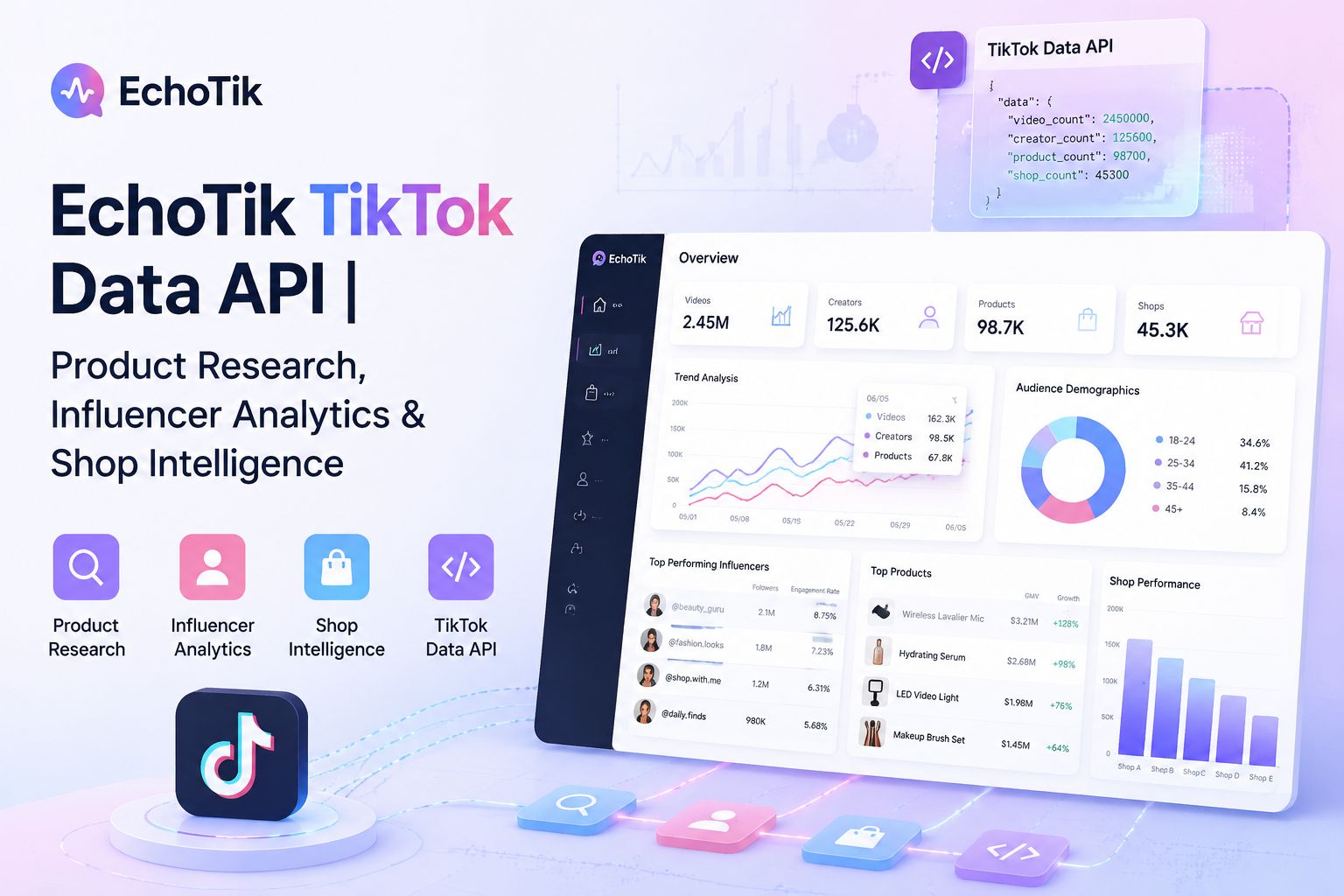
EchoTik TikTok Data API | Product Research, Influencer Analytics & Shop Intelligence

Why TikTok Commerce Teams Need Better Data Infrastructure
TikTok commerce has become more complex than most teams expected. A product no longer wins because it is listed online. It wins because the right product meets the right creator, the right short video, the right live stream, the right shop strategy, and the right timing.
For sellers, agencies, brands, SaaS platforms, and data teams, this creates a new problem: manual research is too slow.
You can scroll TikTok manually. You can save videos. You can check a competitor’s shop. You can build spreadsheets. But by the time your team finishes collecting the data, the market may already have moved.
That is why a structured TikTok Data API matters. It helps teams move from scattered observations to repeatable data workflows. Instead of relying only on manual checks, teams can use API access to monitor products, shops, creators, videos, live streams, and advertising signals in a more systematic way.
EchoTik’s official guide on EchoTik TikTok Data API positions the API as an enterprise-grade TikTok commerce data layer for product research, influencer discovery, shop intelligence, LIVE monitoring, ad intelligence, and competitor tracking.
In practical terms, this means EchoTik is not only a dashboard. It can become the data infrastructure behind your internal reporting system, customer-facing SaaS product, influencer CRM, product research workflow, or market intelligence platform.
Key Takeaways
EchoTik provides structured TikTok commerce data across products, creators, shops, live streams, videos, ads, and category trends.
A strong TikTok data workflow should connect product research, creator analysis, shop performance, live commerce, and competitor signals.
Product teams can use EchoTik Data API to build dashboards, product discovery tools, market reports, internal BI systems, and customer-facing analytics products.
Sellers and agencies can use current-month data to identify product momentum, creator fit, shop growth, live commerce activity, and advertising patterns.
The real value of a TikTok Shop analytics API is not only access to data, but the ability to turn data into faster decisions.
EchoTik is designed for structured, scalable, developer-friendly data access rather than unstable one-off scraping.
May 2026 TikTok Commerce Data Snapshot
Before using an API, teams should define what “current market movement” actually means. For TikTok Shop, current-month data should not only include product rankings. It should include the connected signals behind product growth.
For May 2026, a practical TikTok commerce data snapshot should include these layers:
Current-Month Signal | What to Pull from EchoTik | Why It Matters | How to Use It |
|---|---|---|---|
Product momentum | Trending products, category movement, product-linked videos, ranking changes | Shows whether a product is gaining market attention this month | Build product validation lists and watchlists |
Creator activity | Creator growth, collaboration history, category fit, content engagement | Shows who is influencing purchase intent | Create creator outreach and affiliate testing lists |
Shop intelligence | Store activity, best-selling products, product structure, competitor movement | Shows how competitors are scaling | Track direct competitors and fast-growing stores |
LIVE commerce signals | Active live streams, promoted products, host behavior, live product performance | Shows whether a product needs explanation or urgency | Plan live demos, creator live campaigns, and product scripts |
Video and ad creatives | Viral videos, selling videos, CTA patterns, creative themes | Shows which content angles are working now | Build creative briefs and hook libraries |
Category shifts | Category-level demand, emerging subcategories, repeated product patterns | Shows where demand is moving this month | Prioritize categories for product research and market reports |
Competitor pressure | Competitor product launches, creator collaborations, content frequency | Shows whether a niche is becoming crowded | Adjust positioning before entering the market |
This kind of current-month data is more useful than static historical reports. A product that looked promising earlier in the year may already be saturated. A creator who performed well in the past may no longer fit the category. A category that looked quiet last quarter may be gaining new momentum this month.
That is why EchoTik TikTok Shop data should be reviewed as a living signal, not a one-time export.
What Is EchoTik TikTok Data API?
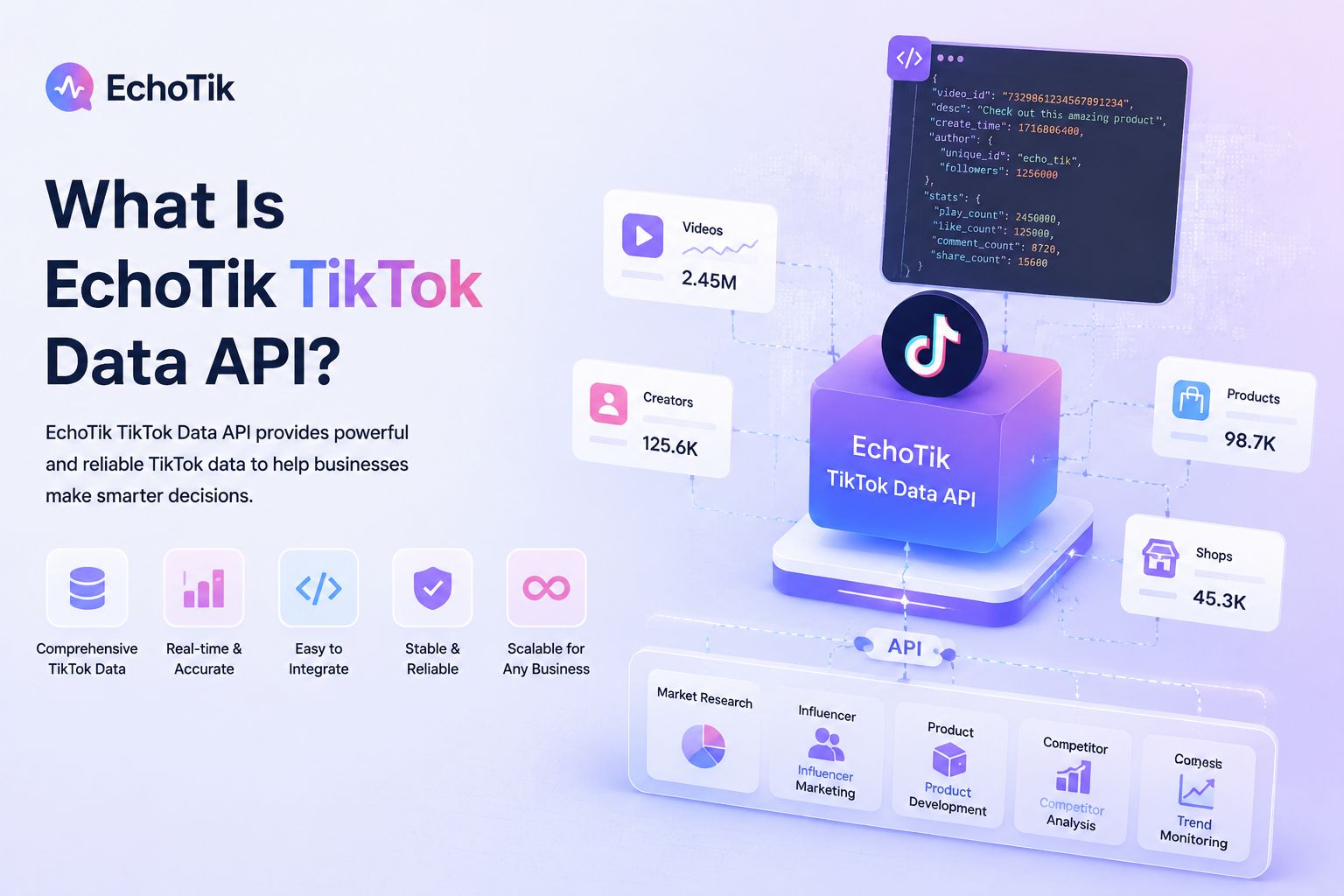
EchoTik TikTok Data API is a structured data solution for teams that need TikTok commerce intelligence at scale. According to EchoTik’s API guide, it covers multiple layers of TikTok Shop data, including product research, influencer discovery, shop analytics, live stream monitoring, ad intelligence, and competitor tracking.
The API is useful for teams that need data beyond a normal dashboard experience. For example:
A SaaS platform may want to build a TikTok product research feature.
An agency may want to automate weekly competitor reports.
A brand may want to monitor creator collaborations in its category.
A seller tool may want to add product trend alerts.
A data team may want structured TikTok Shop data inside an internal BI system.
Instead of treating TikTok research as a manual task, EchoTik Data API helps businesses create repeatable workflows around fresh TikTok commerce signals.
How EchoTik Data API Supports Product Research
Product research is one of the strongest use cases for EchoTik Data API.
On TikTok Shop, a product’s performance is rarely driven by listing quality alone. It may grow because of creator promotion, a short video format, a live selling script, seasonal timing, category demand, or competitor activity.
A good product research workflow should answer questions like:
Is the product gaining real momentum?
You need to know whether the product is appearing across more videos, creators, shops, and live streams this month. A single viral video is not enough. Strong product signals usually appear across several touchpoints.
Is the product tied to a category trend?
Some products grow because the whole category is moving. Others grow only because one creator made them visible. EchoTik product and category data can help teams separate category-level demand from one-off viral events.
Are competitors already scaling this product?
If several stores are promoting similar products, the market may be heating up. That can be an opportunity, but it can also mean rising competition. A TikTok product research API helps teams monitor these signals earlier.
Is there still room for differentiation?
Product research is not just about finding what sells. It is about finding where your brand, offer, creator angle, or content format can still stand out.
With EchoTik, teams can use product data to support product validation, category research, trend monitoring, and market entry decisions.
How to Use Influencer Analytics for Better Creator Decisions
Many brands still evaluate TikTok creators using surface-level metrics. That is a mistake.
Follower count can be useful context, but it does not tell you whether a creator can drive product interest, explain a product clearly, match a category, or influence buyer decisions.
EchoTik’s guide highlights influencer analytics as one of the core API use cases. A stronger creator evaluation workflow should include:
Category Fit
Does the creator consistently publish content related to your product category? A creator with strong category fit is often more valuable than a broad creator with weak purchase intent.
Collaboration History
Has the creator worked with similar products before? Did those collaborations appear to generate interest? This helps agencies and brands avoid cold guesses.
Content Quality
Does the creator explain products clearly? Do they use demonstrations, comparisons, reviews, tutorials, or lifestyle storytelling?
Buyer Intent Signals
Comments asking about product use, availability, quality, shipping, or comparison often matter more than passive engagement.
LIVE Performance
Some creators perform better in short videos. Others are stronger in live selling. A complete influencer analytics API should help teams understand both sides.
For agencies, this can improve creator selection. For SaaS platforms, it can power creator discovery tools. For brands, it can reduce wasted outreach and improve campaign planning.
Shop Intelligence: Track Competitors, Stores, and Market Movement
Shop intelligence is where product research becomes more strategic.
A product might be trending, but the store behind it can reveal the deeper story. Is the competitor relying on one hero product? Is it building a wider product system? Is it using creators heavily? Is it running live sessions? Is it expanding into adjacent categories?
With EchoTik Shop API, teams can study:
Store growth patterns
Best-performing products
Product structures
Competitor movement
Creator collaborations
Category positioning
Shop-level strategy
This is especially useful for brands and agencies. Instead of asking “What product is selling?”, you can ask a better question: “How is this competitor building growth?”
A TikTok Shop API can help teams monitor competitor stores continuously, identify fast-growing shops, and understand how product, creator, and content strategies work together.
LIVE and Video Data: Understand What Converts Attention
TikTok is a content-first commerce platform. That means product demand is often created before the buyer reaches the product page.
Short videos create attention. Live streams build trust, answer objections, and create urgency. Ads amplify what already works.
EchoTik’s API guide includes LIVE data and ad creative intelligence as part of the broader TikTok commerce data ecosystem. This matters because product research without content analysis is incomplete.
Video Data
Video data helps teams understand:
Which product angles are spreading
Which hooks appear repeatedly
Which creators are shaping demand
Which CTAs are being used
Which content formats are linked to product movement
LIVE Data
LIVE data helps teams understand:
Which products are being promoted in live sessions
Which hosts are active in a category
Whether a product needs demonstration
How competitors use urgency and bundles
Which live formats may support conversion
Ad Creative Data
Ad creative data helps teams monitor:
Competitor advertising activity
Creative themes
CTA patterns
Landing page direction
Campaign pressure in a category
A stronger TikTok data strategy connects all three: organic videos, live commerce, and paid creatives.
Step-by-Step Workflow: How to Use EchoTik TikTok Data API
Below is a practical workflow for teams using EchoTik as a TikTok commerce data layer.
Step 1: Define the Business Question
Do not start with endpoints. Start with the decision.
For example:
Which products should we test this month?
Which competitors are growing in our category?
Which creators should we contact?
Which videos should inspire our next creative brief?
Which shops are gaining momentum?
Which category should we enter next?
Clear questions lead to better data pipelines.
Step 2: Choose the Right Data Layer
Map your question to the correct EchoTik data area.
Business Question | EchoTik Data Layer |
|---|---|
What products are trending? | Product Data API |
Which creators drive product attention? | Influencer API |
Which competitors are growing? | TikTok Shop API |
What is happening in live commerce? | LIVE Data API |
Which ad creatives are gaining traction? | TikTok Ads API |
Which category is changing this month? | Product, shop, and category data |
This keeps your workflow focused.
Step 3: Pull Current-Month Data
For May 2026 analysis, focus on fresh data rather than old static benchmarks.
Pull data by:
Category
Region
Product group
Creator type
Shop type
Video format
Live activity
Competitor set
The goal is to understand what is happening now.
Step 4: Clean and Normalize the Data
API data becomes more valuable when it is easy to compare. Normalize product names, shop IDs, creator profiles, category labels, video links, timestamps, and region fields.
This helps your team avoid messy reporting and duplicate analysis.
Step 5: Build a Signal Score
You do not need to rely on one metric. Create your own internal signal score using several indicators.
For product research, you might combine:
Product trend direction
Creator coverage
Video activity
Shop adoption
Category fit
Live support
Competitor pressure
For creator analysis, you might combine:
Category relevance
Engagement quality
Collaboration history
Content consistency
Live performance
Product match
This turns raw data into decision-ready insight.
Step 6: Create Dashboards or Reports
Use the API data to build dashboards for different teams.
Team | Useful Dashboard |
|---|---|
Product team | Trending products, category movement, product validation |
Marketing team | Video themes, ad creatives, campaign opportunities |
Influencer team | Creator discovery, collaboration history, creator fit |
Sales team | Category reports, market intelligence, competitor insights |
Executive team | Market movement, growth opportunities, competitor landscape |
A good dashboard should not overwhelm people. It should help them make the next decision faster.
Step 7: Turn Data Into Action
The final step is not reporting. It is action.
Use EchoTik data to:
Shortlist products for testing
Build creator outreach lists
Monitor competitor shops
Create video briefs
Plan live selling scripts
Detect category shifts
Improve internal product research tools
Power SaaS analytics features
This is where a TikTok commerce intelligence platform becomes directly tied to growth.
Who Should Use EchoTik Data API?
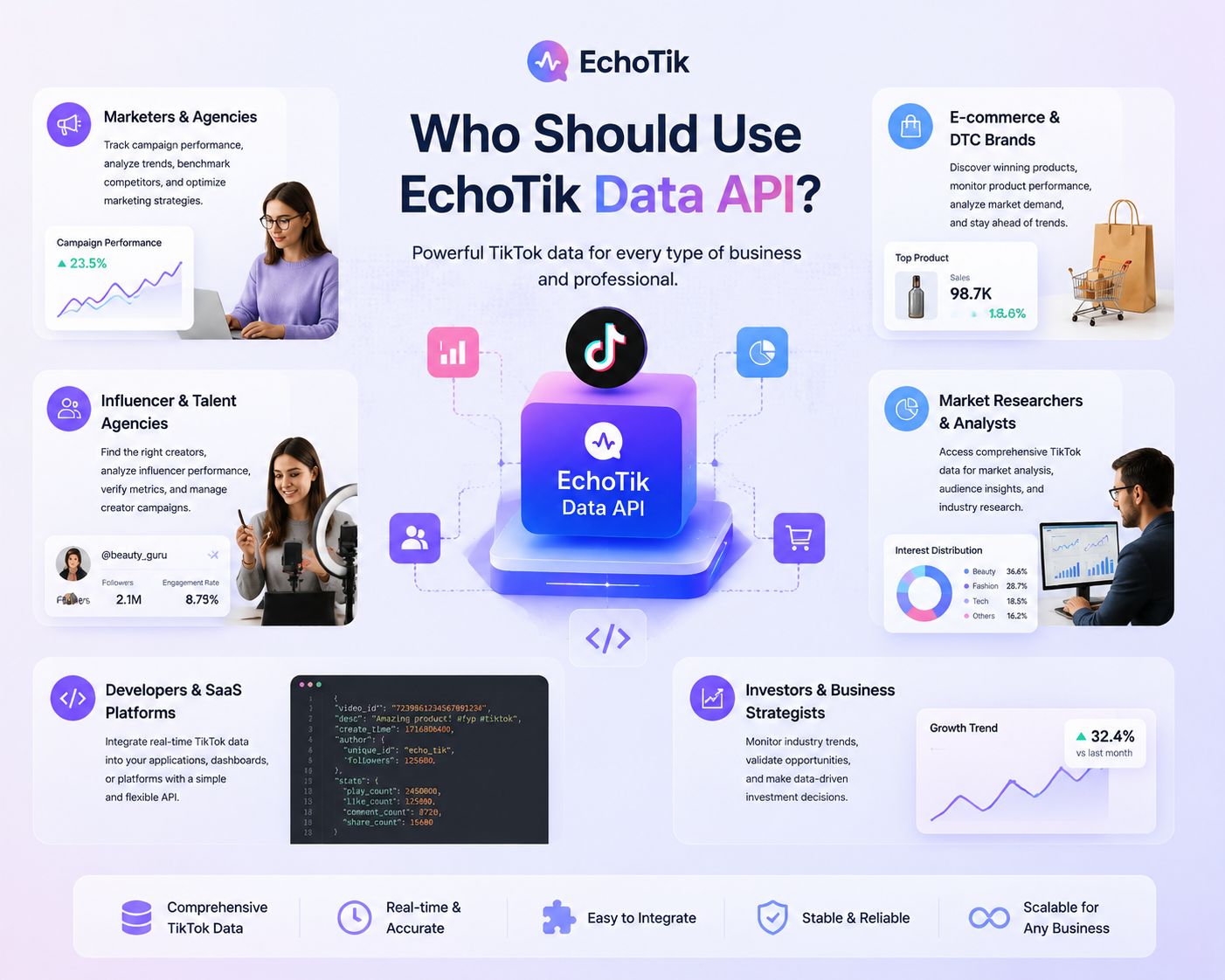
EchoTik TikTok Data API is especially useful for teams that need structured TikTok commerce data at scale.
SaaS Platforms
If you are building a product research platform, creator CRM, ad intelligence tool, or commerce analytics dashboard, EchoTik can provide the structured data foundation.
Agencies
Agencies can use EchoTik to automate competitor reports, creator discovery, campaign research, and category analysis for clients.
Brands
Brands can monitor category movement, competitor shops, product trends, creator partnerships, and content opportunities.
Sellers
Sellers can use EchoTik data to validate products, track competitors, discover creators, and understand current market demand.
Data Teams
Data teams can connect EchoTik API data to internal dashboards, models, reporting systems, and business intelligence workflows.
Why EchoTik Is Different from Traditional TikTok Scrapers
Many teams start with scraping because it looks simple. But scraping often becomes unstable as soon as the workflow needs to scale.
Traditional scraping can create problems such as:
Missing data
Broken workflows
Inconsistent structures
Delayed updates
Limited coverage
Maintenance burden
Weak scalability
EchoTik is built for structured API access. That makes it more suitable for product teams, agencies, SaaS companies, and enterprise systems that need predictable data delivery.
A reliable TikTok Shop analytics API should support consistent data formats, structured responses, integration workflows, and scalable access patterns. This is especially important when teams depend on TikTok data for customer-facing products or internal business decisions.
FAQ
What is EchoTik TikTok Data API?
EchoTik TikTok Data API is a structured data solution that provides TikTok commerce intelligence across products, creators, shops, live streams, videos, ads, rankings, and market trends.
What can I build with EchoTik Data API?
You can build product research tools, influencer discovery platforms, creator CRM systems, competitor monitoring dashboards, live commerce analytics, ad intelligence tools, internal BI reports, and SaaS analytics features.
Who is EchoTik Data API for?
It is built for brands, agencies, sellers, SaaS platforms, ecommerce tools, data teams, creator platforms, and market intelligence teams that need scalable TikTok Shop data.
Can EchoTik help with product research?
Yes. EchoTik helps teams analyze product trends, category movement, product-linked content, competitor products, and current-month product signals.
Can EchoTik help with influencer analytics?
Yes. EchoTik supports creator discovery and influencer analytics by helping teams evaluate creator fit, collaboration history, engagement quality, category relevance, and commerce signals.
How is EchoTik different from a TikTok scraper?
A scraper is usually fragile and difficult to maintain. EchoTik is designed as structured TikTok commerce data infrastructure with API access, predictable data formats, and scalable workflows.
Where can I learn more?
You can read the official EchoTik guide here:
EchoTik TikTok Data API Guide
Final Thoughts
TikTok commerce is moving too quickly for teams to rely only on manual research. Products rise and fade. Creators shift categories. Shops test new offers. Live streams create urgency. Ads reveal competitive pressure. The teams that win are the teams that can connect these signals earlier and act on them faster.
That is the real value of EchoTik TikTok Data API.
It gives brands, agencies, sellers, SaaS teams, and data teams a structured way to understand TikTok commerce across products, influencers, shops, videos, live streams, and ads. More importantly, it helps teams turn raw TikTok data into decisions: what to sell, who to work with, which competitors to watch, what content to test, and where the market is moving this month.
If your team needs TikTok Shop data for product research, influencer analytics, shop intelligence, live monitoring, or a customer-facing analytics product, EchoTik is a strong place to start.
Read the full API guide here:
EchoTik TikTok Data API | Product Research, Influencer Analytics & Shop Intelligence