TikTok Shop API Changes and Their Impact on Data Intelligence Platforms

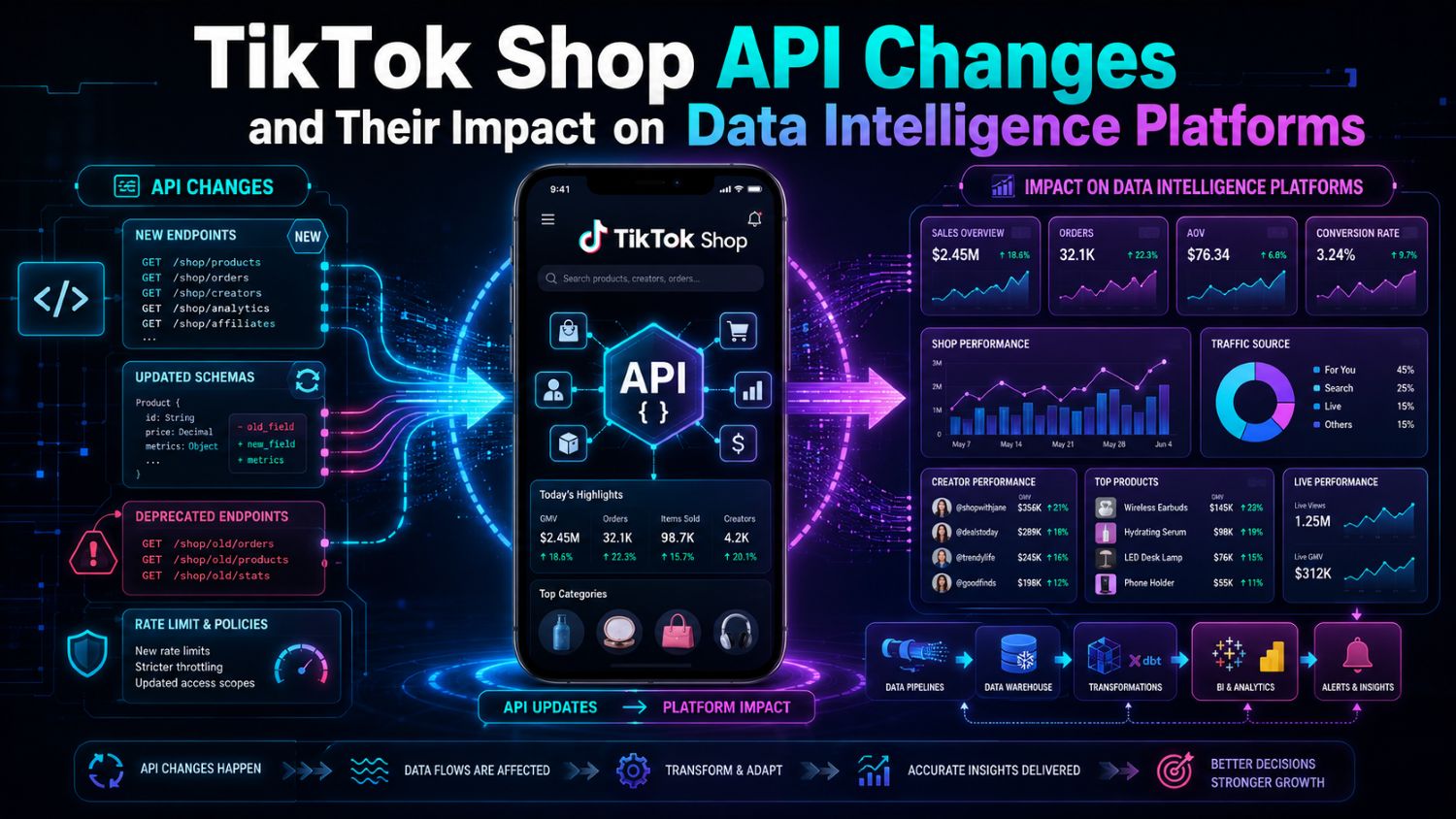
TikTok Shop sellers use data to choose products, study competitors, recruit creators and track LIVE performance.
But that data does not stay fixed. TikTok can change API versions, available fields, metric definitions, access permissions and supported markets.
These changes can affect what a TikTok Shop analytics platform displays. They may also affect data update frequency, historical comparisons and estimated sales figures.
For a complete overview of products, shops, creators, videos and sales metrics, read our guide to TikTok Shop data.
This guide explains what TikTok Shop API changes mean, where data gaps can appear and what sellers should check before trusting a number.
Quick Answer
TikTok Shop API changes can affect which data points third-party platforms receive, how quickly they receive them and how metrics are calculated.
The impact is not the same for every platform.
Some platforms rely heavily on official APIs. Others combine authorized API access, public market signals, historical records and estimated data.
Sellers should check the collection time, market coverage, metric definition and whether a number is confirmed or estimated before using it to make a decision.
What TikTok Shop Data Can Analytics Platforms Access?
There is no single API endpoint that provides every piece of TikTok Shop market data.
Different endpoints, permissions and collection methods cover different parts of the ecosystem.
Product Data
Product data can include:
Product title and description
Category and attributes
Images
Price
Inventory
Product status
Sales terms
Shop information
Product reviews and ratings
This information helps sellers find products and compare listings.
However, access to a seller’s private product information is different from access to broader market-level product signals. Analytics platforms may need to combine several sources to build a useful product research view.
Shop and Sales Data
Authorized seller APIs can provide order and shop data for a connected account.
This can include order status, product quantities, fulfillment information and transaction details.
Market intelligence platforms work differently. They normally cannot access every competitor’s confirmed private order records.
For competitor research, a platform may display estimated GMV, estimated sales, visible product activity and other market signals. These figures should be clearly labeled as estimates.
Creator and Affiliate Data
Creator data may include profile details, affiliate activity, promoted products and content performance.
The level of access depends on authorization.
For example, some creator-owned or affiliate order data requires the creator to grant permission. A platform should not present private creator information without the correct access.
For seller research, the more useful view often combines:
Creator audience size
Recent content performance
Products promoted
Video frequency
Estimated sales contribution
LIVE activity
Creator and product matching history
One large video is not enough to judge a creator. Sellers need to see whether the creator can generate repeatable product interest.
Video and LIVE Commerce Data
Video and LIVE data help sellers understand how products are being sold.
Available signals may include:
Video views
Likes, comments and shares
Products linked to a video
LIVE viewers
LIVE orders
Items sold
GMV or estimated GMV
Stream duration
Audience trends
Some LIVE analytics require creator authorization. Other market-level data may come from public activity and permitted tracking methods.
This is why two platforms can show different LIVE numbers for the same period.
Why TikTok Shop API Changes Matter
An API change is not only a technical issue.
It can change what sellers see in a dashboard.
For example, TikTok may:
Add a new analytics endpoint
Remove an older API version
Change a field name
Adjust a metric definition
Change authorization requirements
Limit an endpoint to certain markets
Add new rate limits
Change how products and creators are identified
TikTok’s official Shop API changelog shows ongoing changes across analytics, affiliate, finance and product-related APIs.
In 2026, the changelog included new analytics capabilities, metric consistency adjustments, a bestsellers analytics launch and changes to several affiliate and finance endpoints.
The practical result is simple: data platforms must keep adapting.
How API Changes Affect Data Intelligence Platforms
The effect depends on the type of change and how the platform collects its data.
Data Availability
A platform may lose access to a field when an endpoint is retired or a permission changes.
The data may not disappear completely. The platform may be able to collect a similar signal through another approved endpoint or source.
But the replacement field may not mean exactly the same thing.
A responsible platform should explain the change instead of silently treating both fields as identical.
Update Frequency
Some data can update through webhooks or direct API requests. Other metrics may refresh on a schedule.
If an API introduces stricter rate limits or changes its response process, a platform may need more time to refresh a large number of products and shops.
This can create delays.
A number collected two hours ago and a number collected yesterday should not be treated as equally current.
Historical Data
Historical data is valuable because it shows movement.
Sellers can use it to see whether a product is growing, whether a shop is losing momentum or whether a creator’s performance is consistent.
An API change can break that comparison when the underlying metric changes.
For example, an older field may count orders one way while a newer field uses a different status or attribution window.
Good platforms preserve historical records and clearly mark changes in methodology. They do not merge incompatible metrics without explanation.
Market Coverage
TikTok Shop features and APIs are not always available in every country at the same time.
A platform may have strong coverage in the United States, Indonesia or the United Kingdom but less data in a newer TikTok Shop market.
Market availability can also differ by endpoint.
Before choosing a platform, check whether it supports the exact country you plan to sell in.
Metric Definitions
Similar-looking metrics can measure different things.
For example:
Orders placed are not the same as completed orders.
Product units sold are not the same as unique orders.
GMV is not the same as seller revenue.
Direct GMV is not always the same as total attributed GMV.
Product sold count may include orders that are later returned.
A change in a metric definition can make a number rise or fall even when actual market demand has not changed.
Always read the definition before comparing data across tools or time periods.
Creator and Product Matching
TikTok may change creator IDs, product identifiers or affiliate endpoints.
That can affect how a platform connects a creator to a promoted product.
A temporary mismatch may cause a creator’s sales contribution to look incomplete. It may also make a product appear to have fewer active affiliates than it really has.
Strong matching requires more than a name. Platforms may need to compare creator IDs, content links, product IDs, shop information and timestamps.
Sellers should compare API availability with broader TikTok Shop sales data before making product or creator decisions.
How API Changes Can Affect TikTok Shop Sales Data Accuracy
There is a difference between confirmed account data and estimated market data.
If you connect your own seller account through an authorized integration, the platform may receive direct order information within the permissions you approve.
Competitor data is different.
A third-party platform usually does not have private access to every competitor’s final orders, cancellations, returns and payouts. It may estimate performance using visible sales signals, product activity, creator content and LIVE data.
That does not make the data useless.
Estimated TikTok Shop sales data is valuable for comparison. It can help you spot a fast-growing product, compare shops or see which creators are creating demand.
The mistake is treating an estimate like an accounting report.
Use estimated data to answer questions such as:
Is this product growing faster than similar products?
Is demand coming from one creator or many?
Is the shop relying on LIVE, videos or both?
Has sales momentum continued for several weeks?
Is the category becoming more competitive?
Use your own seller dashboard for final revenue, profit and payout reporting.
First-Party Data vs Third-Party TikTok Shop Data
First-party and third-party data serve different purposes.
Data type | Best used for | Main limitation |
|---|---|---|
First-party seller data | Confirmed orders, revenue, inventory and account performance | Only covers accounts you own or are authorized to access |
Third-party market data | Product discovery, competitor research, creator research and market trends | Some sales and GMV metrics may be estimated |
First-party data tells you what happened inside your business.
Third-party data helps you see what is happening across the market.
Most sellers need both.
Use first-party data to manage operations. Use a TikTok Shop analytics platform to find opportunities and understand competitors.
How Often Is TikTok Shop Data Updated?
There is no single update frequency for every TikTok Shop metric.
Different data types move at different speeds.
Order status data may update through real-time or near-real-time systems. Product rankings may refresh several times per day or on a daily schedule. Historical reports may be processed less frequently.
LIVE data also behaves differently from product data. Viewer and sales signals can change throughout a stream, while final totals may take longer to settle.
Before relying on a number, check:
The collection time
The reporting period
The last update time
Whether the event is still active
Whether the metric is preliminary
Whether refunds or cancellations are included
A good data platform shows timestamps instead of making every figure look live.
What Sellers Should Check Before Trusting a Data Platform
Do not judge a platform only by the number of metrics on its homepage.
Check how useful those metrics are for real decisions.
Data Collection Time
Look for a visible timestamp.
You need to know when a product, creator or LIVE result was last checked.
Older data can still be useful for historical analysis. It should not be presented as a current market signal.
Supported Markets
Confirm that the platform supports your target country.
Do not assume strong US coverage means equally strong coverage in Mexico, Spain, Thailand or another market.
Check product, shop, creator and LIVE coverage separately.
Estimated vs Confirmed Metrics
The platform should tell you which figures are estimated.
Estimated GMV can be useful, but it should not be described as confirmed seller revenue.
Clear labels build trust and help users compare products properly.
Historical Coverage
A current sales figure tells you size.
Historical data tells you direction.
Check how far back the platform stores product, shop, creator and LIVE records. Longer coverage makes it easier to separate a temporary spike from steady demand.
Update Frequency
Ask how often important metrics refresh.
You may not need every field to update in real time. But you should know whether you are looking at an hourly, daily or weekly snapshot.
The right frequency depends on the task.
Fast-moving product research needs fresher data than a long-term category report.
Transparent Metric Definitions
A platform should explain what its metrics mean.
If it shows sales, GMV, conversion or creator contribution, check what is included.
A useful definition should explain the source period, calculation method and whether the value is estimated.
If you cannot understand how a number was created, do not make a large inventory decision based on it.
How to Use TikTok Shop Data After an API Change
Do not stop using data because an API changed.
Change how you validate it.
Start with these steps:
Check the date range and last update time.
Confirm whether the metric is estimated or directly authorized.
Compare the result with the previous period.
Look for unusual jumps across many products at the same time.
Compare sales with creator, video and LIVE activity.
Use more than one signal before testing a product.
Start with a small test instead of placing a large order.
A sudden GMV increase can be real. It can also reflect a changed calculation, a delayed update or a new attribution rule.
Supporting signals help you tell the difference.
If GMV rises while more creators post, video sales increase and LIVE activity grows, the trend is more believable.
If only one metric changes, investigate before acting.
How EchoTik Maintains Useful TikTok Shop Market Intelligence
EchoTik helps sellers study products, shops, creators, videos and LIVE commerce in one workflow.
The goal is not to ask sellers to trust one number.
Instead, users can compare several signals:
Estimated product sales and GMV
Shop performance
Product ranking movement
Creator activity
Video performance
LIVE sales and audience trends
Category and regional results
This matters after an API change.
If one metric becomes delayed or its definition changes, sellers can still check related market activity before making a decision.
For example, do not choose a product only because estimated GMV is high.
Check whether sales are recent, whether several creators are driving orders and whether the product has continued to perform across multiple days.
For LIVE research, sellers can also use EchoTik Live Monitor to study active rooms and performance trends.
Teams that need structured data access can review the EchoTik Data API.
Practical Takeaways
TikTok Shop API changes are normal. The important question is how a data platform handles them.
Before trusting a dashboard:
Check when the data was collected.
Confirm the supported market.
Separate estimates from confirmed data.
Read the metric definition.
Compare current data with historical movement.
Validate sales with creator, video and LIVE signals.
Use market data for decisions, not financial accounting.
Good product research is not about finding the biggest number.
It is about understanding what created that number and whether the demand can continue.
Frequently Asked Questions
Does TikTok Shop have an API?
Yes. TikTok Shop provides APIs for approved developers and partners.
Available functions can include products, orders, fulfillment, logistics, finance, analytics and webhooks. Access depends on the application’s permissions, market and authorization.
Can sellers access TikTok Shop sales data?
Sellers can access data for their own authorized shops through TikTok Shop tools and approved integrations.
They cannot use the API to access private order records from unrelated competitor shops.
Third-party competitor sales figures are usually market estimates rather than confirmed private order totals.
Are third-party TikTok Shop sales estimates accurate?
They can be useful for product and competitor comparisons, but they should not be treated as exact financial records.
Accuracy depends on the source data, update time, market coverage and estimation method.
Use estimates to compare momentum. Use your seller account for confirmed revenue and payout information.
How often is TikTok Shop data updated?
It depends on the metric and platform.
Some authorized order events can update quickly through APIs or webhooks. Product rankings, competitor estimates and historical reports may refresh on a different schedule.
Always check the timestamp shown by the platform.
Can API changes affect historical data?
Yes.
An API change may alter a field, metric definition or attribution method. This can create a break between old and new data.
A reliable platform should preserve historical records and explain major methodology changes.
Explore TikTok Shop Data with EchoTik
Compare products, shops, creators and market trends before investing in inventory or campaigns.
Explore TikTok Shop Data with EchoTik and use multiple sales signals to make a better decision.