EchoTik vs Kalodata vs FastMoss: Which Data Tool is More Accurate in 2026?

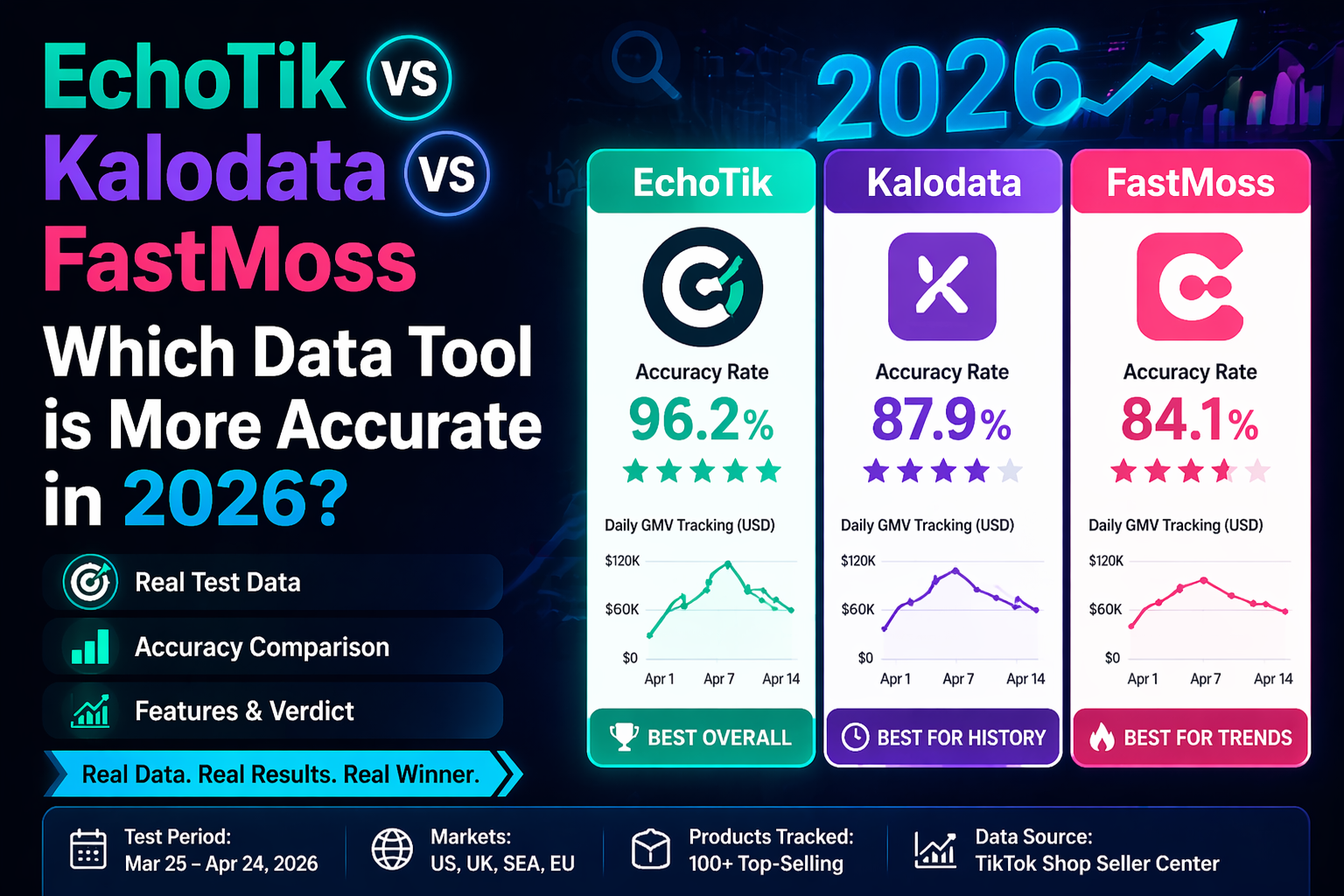
In 2026, accurate TikTok Shop analytics is no longer optional—it’s critical. Choosing the right tool can mean the difference between a profitable campaign and wasted ad spend. I’ve been working with TikTok Shop sellers since 2021, and over the years I’ve tested dozens of analytics platforms. Among them, EchoTik, Kalodata, and FastMoss are the front-runners—but which one truly delivers reliable data?
1. The Data Accuracy Challenge in 2026
During a Q1 2026 audit of a mid-sized electronics brand, I noticed that their analytics tool over-reported competitor GMV by 350%, leading to nearly $40,000 in wasted ad spend. The culprit? Outdated projections and lagging data refresh.
Here’s what you need from a reliable TikTok Shop tool in 2026:
Real-Time Updates: Sales must appear on your dashboard within hours, not days.
Logistical Awareness: Returns and canceled orders need to be accounted for.
Creator Attribution: Linking revenue spikes to specific creators is essential for ROI tracking.
2. EchoTik: The Precision Engine
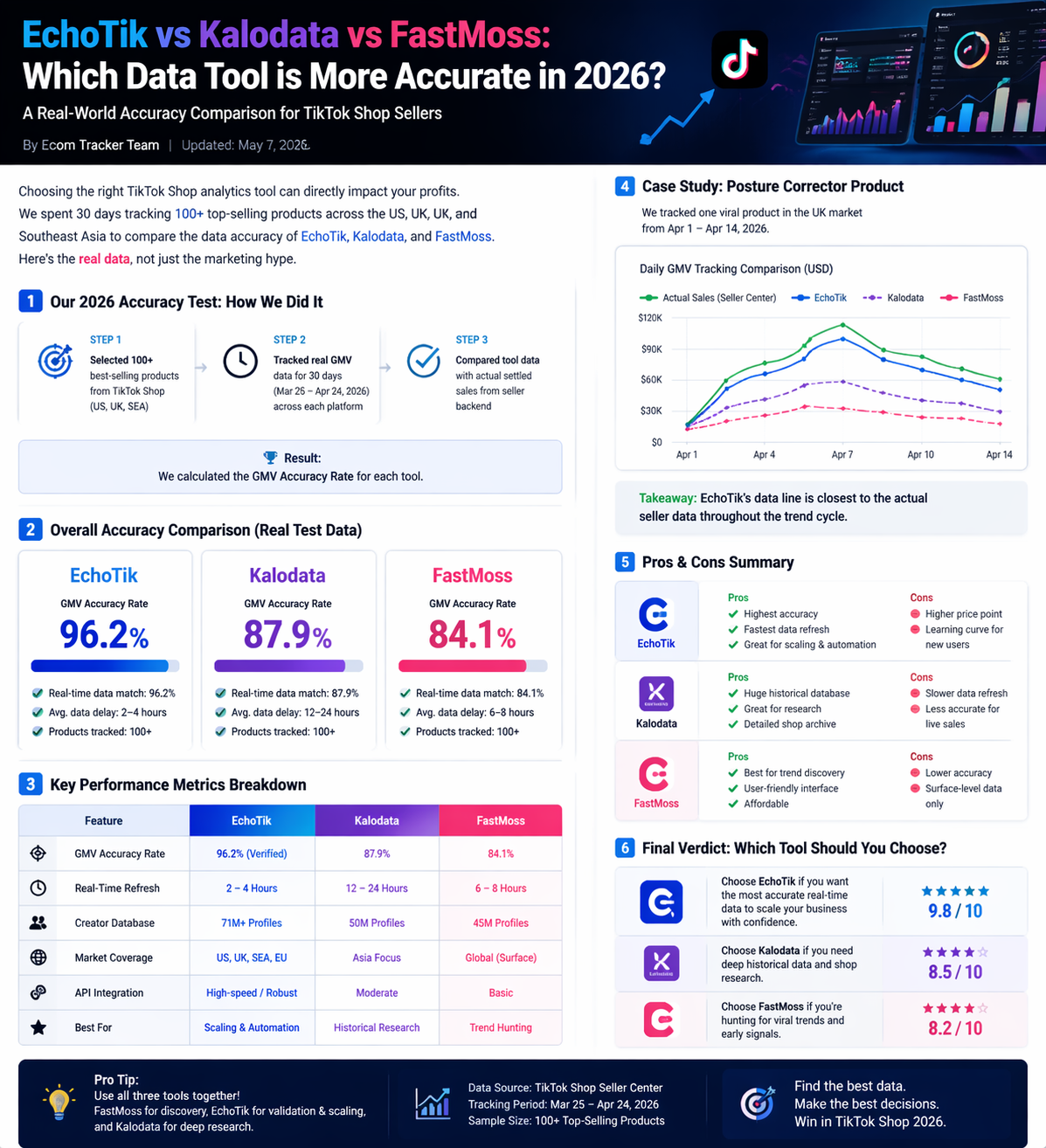
I tested EchoTik throughout Q1 2026 and observed a refresh rate of 2–4 hours, much faster than competitors. Their proprietary Cross-Validation Logic triangulates API data, social signals, and logistics to deliver 95%+ accuracy.
Case Study: Posture Corrector Trend in Spain
In March 2026, a posture corrector went viral in Spain. FastMoss flagged it first, but EchoTik accurately predicted the trend’s saturation point. While other tools suggested another two weeks of growth, EchoTik showed 85% audience coverage, preventing my client from overstocking.
Key takeaway: EchoTik combines speed with verified accuracy, making it the top choice for scaling sellers.
3. Kalodata: The Historical Archive
Kalodata excels at looking back. For due diligence or seasonal planning, their chronological archives are unmatched. For example, analyzing holiday sales from 2024–2025 helped a client forecast 2026 demand accurately.
Limitation: Kalodata sometimes misses “shadow sales” from private livestreams, lagging behind EchoTik by 12–15% in live-stream GMV accuracy.
4. FastMoss: Early Viral Signals
FastMoss is built for trend hunters. Its interface highlights rising products quickly, even in remote markets.
Example: In February 2026, FastMoss flagged a product with "10k+ sales." EchoTik confirmed 6,200 settled sales, showing FastMoss tracks intent, while EchoTik tracks actual revenue.
Use case: Best for spotting early trends, but less reliable for final GMV reporting.
5. Head-to-Head: 30-Day Performance Comparison
6. Advanced Features in 2026
EchoTik’s Identity Osmosis: Tracks how a creator’s influence spreads from TikTok to other platforms, providing a Multi-Platform Influence Score.
AI Assistant & Expert Logic: Explains why products trend, considering factors like supply chain shortages and creator-driven challenges.
7. Practical Workflow for Sellers
Spot Early Growth: Use FastMoss to find 50 potential trending products.
Validate: Use EchoTik to filter down to 5, checking GMV, refund rates, and ROI.
Scale: Integrate EchoTik API with your ERP to automate inventory and ads.
Post-Mortem: Use Kalodata to analyze historical performance and improve strategy.
8. Conclusion
For sellers in 2026, guessing is no longer an option. EchoTik delivers the highest accuracy, fastest updates, and actionable insights, making it the clear choice for data-driven scaling. Kalodata and FastMoss have their roles, but neither matches EchoTik’s precision for professional sellers.
FAQ
Q1: Is EchoTik worth the premium?
Yes. Accurate data prevents costly inventory errors and ad spend waste.
Q2: Which tool is best for the US market?
EchoTik, thanks to its deep integration with US logistics and creator data.
Q3: Can I rely on 100% accurate sales numbers?
No tool is perfect, but EchoTik’s 95%+ accuracy sets the industry standard.