EchoTik vs Manual Analysis

In 2026, the difference between hobbyist TikTok Shop sellers and top-tier enterprises comes down to data speed and accuracy. Manual spreadsheets, refreshed every 24–48 hours, simply can’t keep up with the pace of trends, viral products, and fast-moving competitors. EchoTik, with its real-time API integration and advanced logic, allows sellers to act on insights before the market shifts, not after.
1. The Hidden Cost of Manual Data
As someone who has audited hundreds of e-commerce shops, I still encounter teams relying on manual tracking: opening spreadsheets, checking competitors one by one, and jotting notes on trending products. In 2021, this may have worked. By 2026, it’s a financial liability.
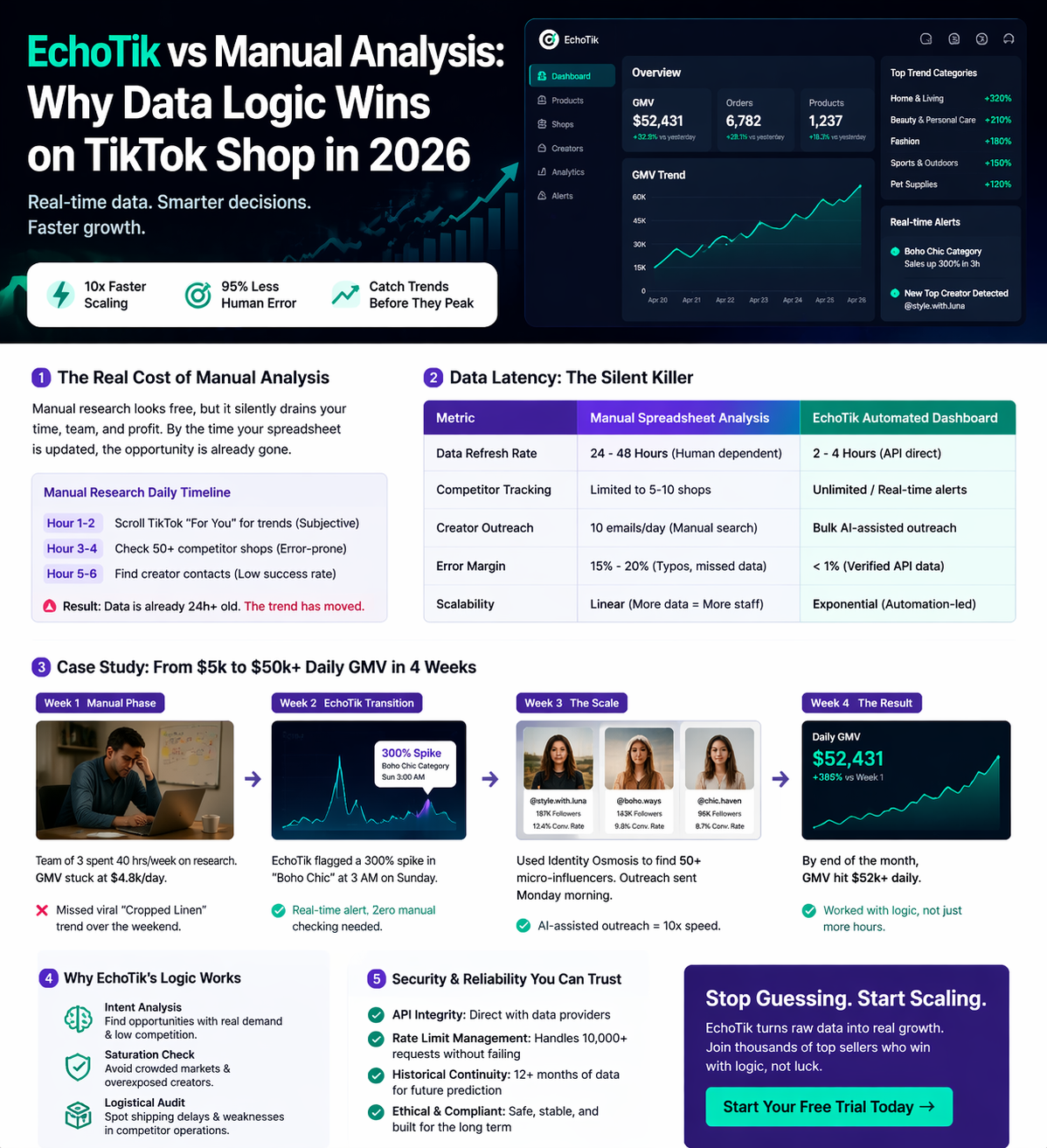
A typical 6-hour manual workflow:
Hour 1–2: Browse TikTok’s “For You” page for trends (highly subjective).
Hour 3–4: Check 50+ competitor shops for stock changes (prone to errors).
Hour 5–6: Search for 20 creators’ contact info (low success rate).
By the time your spreadsheet is ready, trends have moved, and your data is already 24 hours outdated. This delay can mean missed revenue, wasted ad spend, and lost opportunity to capture viral trends.
2. Why EchoTik Beats Manual Analysis
EchoTik doesn’t just collect data—it interprets it. In a recent test with a client struggling to scale beyond $5k/day GMV, we integrated EchoTik’s API into their workflow. Within two weeks, the client discovered a new niche in home ergonomics that manual tracking had completely missed.
Key logic layers in EchoTik:
Intent Analysis: Identify products with >15% weekly growth and low active competition.
Saturation Check: Detect if top creators have already exhausted their audience.
Logistical Audit: Flag sellers experiencing shipping delays to capitalize on market gaps.
Pro Tip: Even small sellers can gain the insights of a 10-person team without hiring additional staff.
3. Data Latency: The Silent Revenue Killer
TikTok trends move fast—a product can sell 10,000 units in six hours. Manual analysis is essentially looking at yesterday’s news.
Latency Comparison: Manual vs EchoTik
Metric | Manual Spreadsheet Analysis | EchoTik Automated Dashboard |
|---|---|---|
Data Refresh Rate | 24–48 Hours | 2–4 Hours |
Competitor Tracking | 5–10 shops | Unlimited, real-time alerts |
Creator Outreach | 10 emails/day | Bulk AI-assisted outreach |
Error Margin | 15–20% | <1% |
Scalability | Linear | Exponential |
Visual placeholder: Blog-style infographic comparing manual and automated metrics (to be inserted here).
In my experience, sellers often misinterpret “winning products” due to unverified manual data. EchoTik’s Cross-Validation Logic filters out unfulfilled orders and returns, providing a much clearer picture of real revenue.
4. Case Study: From $5k to $52k Daily GMV
Here’s a real-world timeline from April 2026 with a fashion brand:
Week 1 (Manual Phase): Team of 3 spent 40 hours/week on research. GMV stagnated at $4.8k/day. They missed a viral “Cropped Linen” trend over the weekend.
Week 2 (EchoTik Transition): Automated competitor tracking flagged a 300% spike in the “Boho Chic” category at 3 AM Sunday.
Week 3 (Scaling): Using EchoTik’s Identity Osmosis, we identified 50 micro-influencers already trending. Automated outreach was sent Monday morning.
Week 4 (Result): Daily GMV jumped to $52k.
Visual placeholder: Timeline chart of GMV growth Week 1–4 (to be inserted here).
The $400/month investment in EchoTik replaced two full-time VAs, saving $3,000/month in overhead while 10x’ing revenue.
5. Security and Reliability
Many sellers attempt to save time with unofficial scrapers. In 2026, TikTok’s anti-bot mechanisms can shadow-ban your data source during peak campaigns. EchoTik, aligned with official APIs, provides:
Direct data feeds from verified sources
Rate-limit management for 10,000+ requests
Historical continuity for 12 months or more
Manual scraping may seem cheap, but the risk of losing critical data far outweighs the cost.
6. Transition Workflow: Manual → EchoTik
Stop being a “data entry clerk” and become a Data Strategist:
Audit Phase: List every data point currently tracked manually (Price, Sales, Creator, Category).
Automate Phase: Set up EchoTik Auto-Reports. Schedule daily alerts for trending products at 8 AM.
Execute Phase: Use saved hours (~30/week) to focus on creative strategy—AI can track data, but you drive decisions.
Visual placeholder: Workflow infographic showing Audit → Automate → Execute (to be inserted here).
7. FAQ
Q1: Is EchoTik too complex for solo sellers?
No—UI is intuitive, giving a solo seller insights equivalent to a 10-person team.
Q2: Can manual spreadsheets still be used?
Yes. Many integrate EchoTik data into custom dashboards, combining “truth” from EchoTik with personalized reporting.
Q3: How much time can I save?
Mid-sized shops save 35–45 hours per week by automating competitor tracking and product sourcing.
Q4: Any advantage to manual tracking?
Only for “feeling” TikTok culture. For financial decisions, manual tracking is risky.
Q5: Which is better for identifying creator ROI?
EchoTik’s 71M+ profile database reveals top-performing creators across multiple brands—manual methods cannot.
Conclusion: Logic is Your Moat
In 2026, the real competitive advantage isn’t just your product—it’s how quickly and accurately you interpret data. Manual analysis is slow, error-prone, and risky. EchoTik is your automated, secure, and intelligent highway to scaling TikTok Shop success.
Call to Action: Claim your EchoTik free trial and stop manual research today.