How to Calculate a TikTok Shop Break-Even Price

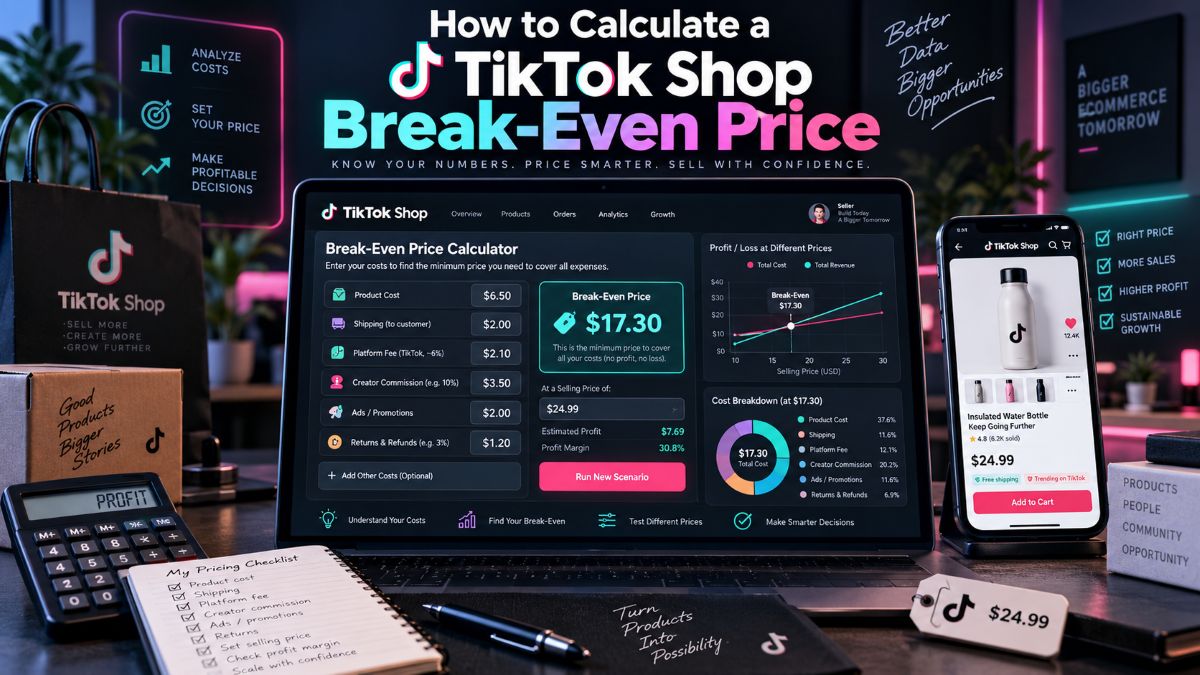
TikTok Shop break even priceA product can look like an easy win at $24.99.
The supplier charges $7. Shipping seems manageable. A few creators want to promote it. The listing looks good, and similar products are already selling on TikTok Shop.
Then the first settlements come in.
There is a creator commission on some orders. A discount gets used more often than expected. Shipping is a little higher for certain zones. Two customers return the product because the color in the video looked different from the actual item.
The product may still be worth selling. But $24.99 may not be the number that keeps the business healthy.
That is what a TikTok Shop break-even price is for. It tells you the lowest price that covers the average cost of getting one order sold, packed, shipped, and settled.
Price the order you actually have, not the one on the product page
Most pricing problems begin when sellers only subtract the product cost.
Product cost matters, obviously. But it is only one part of the order.
A realistic calculation usually starts with the costs that stay fairly stable per unit: the item itself, packaging, warehouse handling, fulfillment, and the shipping cost you expect to cover. If you use samples often, lose inventory to damage, or have a product with steady returns, those expenses belong in the picture too.
Then there are costs that move with the sale price.
Creator commission is the obvious one for affiliate orders. Platform charges can also be percentage-based. Paid traffic may be tracked as a percentage of revenue or as a dollar cost per conversion, depending on how you manage ads. Seller-funded coupons come out of the order just as surely as a fulfillment bill does.
That is why two stores can sell the same product at the same price and have totally different margins. One might rely mostly on organic content. The other could be paying an affiliate, supporting a coupon, and using paid ads to keep the listing moving.
The number to calculate before you set the price
The cleanest version of the math is:
Break-Even Price =
Fixed Cost per Unit ÷
(1 − Platform Fee Rate − Affiliate Rate − Return Rate)
If you regularly acquire orders through ads and track advertising as a percentage of revenue, add that rate too:
Break-Even Price =
Fixed Cost per Unit ÷
(1 − Platform Fee Rate − Affiliate Rate − Ad Cost Rate − Return Loss Rate)
The formula is not meant to predict every order perfectly. No pricing model can do that. It is meant to show whether your normal order has enough room to survive the costs you already know are coming.
Take a basic scenario.
A seller has a product that costs $7. Packaging costs $0.70. Fulfillment and shipping average $4. The seller also sets aside $1.30 per order for the messy stuff: occasional returns, replacement inventory, and handling losses.
That puts the fixed cost at $13.
The seller plans around a 6% platform-related fee, 12% affiliate commission, 8% ad cost, and a 3% allowance for return-related losses. Those are only example assumptions—not universal TikTok Shop rates.
At those numbers, the break-even price lands around $18.31.
That means a sale below that price is likely losing money on average. A price just above it may technically avoid a loss, but it leaves almost no room for a surprise. One extra discount, a higher shipping label, or a refund can wipe out the order’s profit.
This is the part sellers tend to feel after launch. The product sells. GMV looks good. Cash feels tighter than expected.
Shipping can quietly change the whole calculation
Shipping is easy to underestimate because the product may fit in your hand. The carrier only cares about the package it receives.
A lightweight item packed in a large box can cost more than expected. A bundle may improve your average order value but also push the package into a new weight tier. If you use Fulfilled by TikTok, the fee structure can differ from shipping orders yourself.
TikTok Shop gives sellers access to shipping-rate tools in Seller Center, and those rates should be checked against the package dimensions and fulfillment option you will actually use. TikTok’s shipping overview has the current details.
This is worth doing before you order a large inventory run.
A $4 shipping difference does not sound dramatic until you multiply it by 1,000 orders. At that point, it can decide whether the product was a smart buy or an expensive lesson.
The same goes for returns. Apparel, beauty items with bold claims, fragile products, and anything that can look different on camera should have more breathing room in the price. There is no point pretending every order will stay final if your own data says otherwise.
Affiliate sales need their own version of the math
A product that works through organic shop traffic may not work at the same price through creators.
Say the seller from the earlier example starts offering a 15% affiliate commission. On an $18.99 item, the creator earns roughly $2.85 before other costs are considered. That may be fine if the creator is sending high-intent buyers and the product has low refund risk.
But it can get ugly fast when the product is already discounted or requires paid support to keep moving.
That does not mean affiliate commissions are a bad idea. It means the commission needs to match the role the creator is playing.
A creator who brings fresh customers and repeatedly sells the product may deserve a strong rate. A creator who gets views but weak product clicks probably does not. Look at their order quality, not just the GMV screenshot.
If your product only becomes profitable when every sale comes from organic traffic, it is not ready for a broad affiliate push yet. You may need a better supplier price, lower fulfillment cost, or a product bundle that gives you more room.
Break-even is the floor. Your operating price needs room above it.
Once you know the floor, the next question is straightforward: how much should remain after the order is paid for?
That answer depends on what the shop is trying to do.
A newer seller may accept thinner margins on a first product to generate reviews and learn what converts. A shop funding inventory, creator samples, and ads needs more room. A product with unpredictable return behavior should not be priced like a simple, low-risk consumable.
Instead of asking, “What is the highest price I can get away with?” ask whether the price can absorb a normal bad week.
Can you still afford a creator commission? Can you run a coupon without panicking? Can you replace a damaged item? Can you pay for traffic if organic reach slows down?
If the answer is no, the price may be too close to break-even—even if the listing is getting orders.
TikTok Shop also expects product and shipping prices to be fair and transparent. Inflating shipping to make the item price look lower can create customer trust issues and policy problems. TikTok’s current pricing policy covers misleading prices, pricing differences between variants, and excessive shipping charges.
Keep revisiting the number after launch
Your first break-even price is based on estimates. A month later, you should have better information.
Use actual shipping charges instead of the quote you started with. Replace your return estimate with your real return rate. Review how often customers use discounts. Check whether affiliate orders are profitable after commission, not merely good for GMV.
Sometimes the answer is to raise the price. Sometimes it is to remove an unprofitable variant, adjust a bundle, or stop offering commission on a product that cannot support it.
The useful part of this calculation is not finding one perfect number and forgetting it. It is catching an unprofitable order pattern before it becomes your normal business model.
You can run your own assumptions with the free TikTok Shop calculator. Use your current product cost, shipping quote, commission plan, and ad results—not generic estimates—so the result reflects the shop you are actually running.