How to Check TikTok Fake Followers and View Ratio

How to Check TikTok Fake Followers and View Ratio Before Working With a Creator
Quick Answer
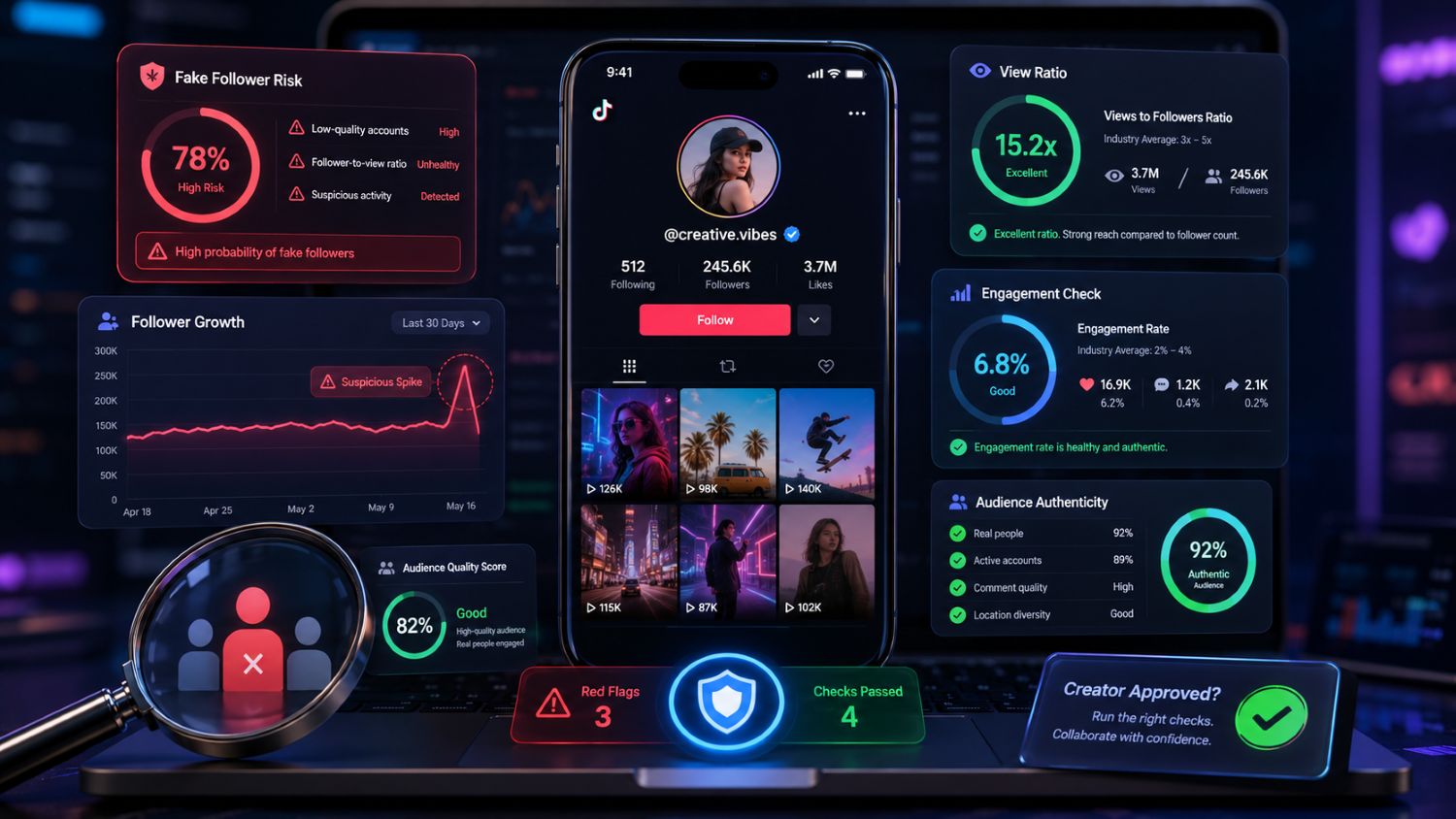
To check TikTok fake followers and view ratio, do not judge an account by follower count alone. Look at follower growth, average video views, likes, comments, shares, engagement trends, live performance, content consistency and commerce history together.
A creator with a large audience but weak view ratio may not always be fake. Sometimes the account has old followers, poor recent content, or a mismatched audience. But if follower growth looks unnatural, views are unstable, comments are thin, and recent videos cannot hold attention, the account needs deeper review before you pay for a collaboration.
This is where EchoTik can help sellers and brands make a better decision. EchoTik’s public site shows access to 100M+ creator data and 180M+ product data, while its API page covers creator data, video data, engagement trends, follower count, live stream data, product data, shop data and market trends.
What Is TikTok View Ratio?
TikTok view ratio usually means the relationship between a creator’s follower count and the views their videos receive.
A simple way to read it:
Signal | What It May Mean |
|---|---|
High followers + consistently low views | Audience may be inactive, mismatched, old, or artificially inflated |
Low followers + high views | Strong content-market fit or algorithmic breakout potential |
High views + weak comments/shares | Passive traffic, weak trust, or entertainment-only audience |
Stable views + stable comments + relevant product content | Healthier creator signal |
Sudden follower jump + no matching video growth | Needs further review |
Do not use one fixed ratio for every niche. Beauty, gadgets, home goods, fitness, finance, pets and entertainment accounts behave differently. The better method is to compare a creator against similar creators in the same category.
Can You Detect Fake Followers With One Tool?
No serious operator should promise that one number can prove fake followers.
Fake followers are usually detected through patterns, not one metric. TikTok itself says it does not allow fake engagement or services that artificially increase engagement. The FTC has also addressed fake indicators of social media influence, including fake followers and views, in its rule on consumer reviews and testimonials.
So the practical question is not “Can I get a magic fake follower score?” The better question is:
Can I collect enough signals to decide whether this creator is worth contacting, testing, negotiating with, or rejecting?
That is the angle where EchoTik becomes useful.
Real EchoTik Data You Can Use in This Article
Use this section to make the article stronger than AI-generated filler.
EchoTik Public Data Point | How It Supports This Topic |
|---|---|
100M+ creator data | Useful for comparing TikTok creators instead of judging one account alone |
180M+ product data | Helps connect creator quality with real commerce categories and products |
Creator data: GMV performance, audience profiles, engagement trends, follower count, video and live lists | Supports fake follower and view ratio analysis from multiple angles |
Video data: likes, views, engagement trends, comments, ranking analysis, caption extraction | Helps verify whether views match real interaction |
Live stream data: total viewers, peak viewers, follower growth during live, live GMV | Helps judge whether live influence is real or inflated |
EchoTik Extension: 90-day influencer trends on TikTok.com | Good for quick creator checks before outreach |
These are public claims from EchoTik’s homepage, API page, e-commerce page and browser extension page.
How to Check TikTok Fake Followers and View Ratio With EchoTik
Step 1: Start With the Creator’s Recent Video Views
Open the creator profile and collect the latest batch of videos. Do not check only the best-performing video. Viral outliers are common on TikTok.
Look for the normal range:
Are most videos getting similar views?
Is there one viral post and many weak posts?
Are product videos performing worse than entertainment videos?
Do old videos outperform recent ones by a large gap?
If a creator has a large follower base but recent videos cannot reach even a small portion of that audience, it does not automatically mean fake followers. But it does mean you should not pay based on follower count.
Step 2: Compare Views Against Engagement
A healthy TikTok account usually shows some balance between views, likes, comments and shares.
Use EchoTik’s video data and engagement trend features to review:
Views
Likes
Comments
Shares
Engagement trend
Comment quality
Top-performing videos
Recent video ranking signals
A suspicious pattern is not “low likes” alone. A more dangerous pattern is high views with empty comments, repetitive comments, irrelevant comments, or no product-related conversation.
For TikTok Shop sellers, comments matter because they reveal buying intent. A creator may have entertainment reach but weak buyer trust.
Step 3: Review Follower Growth Over Time
Fake or low-quality audience problems often appear in growth patterns.
Using EchoTik’s creator analytics and API data, check whether follower growth looks natural. A normal creator usually grows through content spikes, viral videos, live sessions, collaborations or product exposure.
Watch for:
Sudden follower jumps without matching video performance
Flat engagement after large follower growth
No clear content event behind the growth
Followers increasing while comments and shares stay weak
Follower growth that does not match live or video activity
EchoTik’s API page specifically lists follower count, engagement trends, video lists, live lists and creator milestones under creator data. That is exactly the kind of data needed for this analysis.
Step 4: Check the 90-Day Trend Before Contacting
For quick outreach decisions, use the EchoTik browser extension. The public extension page says it can check influencers’ key metrics and 90-day trends on TikTok.com.
This is useful before you contact a creator because it gives you a fast read on whether the account is improving, declining or unstable.
A creator with modest followers but improving 90-day trend may be more valuable than a large account that is slowly losing audience response.
Step 5: Look at Commerce Fit, Not Just Influence
For TikTok Shop, fake follower detection is only half the job. The bigger question is whether the creator can sell.
Go to EchoTik TikTok E-commerce Analysis and compare the creator against product categories, best-selling products, top influencers and commerce-related rankings.
Ask:
Has this creator promoted similar products before?
Do their videos match your product category?
Are their followers likely to care about this product?
Do their product videos perform differently from non-product videos?
Are they active in short video, live commerce, or both?
This moves the analysis from “Is the account real?” to “Is this account commercially useful?”
Step 6: Use Live Data for a Stronger Trust Check
If the creator also does live selling, live data can expose quality faster than profile numbers.
EchoTik’s API page lists live stream data such as total viewers, peak viewers, follower growth during live and live GMV. These signals help sellers understand whether the creator can hold attention and generate commerce action in real time.
Useful checks include:
Does peak viewer count match follower size?
Does the live room create follower growth?
Are viewers staying long enough to hear the pitch?
Are sales connected to specific products or just temporary traffic?
Does the creator repeat strong live performance across sessions?
A fake-looking account often struggles to produce consistent live commerce behavior.
Red Flags That Need Deeper Review
Do not reject a creator for one weak signal. But if several appear together, slow down.
Red Flag | Why It Matters |
|---|---|
Huge followers, weak recent views | Audience may be inactive or low quality |
Sudden follower growth, no viral content | Possible artificial growth or unrelated exposure |
High views, almost no comments | Passive traffic with weak trust |
Repetitive comments | May indicate low-quality engagement |
Product videos underperform badly | Audience may not have buyer intent |
Live viewers spike briefly then disappear | Weak attention or poor traffic source |
No category match | Influence may not convert into sales |
The Best Way to Score a TikTok Creator
Instead of using one fake follower score, build a simple internal scorecard:
Dimension | What to Check |
|---|---|
Audience Health | Follower trend, recent views, engagement stability |
Content Quality | Hook strength, repeatable formats, product explanation |
Commerce Fit | Similar products, category match, buyer comments |
Live Ability | Total viewers, peak viewers, live follower growth |
Risk Level | Sudden spikes, comment quality, view inconsistency |
Test Priority | Start with sample seeding, low-risk collaboration or affiliate-only deal |
This is how professional sellers avoid emotional decisions. They do not chase big follower numbers. They build a repeatable creator selection system.
Why EchoTik Is a Better Fit for Seller-Side Creator Checks
Generic TikTok analytics tools may show surface engagement. EchoTik is more useful for TikTok Shop sellers because it connects creator analysis with products, shops, videos, lives and market trends.
That matters because sellers do not need “popular creators.” They need creators who can move products.
EchoTik’s public pages support this positioning clearly:
It helps creators and brands track target TikTok creators and videos.
It helps sellers explore hot products and make product selection decisions.
Its e-commerce feature page highlights 13 leaderboards, 14 product-selection dimensions with 60+ metrics, 17 influencer filtering dimensions with nearly 100 metrics, and 12 live-streaming dimensions with 40+ metrics.
Its API covers creators, videos, live streams, products, comments, shops, music, keywords, ads and topics.
That is the argument to make in the article: EchoTik does not just help you check if a creator looks real. It helps you decide whether the creator is worth testing for TikTok Shop growth.
FAQ
How do I check TikTok fake followers?
Check follower growth, recent views, engagement trends, comment quality, video consistency, live data and category fit. Do not rely on follower count alone.
What is a good TikTok view ratio?
There is no universal good ratio. Compare creators inside the same niche and check recent performance instead of lifetime follower count.
Can EchoTik detect fake followers directly?
EchoTik should be positioned as a TikTok analytics and data platform, not a magic fake follower detector. It helps sellers review creator data, video engagement, follower trends, live data and product relevance to make a safer decision.
Why do some creators have many followers but low views?
Their followers may be old, inactive, from a different niche, or no longer interested in the current content. It can also happen when content quality declines.
Should I work with a creator who has low followers but high views?
Maybe. Low-follower creators with strong recent views, real comments and product-category fit can be valuable, especially for TikTok Shop affiliate testing.