How to Choose a TikTok Shop Niche

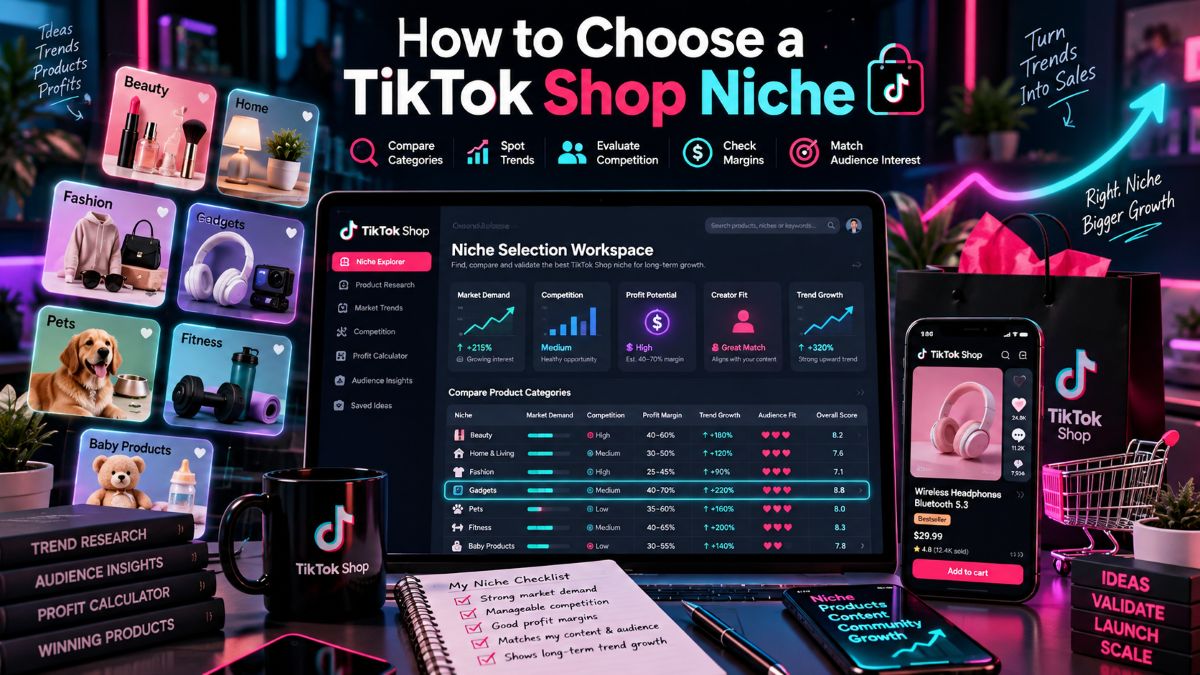
A large TikTok Shop category can look tempting from the outside.
There are big GMV numbers, thousands of videos, plenty of creators, and products selling every day. Then you look closer and realize the top shops already own most of the sales, prices are falling, and every creator is promoting the same five products.
That is not necessarily a bad category. It may just be a bad place to enter without a clear angle.
A good TikTok Shop niche has demand, but demand alone is not enough. You also need room to compete, a product that works in short-form content, and enough margin left after fees, shipping, creator commissions, refunds, and discounts.
A Niche Is Not the Same Thing as a Product
A niche is the part of the market you want to compete in. A product is the individual item you choose to sell inside that market.
“Pet supplies” is a broad category. “Travel accessories for small dogs” is closer to a niche. A specific portable pet water bottle is a product.
This matters because sellers often jump straight into product research. They find one item with strong sales and assume they found an opportunity.
Maybe they did. But the category around that item may already be crowded, expensive to promote, or full of products with weak margins.
Choose the category first. Then look for products that give you a reason to compete inside it.
Pick One Market Before You Compare Categories
TikTok Shop is not one market.
The U.S., UK, Indonesia, Malaysia, Thailand, and other markets can have very different price points, shopping habits, creator ecosystems, shipping expectations, and product preferences.
A beauty niche that looks crowded in the U.S. may still have room in another market. A low-priced home item that sells well in Southeast Asia may not leave enough margin once you account for shipping and returns in the UK.
Keep your research focused on one country at a time.
Use the last seven days to spot sudden movement. Look at 30 days to see whether the category has been consistently active. A longer view, such as 90 days, can help you avoid mistaking a seasonal bump for a lasting opportunity.
The time range does not have to be perfect. It just needs to stay consistent across the categories you compare.
Start With Demand, Then Look for the Catch
Category GMV and sales volume are useful because they show whether shoppers are spending money.
But high demand always has a catch somewhere.
Sometimes the category is controlled by large brands. Sometimes it is full of nearly identical products. Sometimes the average order value is too low to support creator commissions. Sometimes the category gets plenty of views but produces high return rates.
When reviewing a category, look at more than total sales:
Are sales growing, holding steady, or cooling down?
How many active products and shops are competing?
Is there room beyond the top few sellers?
What does the typical price look like?
Are products sold through short videos, LIVE, search, or a mix?
Can a new seller explain the product clearly in a few seconds?
You can use TikTok Shop data to compare category sales, product activity, active shops, and creator coverage before deciding where to focus.
The goal is not to find the biggest category. It is to find one where a new seller still has a realistic way in.
Growth Is More Useful Than a Big Number
A mature category can be stable and profitable. It can also be hard to enter because every strong product already has dozens of established sellers.
A fast-growing category is exciting, but it may be driven by a short trend, a single viral product, or a limited-time promotion.
Neither situation is automatically good or bad. You need to know what kind of category you are looking at.
A mature category may work if you have a better product, better sourcing, stronger branding, or an audience already interested in what you sell.
A newer category may work if demand is rising, creator interest is spreading, and the product still has room for fresh content angles.
The risky situation is a category that looks huge because it had one explosive month, but now prices are sliding and new creator activity has already slowed down.
That is why short-term growth should be checked beside a longer trend. One tells you what is happening this week. The other tells you whether the category has been moving for a while.
Competition Is Not Just the Number of Shops
A category with 500 shops is not always harder than a category with 50.
What matters is where the sales are going.
If the top 10 shops control most of the category’s GMV, a new seller has to work harder for visibility. Those shops may have stronger creator networks, more reviews, better fulfillment, and bigger budgets for discounts.
On the other hand, a category with many active shops can still be open if sales are spread across smaller sellers. That usually means buyers are willing to try different stores, products, bundles, and price points.
Look for signs of concentration:
A few shops repeatedly dominate the bestseller lists
The same products appear across every top store
New sellers do not stay visible for long
Big brands own the highest-volume listings
Price differences between shops are very small
Then look for signs of room:
Newer shops are appearing among active sellers
Products have different formats, bundles, or use cases
Mid-sized creators are still generating orders
Buyers are leaving reviews for more than one or two brands
There are obvious content angles that competitors are ignoring
You do not need an empty category. Empty categories can mean there is no demand. You need a category where the market is active but not completely locked up.
Creator Coverage Changes the Opportunity
TikTok Shop is different from a normal marketplace because the content side matters so much.
A category may have demand, but if the products are difficult to show, difficult to explain, or not worth a creator’s commission, growth can be slow.
Look at the creator side before entering.
Are multiple creators promoting products in the category? Are they using different video styles? Are smaller creators earning orders, or does everything depend on a few large accounts?
A healthy category usually has more than one way to sell.
For example, a skincare category may support tutorials, routines, reviews, ingredient explainers, before-and-after content, and LIVE demos. A kitchen product may work through quick demonstrations, problem-solving videos, recipes, and gift ideas.
If every successful video uses the exact same hook, the niche may be more fragile than it appears. Once viewers get tired of that format, sellers have very little else to work with.
Creators also need a reason to choose your product over another one. A competitive commission helps, but it cannot fix a weak product, unclear offer, or poor customer experience.
Check Whether the Product Can Carry Content
Some products are easy to sell on TikTok because the value is obvious immediately.
They solve a visible problem. They create a clear before-and-after. They fit into a routine, a demonstration, or a relatable situation.
Other products need more explanation. That does not make them impossible to sell, but it changes what you will need from creators and content.
Before entering a niche, ask a few blunt questions:
Can someone understand the product in the first few seconds of a video?
Can it be demonstrated without exaggerated claims?
Can creators make more than one kind of video about it?
Can the product be shown in real life, not just in polished images?
A niche with content depth gives you more chances to test. If the first video angle fails, you still have other ways to sell the product.
GMV Does Not Pay the Bills
This is where many category lists become less useful.
A niche can have strong GMV and still be a poor business once you factor in product cost, shipping, platform charges, affiliate commission, customer discounts, ads, and returns.
Price matters because it affects every other decision.
A low-priced product may be easy to impulse-buy, but the margin can disappear quickly. A higher-priced product may leave more room for commission and shipping, but buyers may need more trust before they convert.
You also need to think about return risk. Apparel, beauty, electronics, fragile products, and products with aggressive claims can create extra work after the sale.
Before choosing a niche, estimate the basic economics for a typical product:
Average selling price
Landed product cost
Packaging and fulfillment cost
Shipping cost
Platform charges
Creator commission
Discount or ad spend
Expected refund or return cost
You do not need a perfect forecast. You need enough clarity to know whether the category can support a real margin.
A Simple Way to Score a Category
A score does not choose a niche for you. It helps stop one impressive number from taking over the decision.
Give each category a score out of 100 after you review the market. Use your own judgment. A niche with lower GMV but better pricing and less concentrated competition may deserve a higher score than a huge but overcrowded category.
Area to assess | Points available |
|---|---|
Demand and sales activity | 15 |
Recent growth direction | 15 |
Competition and shop concentration | 15 |
Creator coverage and commission pressure | 15 |
Product depth and repeat-purchase potential | 10 |
Video and LIVE demonstration potential | 10 |
Price and likely margin | 10 |
Return, shipping, and compliance risk | 10 |
Total | 100 |
A score above 75 can be worth moving into product validation. A score between 60 and 74 may still be promising, but it probably needs a narrower angle or a smaller test. Anything below that is not necessarily a permanent no; it may simply be a category to revisit later.
What a Comparison Can Look Like
Here is an illustrative example. These are not live market figures or a recommendation to sell any one category.
Category | What looks attractive | What needs caution | Example score |
|---|---|---|---|
Beauty & Personal Care | Strong creator fit, repeat-purchase potential, many content angles | Crowded products, high claim and return risk | 72 |
Home & Kitchen | Easy demonstrations, broad content potential, practical use cases | Product quality and shipping costs can hurt margin | 76 |
Pet Supplies | Emotional content, loyal buyers, room for specific sub-niches | Product safety, shipping size, and price sensitivity | 68 |
In this example, Home & Kitchen scores highest. That does not mean every kitchen product is the best choice.
It means the category may deserve the next step: looking for a specific product with a healthy margin, manageable shipping, good reviews, and a clear content angle.
Beauty may still be the better move if you have a unique product, trusted supplier, or strong creator relationships. The score is there to make the trade-offs visible.
Do Not Choose a Category Just Because It Is Popular
The most common mistake is stopping at GMV.
Other mistakes are just as expensive: using one viral week as proof of demand, ignoring creator commission, comparing different countries in the same sheet, or assuming high sales mean high profit.
A category can be popular and still be a poor fit for your business.
You may not have the budget to compete on price. You may not have the fulfillment setup for fragile products. You may not be able to create or source enough content to keep the product visible.
A smaller category with a clearer customer, better margins, and more room for creators can be a stronger starting point than the biggest category on the board.
The Tools Matter Less Than the Questions
You do not need a long stack of software to research a niche. You need consistent market data, a way to track changes, and enough discipline to compare like with like.
Seller Center helps you understand your own shop. Market research platforms help you see category movement, products, competitor shops, and creator behavior outside your account.
If you are deciding which platforms fit your research process, read our guide to the best TikTok analytics tools.
Choose a category only after you understand why shoppers buy there, how creators sell there, and where your margin will come from. That is a much better starting point than following the largest GMV number you can find.