How to Find Winning TikTok Ads

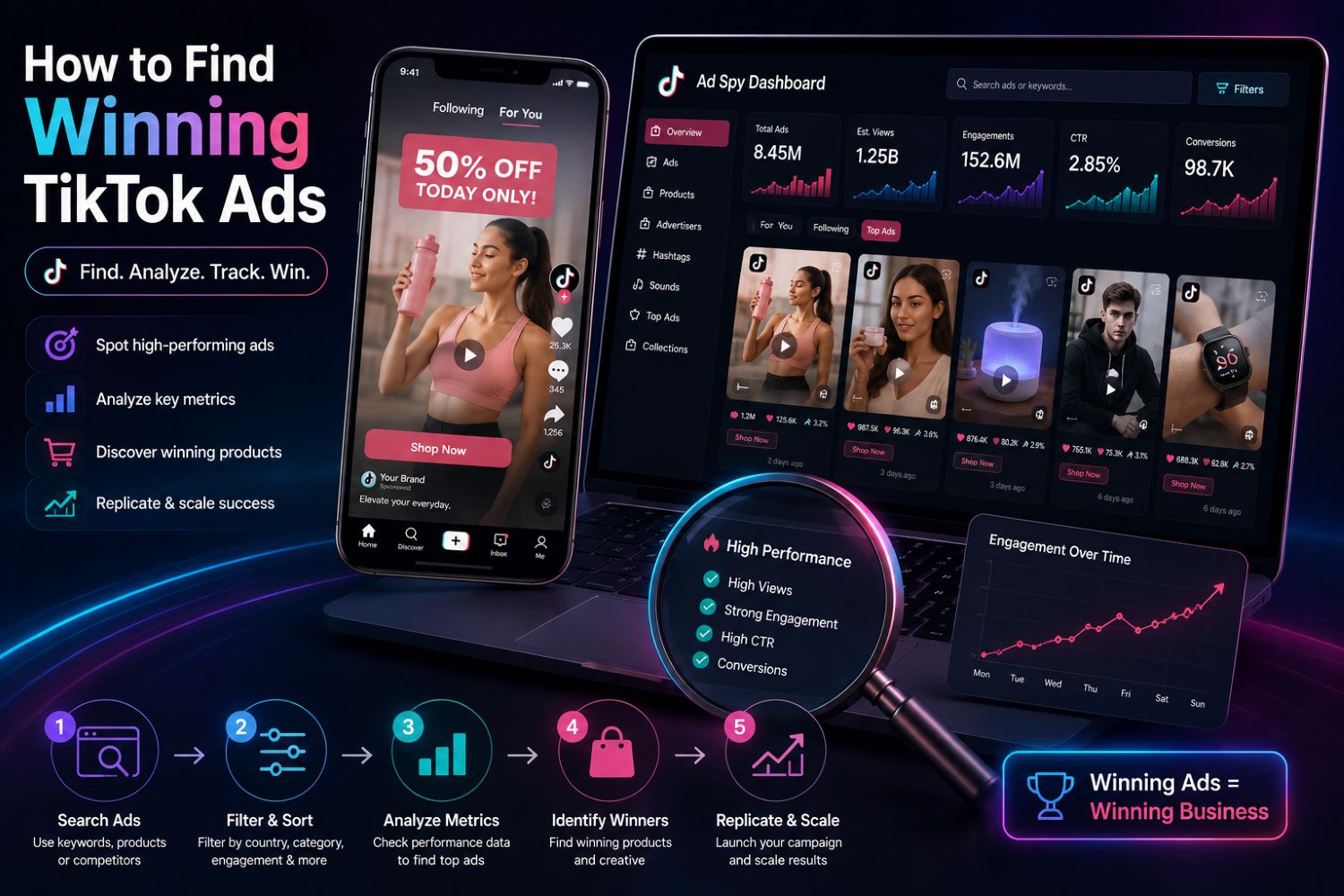
Winning TikTok ads are not just the ones with huge view counts. They grab attention, make the product easy to understand, and give people a reason to buy.
That distinction matters. A funny video may get millions of views and zero sales. A simple product demo may get fewer views but drive steady orders.
The job is to find ads with real business potential before every competitor copies them.
If you need a broader framework for studying creatives, products, and advertisers, start with a TikTok ad research tool. It helps you identify the ads worth saving, analyzing, and testing.
You can also compare the best TikTok analytics tools before building your research workflow.
What Makes a TikTok Ad a Winning Ad?
A winning TikTok ad usually does three things well: it gets attention quickly, shows a clear benefit, and makes the next step feel easy.
The product should make sense within a few seconds. Viewers should not have to work hard to understand what it does or why it matters.
The strongest ads often lead with a real problem. Think sweaty summer nights, messy countertops, dry skin, or a hard-to-organize closet. Then they show the product solving that problem on camera.
A winning ad also feels native to TikTok. It does not look like a traditional commercial dropped into a vertical feed. It feels direct, visual, and human.
Metrics That Identify Winning TikTok Ads
Views are useful, but they are only the starting point.
When you analyze winning TikTok ads, look at several signals together. One metric rarely tells the whole story.
Metric | What it can tell you |
|---|---|
Views | Whether the creative earned broad attention |
Engagement rate | Whether viewers reacted instead of scrolling past |
Comments | Whether people have questions, interest, or objections |
Shares | Whether the content is useful, surprising, or worth sending |
Repeat creatives | Whether a brand is continuing to test or scale an angle |
Product activity | Whether attention may be turning into commercial demand |
A high-view ad with weak comments and no repeat testing may be entertainment. An ad with solid engagement, buyer questions, and multiple variations is usually more interesting.
How to Find Winning Ads Before They Saturate
The best time to find a winning ad is before it becomes obvious.
Start by watching smaller but fast-moving creatives in your category. You are looking for early signs of traction, not just the biggest ad everyone has already seen.
Pay attention when several creators begin using a similar hook or product angle. That might be a new way to show a product benefit, a seasonal problem, or a fresh offer.
For example, a portable fan may be marketed as a desk accessory for months. Then creators start showing it as a quiet bedside solution during hot weather. The product is the same, but the customer problem is different.
That shift can create a new testing opportunity.
How to Identify Winning TikTok Ads in Your Category
Do not study every successful ad on TikTok. Study ads that are relevant to your customer.
Pick one product category, one audience, or one problem. Then save ads that match that focus.
For each ad, write down:
The first three seconds
The customer problem
The product benefit shown on screen
The creator type
The offer or call to action
The top questions in the comments
After reviewing 15 to 20 ads, patterns start to show up. You may see that buyers respond more to product proof than discounts. Or you may find that creator-led demos outperform polished brand videos.
That is the kind of insight you can turn into a better test.
How to Analyze Competitor TikTok Ads
Competitor research is not about copying scripts. It is about seeing how other brands position similar products.
Look at what competitors repeat. If they keep producing versions of the same angle, that angle may be working. If they quickly stop using an ad style, it may not have performed well enough to continue.
Then look for what is missing.
Maybe every competitor leads with a discount, but nobody explains product quality. Maybe they show the product but never answer the main buyer concern. That gap gives you a more useful creative direction.
A simple research note could look like this:
Competitors lead with low price. Comments ask whether the product lasts. Test a durability demo with customer proof.
That is much more useful than copying a video word for word.
Winning TikTok Ad Examples: What to Look For
There is no single format for winning TikTok ads. But strong ads usually make one idea very clear.
Ad style | Why it can work |
|---|---|
Problem-to-solution demo | The viewer quickly sees why the product matters |
Before-and-after video | Results are easy to understand visually |
Creator review | A real person can make the product feel more believable |
Side-by-side comparison | Helps buyers understand the difference fast |
“I didn’t expect this to work” hook | Creates curiosity when supported by real proof |
Routine or use-case video | Shows how the product fits into daily life |
The key is not the format alone. The product benefit has to be clear. A product demo without a reason to care will not go far.
Tools for Finding Winning TikTok Ads
A good research process combines creative data with product and shop context.
TikTok’s own tools can help you explore trends and creative inspiration. Third-party platforms can help you organize competitor research, track creators, compare products, and spot commercial patterns.
The right tool depends on the question you are trying to answer.
If you want to know why an ad got attention, look at the hook, format, comments, and creator. If you want to know whether the product has sales potential, look beyond the ad.
A TikTok Shop data analytics tool can help connect ad research with product, shop, creator, and category activity. This makes it easier to separate a viral moment from a product with real momentum.
How to Evaluate Sales Potential
A winning creative and a winning product are related, but they are not the same thing.
Before you test an ad angle, check whether the product has enough room to sell. Look at pricing, customer questions, competing listings, creator fit, and whether the benefit is easy to show on video.
Ask these questions:
Can someone understand the product in five seconds?
Does it solve a common or urgent problem?
Is there proof that buyers care about the result?
Can several creators present it in different ways?
Is the market already crowded with identical ads?
If the answer is yes to the first four and no to the last one, you may have a strong test candidate.
Weekly Winning Ad Research Workflow
You do not need to spend all day watching ads. A simple weekly workflow is enough.
Pick one category or product problem.
Save 10 to 20 relevant TikTok ads.
Record the hook, message, format, and comments.
Check for repeated competitor angles.
Compare creative signals with product and shop activity.
Choose one or two original ideas to test.
Review results and keep learning.
The goal is not to find a perfect ad. The goal is to make each test smarter than the last one.
Final Takeaway
Finding winning TikTok ads comes down to better research.
Look past view counts. Study the hook, product proof, comment section, competitor angle, and signs of real demand.
The best ads make a product feel useful, believable, and easy to buy. Use that standard when you research—and when you build your own creative tests.
Explore EchoTik to research TikTok ads, products, creators, shops, and market trends in one workflow.