How to Track TikTok Competitors: Products, Creators & Content

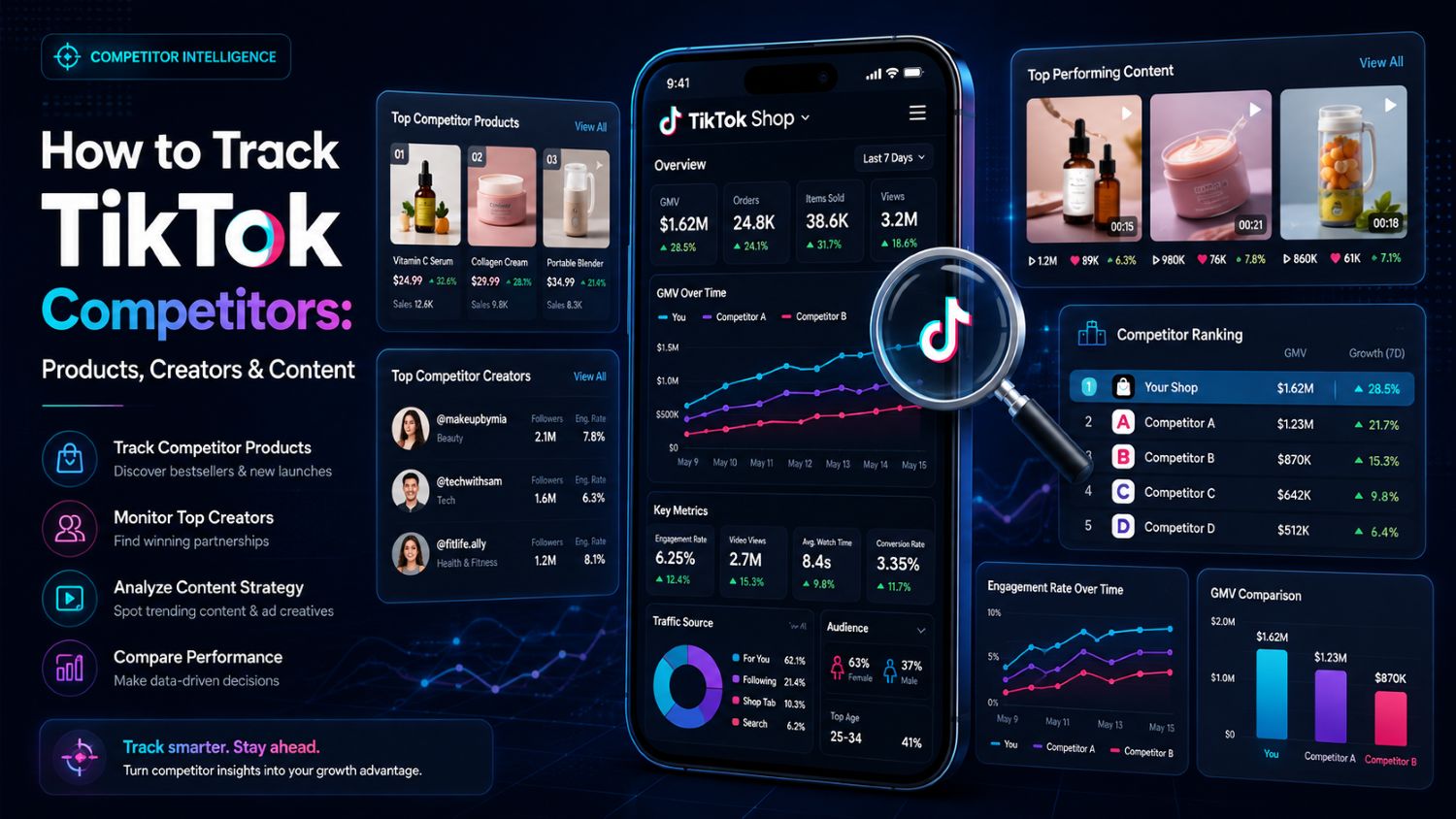
Tracking competitors on TikTok is not about copying their videos.
It is about understanding what drives their growth.
You need to know which products they promote, which creators they work with and which videos bring attention or sales.
TikTok’s public profiles can show part of this picture. A TikTok competitor analysis tool can help you see the patterns behind it.
This guide explains what to track, how to analyze it and how to turn the findings into better decisions.
Quick Answer
To track TikTok competitors, start with five areas:
Account growth
Video performance
Posting frequency
Products promoted
Creator partnerships
For TikTok Shop competitors, add product sales, estimated GMV, shop rankings and LIVE performance.
Do not judge a competitor by one viral video. Look for patterns that continue across several posts, creators and sales periods.
What TikTok Competitor Data Should You Track?
You do not need every available metric.
Focus on data that can change your content, product or creator strategy.
Account Growth
Follower count is a useful starting point, but the current number tells only part of the story.
Track how quickly the account is growing.
A smaller account adding followers every week may be more relevant than a large account that has stopped growing.
Look at:
Current follower count
Follower growth
Total video count
Recent account activity
Average engagement
Growth during product launches
If follower growth increases after a certain content series, study that series more closely.
The format may be attracting the right audience.
Video Performance
Do not look only at a competitor’s most-viewed video.
One viral post may be an exception.
Review recent videos and compare:
Views
Likes
Comments
Shares
Engagement rate
Products linked
Estimated sales
Publishing date
Pay attention to repeatable results.
If several videos using the same format perform well, the format may be more valuable than one viral idea.
Also read the comments. They can reveal product questions, complaints and buying objections that the video did not answer.
Content Frequency
Track how often competitors publish.
Posting frequency can help you understand how much content a category requires.
Some shops grow with a few strong videos each week. Others rely on daily creator content and frequent LIVE streams.
Check:
Posts per week
Days and times published
Gaps between posts
Frequency during promotions
Number of product videos
Balance between selling and non-selling content
Do not copy the frequency without checking the results.
Publishing five weak videos every day is not a strategy. The better question is how often the competitor produces content that actually performs.
Hashtag Performance
Hashtags can show how competitors position their content.
Track the hashtags used in high-performing posts and compare them with the products being promoted.
Look for three groups:
Broad hashtags such as
#fypCategory hashtags such as
#skincarePurchase-intent hashtags such as
#tiktokshopfinds
Broad hashtags may bring reach, but category and product-specific hashtags often provide more useful context.
Do not assume a hashtag created the result.
The product, opening hook and creator may have mattered more. Treat hashtags as one signal rather than the full explanation.
Promoted Products
For TikTok Shop competitor research, product data is one of the most valuable areas.
Track which products competitors are adding, promoting and scaling.
Useful signals include:
Product category
Current price
Discount activity
Estimated sales
Estimated GMV
Recent sales movement
Number of related videos
Number of active creators
Product ranking changes
A product with high total sales may already be saturated.
A better opportunity may be a smaller product with steady growth and an increasing number of creators.
You can use EchoTik E-commerce Analysis to compare TikTok Shop products, shops and creators.
Creator Partnerships
Competitors do not always create their own growth.
Affiliate creators may be responsible for most of their product exposure.
Track:
Which creators promote the shop
Products promoted by each creator
Recent video performance
Estimated creator sales
Posting frequency
Number of competing products promoted
LIVE activity
Repeat partnerships
A creator who posts about a product several times may have a stronger relationship with the shop.
That can be more meaningful than a large creator who published one sponsored video.
You should also check whether sales depend on one creator. Heavy dependence creates risk for the competitor and may reveal space for your own creator strategy.
TikTok Shop Sales
Competitor sales data helps you understand market demand.
Because private competitor orders are not fully available, third-party tools may present estimated sales and GMV.
These figures are useful for comparison. They should not be treated as confirmed financial reports.
Track:
Estimated product sales
Estimated GMV
Sales growth
Shop rankings
Top-selling products
Category performance
Creator contribution
Video and LIVE contribution
Always check the market, date range and update time.
A US product and a UK product may have similar names but completely different demand.
For more context on available metrics, read our guide to TikTok Shop data.
How to Analyze TikTok Competitors Step by Step
A simple process is better than collecting random screenshots.
Step 1: Choose the Right Competitors
Start with five to ten accounts.
Include:
Direct product competitors
Shops in the same category
Fast-growing smaller accounts
Established market leaders
Creators who influence your customers
Do not choose competitors based only on follower count.
A competitor should target a similar customer, sell a comparable product or use a strategy you want to understand.
Step 2: Set a Clear Question
Know what you want to learn before collecting data.
For example:
Which products are growing?
Which creators can sell this category?
What content format produces the most engagement?
How often do leading shops go LIVE?
Is demand increasing or falling?
How does a competitor launch a new product?
A clear question keeps the research focused.
Step 3: Record a Starting Point
Create a baseline for every competitor.
Record:
Followers
Recent video views
Posting frequency
Main content formats
Top products
Estimated sales
Active creators
LIVE frequency
Use the same date range for each account.
Comparing one competitor’s seven-day data with another competitor’s 30-day data will give you a weak result.
Step 4: Find the Content That Repeats
Identify videos that use similar hooks, formats or product demonstrations.
Look for patterns such as:
Before-and-after videos
Product demonstrations
Problem-and-solution hooks
Customer reactions
Creator testimonials
Price-led offers
Product comparisons
LIVE highlights
One strong video gives you an idea.
Several strong videos using the same approach give you evidence.
Step 5: Connect Content to Products
Views alone do not prove that a video can sell.
Check whether the video links to a product. Then review the product’s sales movement around the publishing date.
You may not be able to prove exact attribution for every order, but you can look for supporting signals.
If video activity, creator participation and product sales rise together, the connection is more credible.
Step 6: Study the Creator Network
List the creators producing content for each competitor.
Separate them into groups:
Large creators
Mid-sized creators
Smaller niche creators
Regular affiliates
LIVE creators
Then compare performance.
A group of smaller creators may produce more stable sales than one expensive influencer.
Look for creators who repeatedly generate product interest, not only high views.
Step 7: Monitor Changes Over Time
Competitor analysis becomes useful when it is repeated.
Review the same accounts every week.
Track what changed:
New products
Price changes
New creator partnerships
Increased posting
New content formats
Sales movement
LIVE activity
Ranking changes
A weekly review is often enough for general research. During a product launch, you may want to monitor competitors more closely.
Native TikTok Analytics vs Third-Party Competitor Tools
TikTok’s native analytics are useful for understanding your own account.
They can show your content performance, audience activity and account growth.
However, native analytics do not give you the same level of access to competitor accounts.
For competitors, you can manually review public profiles and videos. This works when you are tracking only a few accounts.
It becomes difficult when you want to compare many products, creators, shops and markets.
Research need | Native TikTok tools | Third-party tools |
|---|---|---|
Your account performance | Strong | Varies |
Competitor public videos | Manual review | Easier comparison |
Competitor follower trends | Limited | Historical tracking may be available |
TikTok Shop products | Limited research | Product and category comparison |
Estimated competitor sales | Not generally available | May be estimated |
Creator partnerships | Manual research | Broader creator analysis |
LIVE competitor tracking | Manual | Monitoring and historical analysis |
Use native analytics for your own confirmed performance.
Use third-party TikTok competitor analytics for broader market research.
Best TikTok Competitor Analysis Tools
The right tool depends on what you want to track.
For a broader comparison, review our guide to the best TikTok analytics tools in 2026.
EchoTik
EchoTik focuses on TikTok Shop market intelligence.
It helps sellers compare products, shops, creators, videos and LIVE rooms.
Use it when you need to understand:
Competitor shop performance
Product sales movement
Product rankings
Creator partnerships
Affiliate content
LIVE shopping performance
Category trends
The main advantage is that you can connect content activity with product and shop data.
Start with EchoTik E-commerce Analysis for product, shop and creator research.
For competitor LIVE rooms, use EchoTik Live Monitor.
TikTok Creative Center
TikTok Creative Center is useful for studying popular ads, hashtags, songs and creative patterns.
It is a good free starting point for content research.
However, it is not a complete TikTok Shop competitor analysis tool. You may still need another platform for product sales, shop performance and creator-commerce research.
TikTok Ads Library
The TikTok Ads Library can help you review advertisements and branded content available within its coverage.
Use it to study:
Advertised products
Creative formats
Hooks
Offers
Calls to action
Landing page positioning
It helps with paid creative research, but it does not provide a full view of organic TikTok Shop activity.
Social Media Management Tools
Some social media management tools offer competitor account tracking.
They may compare follower growth, engagement and posting frequency.
These tools work well for brand and content teams. They may provide less detail on TikTok Shop products, sales and affiliate creators.
Choose based on the problem you need to solve.
Do not pay for a large social media suite if your main goal is TikTok Shop product research.
How to Turn Competitor Data Into Action
Competitor research is useful only when it changes what you do.
Improve Your Content Briefs
Use repeated competitor patterns to create better briefs.
Do not copy scripts word for word.
Extract the structure:
What problem appears in the opening?
How quickly is the product shown?
What proof is included?
Which objection is answered?
What makes viewers keep watching?
How does the creator ask for the sale?
Build your own version around your product and customer.
Find Product Gaps
Compare competitor bestsellers with customer comments.
Look for complaints such as:
Too expensive
Difficult to use
Wrong size
Poor packaging
Missing feature
Slow delivery
Weak product explanation
These complaints can reveal a product or positioning gap.
Sometimes the opportunity is not a completely new product. It is a clearer offer or a better bundle.
Build a Better Creator List
Find creators who already perform well in your category.
Review their recent results before contacting them.
Avoid choosing creators based only on follower count.
A useful creator should have:
Relevant content
Consistent views
Real audience interaction
Experience promoting similar products
A format that fits your offer
Evidence of product interest or sales
Start with a small test group. Scale the creators who produce useful results.
Set Smarter Benchmarks
Competitor data can help you set realistic targets.
If leading shops in your category publish several creator videos every day, one video per week may not be enough.
If most competitors rely on discounts, you may need a stronger value proposition instead of joining a price war.
Benchmarks should guide your plan. They should not force you to copy every competitor decision.
Watch for Saturation
High sales can attract many sellers quickly.
Before testing a product, check:
How many shops sell it
How many creators promote it
Whether prices are falling
Whether sales growth is slowing
Whether the same videos are being repeated
Whether customer complaints are increasing
Strong current sales do not guarantee a good entry point.
The best time to enter is often while demand is growing but competition is still manageable.
A Simple Weekly Competitor Workflow
You do not need to monitor every competitor every day.
Use this weekly routine:
Review five direct competitors.
Record their new products.
Check their best-performing recent videos.
Identify new creator partnerships.
Compare estimated product sales.
Review LIVE activity.
Note major price or ranking changes.
Choose three findings that affect your next action.
Your final notes should be practical.
For example:
Test a product demonstration hook.
Contact five niche beauty creators.
Monitor a competitor’s new bundle.
Avoid a product with falling prices.
Run a LIVE test at the category’s busiest time.
That is more valuable than collecting hundreds of metrics with no decision attached.
Frequently Asked Questions
How can I track TikTok competitors?
Start by tracking their account growth, posting frequency, video performance, hashtags and content formats.
For TikTok Shop competitors, also monitor products, estimated sales, creator partnerships and LIVE activity.
A third-party analytics tool can reduce the manual work.
Can I see a competitor’s TikTok analytics?
You cannot access another account’s private native analytics.
You can review its public content and use third-party tools to track available market signals, historical trends and estimated performance.
Treat estimated commercial metrics as research data rather than confirmed financial records.
What is the best TikTok competitor analysis tool?
The best option depends on your goal.
Use TikTok Creative Center for creative trends and ad inspiration. Use a social media analytics platform for account and engagement research.
For TikTok Shop competitor research across products, shops, creators and LIVE rooms, EchoTik is the more focused option.
How often should I analyze TikTok competitors?
A weekly review is enough for most sellers.
Monitor more often during product launches, major promotions or fast-moving category trends.
Use the same reporting period each time so the comparison stays meaningful.
What TikTok competitor metrics matter most?
The most useful metrics depend on your goal.
For content, track views, engagement, posting frequency and repeated formats.
For TikTok Shop, track product sales movement, estimated GMV, active creators, video activity, LIVE performance and shop rankings.
Is it legal to track TikTok competitors?
Businesses commonly review publicly available competitor information.
Do not attempt to access private accounts, confidential data or restricted systems. Follow TikTok’s terms, applicable laws and the data platform’s permitted use rules.
Track TikTok Competitors with EchoTik
Strong competitor research should lead to a decision.
Use EchoTik to compare products, shops, creators, videos and LIVE rooms before you choose what to sell or promote.