How to Track TikTok Shop Competitor Prices and Promotions

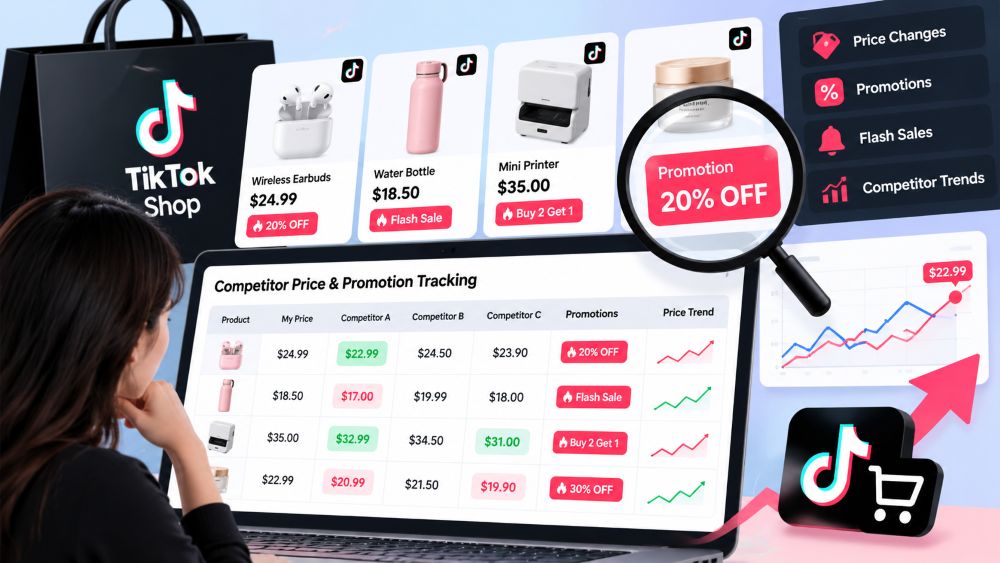
A competitor can drop a product from $39.99 to $29.99 overnight. That does not automatically mean you should follow them.
Maybe they are clearing inventory. Maybe the lower price only works with a platform subsidy. Maybe they have cheaper fulfillment. Or maybe the discount did not help sales at all.
That is why a TikTok Shop price tracker needs more than one number.
Track the listed price, what buyers actually pay, coupon value, bundle size, shipping offer, promotion timing, estimated sales, GMV movement, active creators, and selling videos. When you see those numbers together over time, you can make a better call on whether a price change actually mattered.
Today’s Price Is Only Part of the Offer
The price at the top of a TikTok Shop listing is not always the price a buyer pays.
A product might have a crossed-out list price, a store coupon, a creator-exclusive code, free shipping, a LIVE-only offer, or a bundle that changes the per-unit cost.
Two sellers can both show a $30 product. One may charge shipping and sell a single item. The other may include free shipping and a second item in the package. They are not competing with the same offer.
This is why screenshots taken on random days are not enough. You need some price history.
A competitor’s listed price can stay the same for weeks while the actual buyer price changes every few days through coupons and promotions.
Choose Competitors That Give You Useful Signals
Do not build a watchlist with every store that sells something similar.
Start with a small group:
Three direct competitors with closely matched products
Two established category leaders
Two newer shops that are gaining attention
A few nearly identical products
One or two substitute products buyers may consider instead
Keep the comparison fair. Use the same country, product category, quantity, and time range.
A single-item listing should not be compared directly with a three-pack. A premium version with free shipping should not be compared with a basic version that charges for delivery.
The goal is not to prove another seller is cheaper. It is to understand what a buyer sees when they compare options.
Build a Price History You Can Revisit
A spreadsheet works well for a short competitor list.
Pick the same day each week. Record the offer as a buyer would see it. If there is a coupon, note it. If a seller changes a two-pack to a three-pack, note that too.
Date | Product | Shop | List price | Buyer price | Offer | Shipping | Estimated units sold | Estimated GMV |
|---|---|---|---|---|---|---|---|---|
Week 1 | Product A | Shop A | $39.99 | $29.99 | 25% off | Free | 1,200 | $35,988 |
Week 2 | Product A | Shop A | $39.99 | $34.99 | 12.5% off | Free | 950 | $33,241 |
Week 3 | Product A | Shop A | $39.99 | $39.99 | No visible offer | Free | 690 | $27,593 |
This example shows a pattern, not proof.
The lower price may have helped sales. It may also have appeared during a stronger creator campaign or a large LIVE event. That is why price history needs to sit beside sales, content, and creator activity.
Third-party sales and GMV figures should be described as estimates. They are helpful for market comparison, but they are not a competitor’s private accounting records.
Price Changes Need a Sales Story Behind Them
A product can sell more after a discount for many reasons.
A new affiliate creator may have posted. A seller may have started going LIVE every night. A seasonal event may have increased demand. More reviews may have made buyers feel safer ordering.
Price change does not automatically cause a sales change.
When you see a competitor adjust an offer, compare three periods:
The seven days before the change
The time when the promotion was active
The period after the promotion ended
Then look at what else happened around the product. Did more creators begin promoting it? Did shoppable videos increase? Was there a change in ranking? Did free shipping appear?
Use TikTok Shop data to compare product prices, sales movement, shops, creators, and related content within the same market.
Work Out the Actual Discount
A discount label can be misleading when products come in different quantities or bundles.
Use the buyer’s final payment, not the product’s crossed-out price.
Effective discount =
(List price − actual buyer payment) ÷ list price × 100
For bundles, calculate the price per item:
Price per unit =
Actual buyer payment ÷ number of items in the bundle
For example, a $24 single product may look cheaper than a $42 two-pack. But the two-pack costs $21 per unit. If it also includes free shipping, it may be the stronger offer.
This is especially important in beauty, supplements, household goods, accessories, and gift sets. Sellers often compete with quantity, not just with the headline price.
How to Read Price and Product Performance Together
Price is one variable. It becomes useful when you compare it with actual market movement.
What changed | What happened next | A reasonable next question |
|---|---|---|
Price dropped | Sales rose sharply | Was price the problem, or did creator activity also increase? |
Price dropped | Sales barely changed | Is the listing, content, or product itself the bigger issue? |
Price increased | Sales stayed steady | Does the product have room for stronger margins? |
Price stayed flat | Sales jumped | Did a creator, video, LIVE, or event create the lift? |
This does not need to become a complicated report.
You are simply trying to avoid the wrong conclusion. If price stayed flat and a product suddenly moved up the rankings, matching a competitor’s discount may not be the right response. The real opportunity may be in creator outreach or stronger product content.
Do Not Match a Discount Until You Check Your Own Math
A competitor’s lower price only matters if you can still make money at that level.
Before matching it, review your landed product cost, packaging, platform charges, affiliate commission, shipping, paid traffic, expected refunds, and the minimum profit you need per order.
If the lower price leaves almost nothing after those costs, it is not a sustainable strategy. It is just a temporary sales number.
There are often better ways to compete.
You could create a bundle, offer a useful gift, set a shipping threshold, run a short coupon, improve the product demonstration, or find creators who are a better fit for the item.
A buyer may choose a higher-priced product if the listing makes the value clear. Clear images, stronger reviews, a better bundle, or faster delivery can matter more than a small price difference.
Watch Out for Promotions That Change Buyer Expectations
Discounts can help a product launch or a campaign. They can also train buyers to wait.
If a competitor runs the same 30% coupon every week, the discounted price is probably their real price. Their list price is less meaningful.
A short LIVE offer is different. A creator-specific deal is different. A bundle tied to a holiday campaign is different again.
Track the kind of promotion, not only the percentage.
Ask whether the product still sells when the offer is gone. If it does, the seller may have built real demand. If sales disappear immediately, the lower price may have been carrying the whole product.
What a Good Price Tracking Tool Should Show
You do not need a long list of tools. You need a tool that fits the market you are researching.
For price monitoring, useful features include country filters, product matching, historical pricing, estimated sales and GMV trends, shop comparison, price-change alerts, exports, and a clear update time.
It should also help you see promotions in context. A product price without bundle details, shipping information, or creator activity can create more confusion than insight.
Compare data coverage, historical reporting, and competitor features in our guide to the best TikTok analytics tools.
Keep the Review Routine Simple
Choose one day each week to update your competitor list.
First, confirm that the product is still comparable. Sellers sometimes change the quantity, formula, color options, or package contents without making it obvious from the product title.
Then record the current buyer price, coupon, shipping offer, and bundle details. Check whether sales movement, creator activity, or content volume changed at the same time.
At the end of the review, make one decision:
Keep your current price.
Test a small offer change.
Improve the bundle or shipping value.
Ignore the competitor move because it is temporary or not relevant.
Do not change your own pricing every time another seller runs a discount. A price tracker is most useful when it keeps you from reacting too quickly.