TikTok Influencer Analytics for Better Creator and Product Decisions

TikTok influencer analytics helps you assess who a creator reaches, how viewers respond, and whether their content supports your commercial goals. For TikTok Shop sellers, that research also informs product selection: which items creators promote, how they demonstrate them, and whether sales activity continues beyond a single campaign.
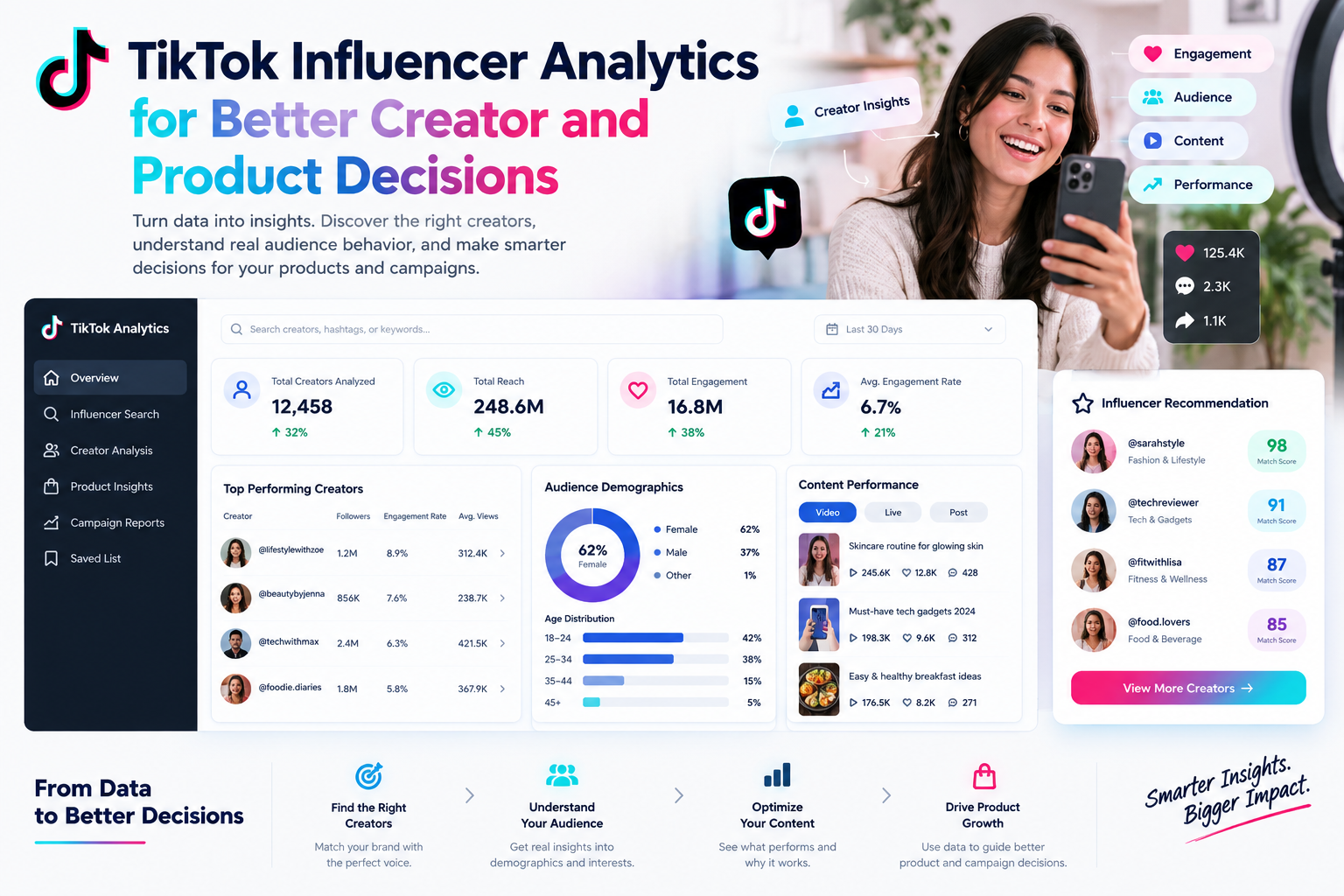
EchoTik connects creator research with product, shop, video, and LIVE analysis. Start with EchoTik's TikTok influencer analytics platform to build a relevant creator shortlist, then investigate the products and content behind the numbers.
Filter Creators Around Your Campaign Brief
Define your target market, product category, and content format before sorting creators by size. EchoTik's Influencer Library and release notes document the following filters or selection dimensions. Availability varies by market and account.
Filter or dimension | What to check | How it helps |
Market and language | Select your market and relevant content language. | Keep discovery relevant to the campaign. |
Creator and product category | Review content niche and promoted categories. | Find creators suited to your offer. |
Followers and likes | Compare audience size and visible popularity. | Create a manageable initial shortlist. |
GMV | Review the available commerce-performance field. | Investigate prior selling activity. |
Commerce status | Check product promotion, showcase, or shop status. | Understand the creator's commerce activity. |
LIVE status | Review livestream-related filters. | Find candidates for a LIVE brief. |
Recent views | Use available recent-view filters and periods. | Review current content activity. |
Audience demographics | Check supported audience filters; access can be market-specific. | Assess fit beyond the creator's location. |
Creator location and audience location answer different questions. A creator working in your target country does not automatically have the audience you need. Review audience information where available, and confirm important gaps with the creator before agreeing to a campaign.
Read Engagement and Sales With Consistent Definitions
Check the Engagement Rate Denominator
Engagement rate by views and engagement rate by followers are different measures. One common calculation is (likes + comments + shares) divided by views, multiplied by 100. For example, 1,000 likes, 80 comments, and 120 shares across 20,000 views produce 6%. This is an illustration, not a universal performance target.
Compare similar content over a consistent recent sample. Note the period, post count, and treatment of paid or sponsored posts. Review the distribution of views and individual posts so one viral video does not become your expectation for every collaboration.
Compare the Shape Behind Sales Totals
EchoTik's creator detail guide describes follower development, promoted videos, LIVE activity, and promoted products. Use the available time ranges to investigate performance across those views. Sales units, GMV, and engagement should remain separate in your notes.
Fictional promoted units across four equal weeks. Both creators total 200 units. This is a teaching illustration, not an EchoTik screenshot or verified creator sales.
Creator A increases from 40 to 60 units a week. Investigate whether comparable content and product conditions support that pattern.
Creator B records 140 units in one week and 20 in each remaining week. Check whether a launch, discount, or LIVE event explains the concentration.
Neither pattern proves which creator will be more profitable for your offer. Compare product fit, campaign costs, attribution definitions, and the work required to reproduce the result.
Use Creator Research to Support Product Selection
Step 1 Write a Specific Brief
Choose the market, customer problem, product category, and content format you want to test. A creator who is strong at LIVE demonstrations may need a different brief from someone producing short product reviews. Set a budget and a clear test objective before reviewing profiles.
Step 2 Build a Relevant Creator Shortlist
Open the EchoTik Influencer Library, search relevant creators, and combine the available filters. Start with relevance, then use audience size and commerce signals to narrow the list. Keep a short selection reason for each candidate rather than relying on a single ranking.
Step 3 Inspect Content and Selling History
Open a creator profile and review the available videos, livestreams, and promoted products. Look for clear demonstrations, category experience, repeated buyer questions, and an offer your team could realistically support. Watch several examples and distinguish ordinary posts from exceptional campaigns.
Follower growth can help frame this review. EchoTik's July 2026 release notes describe creator Milestones, a timeline linking growth stages and representative content. Use it to investigate a change, rather than assuming every sudden increase indicates either strong demand or artificial activity. [3]
Step 4 Cross Check the Related Products
Move from the creator to the promoted products. Compare similar items, current pricing, and sales patterns across other creators or shops. EchoTik's published Daily Sales Trends feature concerns product sales; it provides product context alongside creator research. A creator's successful campaign does not establish that your own listing will perform the same way. [3]
Investigate whether the opportunity depends on an unusual bundle, temporary discount, or one creator's established audience. Then check supplier quality, your costs, product eligibility, and fulfillment capacity before choosing inventory.
Step 5 Save the Evidence and Run a Pilot
Save candidates to favorites and export supported records where your account allows it. Keep the research date, market, time period, product, selection reason, and unresolved questions together. EchoTik documents favorites and data export for creator research. [1][4]
Agree on deliverables, timing, commission or fees, sample arrangements, and content usage before the pilot. Use your own campaign and shop records to evaluate attributed orders, refunds, and costs before expanding the partnership.
Know What the Data Can Establish
Treat third-party sales and audience figures as research signals or estimates, not audited settlement records. Check the metric definition, observation period, update date, and market coverage. For information that is not publicly available, request appropriate creator-provided reporting rather than assuming a username lookup reveals every private metric.
A useful shortlist explains both the evidence and the remaining question: relevant category experience, for example, but audience fit still to confirm. A high engagement rate is not proof of sales, and high GMV is not profit. Pricing, returns, commission, and fulfillment still affect the result.
Frequently Asked Questions
What is TikTok influencer analytics
It is the analysis of creator activity, audience fit, content response, and commercial performance. Brands use it to evaluate partners; TikTok Shop sellers can also connect creator promotion history with product research.
Which metrics should a TikTok Shop seller check first
Begin with category fit and audience relevance. Then review recent content performance, promotion history, and available sales or GMV signals over comparable dates. Follower count helps describe scale, but it does not answer the entire selection question.
Is there one good engagement rate for every creator
No single threshold fits every category, creator size, content type, and calculation method. Compare like with like, state the denominator, and investigate the content behind unusually high or low results.
Can creator analytics identify a winning product
It can reveal products worth investigating and potential ways to demonstrate them. Validate the product's broader sales pattern, competition, sourcing, costs, and your own test results before deciding to scale.
Can I use the same tool for my own account and other creators
Start with TikTok Studio for your own account analytics. Use EchoTik for external creator and commerce research. Confirm which fields and history are available in your market and subscription before building a reporting process around them.
Build a Creator Shortlist You Can Explain
Use TikTok influencer analytics to connect audience fit, content quality, and selling history to a clear test decision. Explore EchoTik to research creators, investigate related products, and prepare a pilot with measurable goals.