TikTok Shop API security best practices for protecting customer data

You do not get a second chance with customer data. If you build a TikTok Shop connector or analytics tool, your security choices either reduce risk up front or create audit work later. This guide takes a compliance‑first path through TikTok Shop API security, mapping each technical control to GDPR and CPRA obligations and giving you copy‑pasteable code to implement.
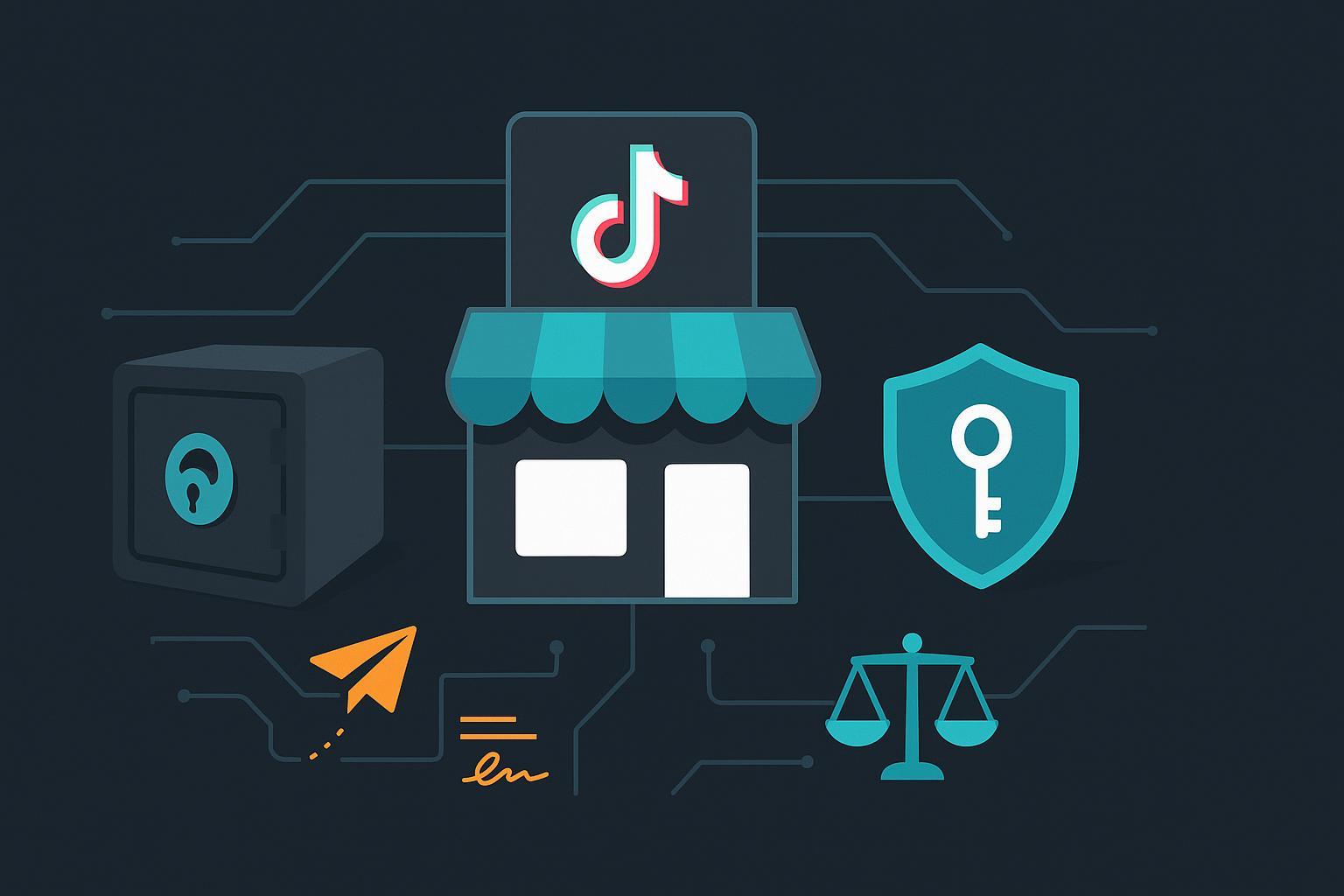
A secure and compliant architecture in one picture
Think of the system as four services with tight boundaries: an Auth Service handling OAuth and token exchange; a Token Vault storing and rotating secrets; an API Client that calls TikTok Shop endpoints with least privilege; and a Webhook Consumer that verifies authenticity before processing events. Data flows only what is necessary, and logs never contain raw access tokens or personal data. This setup aligns naturally to data minimization and security of processing while giving you clear blast‑radius limits if something goes wrong.
OAuth2 for TikTok Shop done right with PKCE
Your threat model starts at login. Follow OAuth 2.0 Security Best Current Practice: public clients must use PKCE, and confidential clients should use it too, with exact redirect URIs and CSRF protection via state. Short‑lived access tokens and refresh token rotation lower replay risk. See the normative guidance in the OAuth BCP published as the current standard in 2025 in the document titled OAuth 2.0 Security Best Current Practice. TikTok’s general OAuth user access token management also outlines flows and refresh handling in the official developer documentation for OAuth user access token management.
Token lifecycle and secrets management for TikTok Shop API security
Strong TikTok Shop API security depends on what happens after login. Access tokens should be short‑lived, and refresh tokens should rotate on each use. RFC 9700 recommends sender‑constraining tokens with mTLS or DPoP where feasible, or using refresh token rotation with reuse detection for public clients. For cloud‑native apps, store secrets in a dedicated vault with strict IAM and audit trails. AWS details practical controls in its official guidance on AWS Secrets Manager best practices.
Refresh token rotation pseudocode with reuse detection:
# On refresh:
# 1) Validate old refresh token belongs to this client and family
# 2) Issue new access + refresh token; mark old as used
# 3) If an old token is presented again, revoke the entire family

def rotate_refresh(client_id, old_refresh_token):
    family = db.get_family(old_refresh_token)
    if family.is_revoked:
        raise Exception('revoked family')
    if old_refresh_token.is_used:
        family.revoke_all()
        raise Exception('token reuse detected')
    new_access, new_refresh = issue_tokens(client_id, family.id)
    old_refresh_token.mark_used()
    vault.store(client_id, {
        'access_token': new_access.value,
        'refresh_token': new_refresh.value,
        'expires_at': new_access.expires_at
    })
    return new_access
Decision box for sender‑constrained tokens versus rotate‑only:
Use DPoP when you control the client and can manage key pairs per device or service. It prevents token replay without mTLS infrastructure. See the proof‑of‑possession approach in the IETF document titled Demonstrating Proof‑of‑Possession for OAuth.
Use mTLS for high‑assurance confidential clients inside your VPC or private network, especially when you already manage certificates. Guidance lives in the standard known as OAuth 2.0 Mutual TLS Client Authentication.
Use rotate‑only when TikTok endpoints or your client platform do not support sender constraints. Compensate with short TTLs, strict IP allow‑listing, and anomaly detection.
Storing tokens with AWS Secrets Manager using least privilege:
import boto3, os, json
secrets = boto3.client('secretsmanager')

def write_tokens(secret_name, access_token, refresh_token, expires_at):
    payload = json.dumps({
        'access_token': access_token,
        'refresh_token': refresh_token,
        'expires_at': expires_at
    })
    secrets.put_secret_value(SecretId=secret_name, SecretString=payload)

# IAM tip: grant secretsmanager:PutSecretValue only to the auth service role.
# Access tip: use VPC endpoints and a customer-managed KMS key for encryption.
Webhooks you can trust for TikTok Shop API security
Never process webhooks until you verify the signature and freshness. Compute an HMAC over the raw request body with your endpoint secret, enforce a tight timestamp tolerance, and use constant‑time comparison. This is the same battle‑tested pattern used by leading platforms, as described in the official webhook verification guide from Stripe. If you need an extended explainer for TikTok real‑time data and verification considerations, see the neutral overview on EchoTik, titled What is the TikTok Real‑Time API A Practical Compliant Playbook.
Node.js example for HMAC verification and replay protection:
// Use express.raw({type: '*/*'}) to obtain raw body
import crypto from 'crypto';

function safeEqual(a, b) {
  const bufA = Buffer.from(a);
  const bufB = Buffer.from(b);
  if (bufA.length !== bufB.length) return false;
  return crypto.timingSafeEqual(bufA, bufB);
}

export function verifyWebhook({ rawBody, signatureHeader, timestampHeader, secret }) {
  const toleranceMs = 5 * 60 * 1000;
  const ts = Number(timestampHeader);
  if (!ts || Math.abs(Date.now() - ts) > toleranceMs) return false;

  const hmac = crypto.createHmac('sha256', secret);
  hmac.update(rawBody);
  const expected = hmac.digest('hex');

  return safeEqual(expected, signatureHeader);
}
Until you confirm TikTok Shop’s exact header names and retry semantics in the Partner Center docs, keep the verification logic abstract and ensure you log failures without sensitive payloads.
Authorization beyond scopes
Scopes decide what a token can do; object‑level authorization decides what a user or tenant is allowed to access. Enforce checks like “shop_id belongs to this tenant” and “order_id is within the authorized shop list,” not just “scope includes orders.read.” Use unpredictable identifiers and server‑side filters that bind every request to the current tenant context. The OWASP API Security Top 10 calls this out as a top risk, described under Broken Object Level Authorization.
Logging, monitoring, and retention that pass audits
Security that is not observed will not hold. Centralize audit logs with structured fields, but redact tokens and personal data by default; record hashed identifiers and minimal context. Alert on unusual patterns such as refresh token use from new ASNs, spikes in 401s, or access from unexpected regions. Align data retention to GDPR storage limitation and security of processing, deleting or pseudonymizing personal data in logs on a schedule. When you need anchor guidance for these obligations, refer to the official GDPR text, specifically the articles titled Principles relating to processing of personal data and Security of processing. For US privacy obligations, review the California Privacy Protection Agency resources summarizing duties and rights on the CPPA official website.
GDPR and CPRA mapping quick reference
Below is a practical mapping from legal requirements to engineering controls you can ship. It is not legal advice; it is a technical checklist that pairs well with your DPA.
Regulation | Requirement | Practical control |
|---|---|---|
GDPR Article 5 data minimization and storage limitation | Collect only necessary fields and purge on schedule | Limit scopes and response fields; implement field‑level filtering; set log retention and purge workflows |
GDPR Article 6 lawfulness | Record lawful basis and purpose limitation | Store consent or contract basis with scope grants; annotate ingestion jobs with purpose tags |
GDPR Article 25 by design and by default | Default to least privilege | Off by default for optional scopes; guard optional fields behind feature flags; document DPIA triggers |
GDPR Article 32 security of processing | Ensure confidentiality, integrity, and availability | TLS 1.3; short‑lived tokens; refresh rotation; DPoP or mTLS when feasible; vault storage; anomaly detection |
GDPR Article 35 DPIA | Assess high‑risk processing | Run DPIAs for large‑scale profiles or sensitive data; record mitigations and sign‑off |
CPRA service provider duties and consumer rights | Process per instructions; support access, delete, correct, opt‑out | Implement DSR APIs and admin flows; deletion endpoints in your connector; propagate opt‑out flags downstream |
Micro example using EchoTik patterns
Disclosure: EchoTik is our product. In our connector‑style pattern, the Auth Service exchanges codes and immediately writes the access and refresh tokens to a dedicated secret in a vault keyed by tenant. Rotation runs on schedule and on use: when a refresh request succeeds, the refresh token is replaced and the old one is marked used; if an old token reappears, the family is revoked and the incident is raised. On webhook receipt, the consumer computes an HMAC over the raw payload, checks a five‑minute timestamp tolerance, and attempts idempotent processing keyed by the event ID to block replays. For an extended walkthrough of TikTok authentication pitfalls and recovery paths, see the neutral guide titled TikTok Shop API Errors Authentication and Integration Guide.
Pre‑launch and recurring audit checklist
PKCE in place for authorization code flows with exact redirect URIs and CSRF state; access tokens short‑lived; refresh token rotation with reuse detection
Secrets and tokens stored in a vault with customer‑managed encryption keys, least‑privilege IAM, and VPC endpoints; no hardcoded secrets in code or CI/CD
Webhooks verified with HMAC over raw body, with timestamp tolerance and idempotency to prevent replay; failures logged without sensitive data
Object‑level authorization enforced for every resource with tenant binding and unpredictable identifiers; rate limits and anomaly detection enabled
Retention schedules documented and enforced for logs and caches; DSR workflows for access and deletion tested; DPIA run when triggers met
What to do next
Want to build or harden a connector without reinventing the wheel? Explore the EchoTik API services page for options that align with these patterns at the page titled API service for connectors and analytics.