TikTok Shop Black Friday 2026: Product Research Checklist

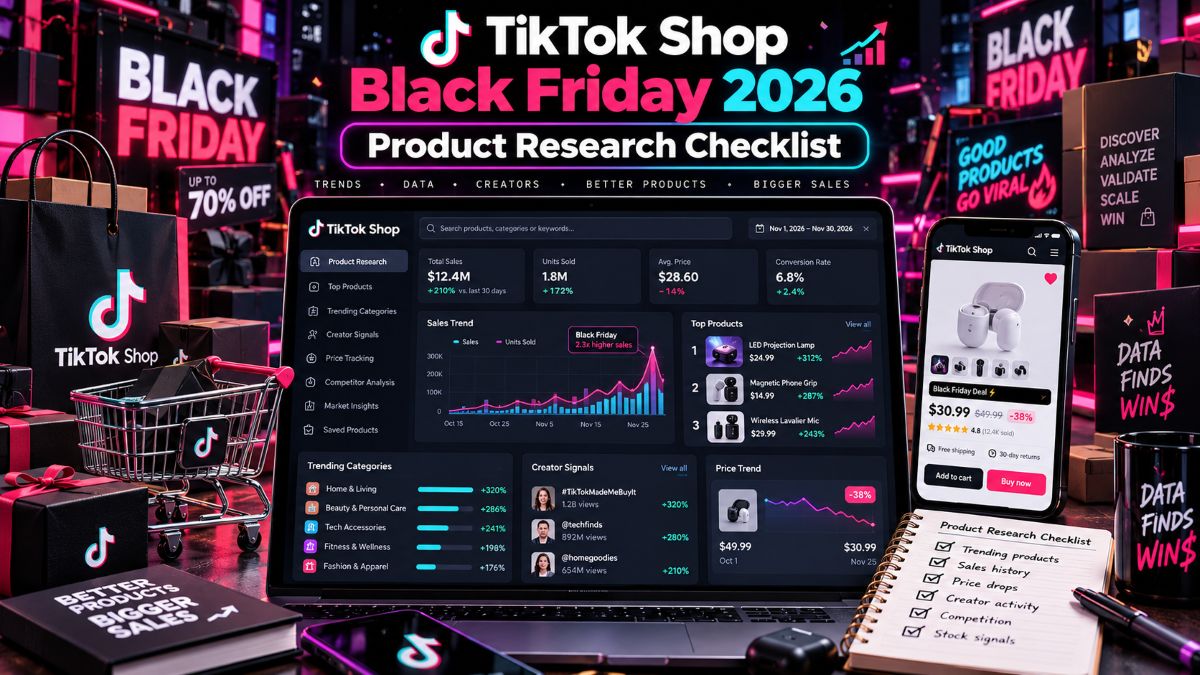
Black Friday can make a weak product look great for a few days.
Discounts bring in traffic. Creators post more often. Buyers are ready to spend. That does not mean every product with a sales spike deserves a large inventory order.
The sellers who get the most out of Q4 usually do their research before the feed gets crowded. They know which products have steady demand, which ones need LIVE to convert, which creators actually drive orders, and how far they can move on price without giving away the margin.
For U.S. sellers, TikTok Shop’s 2026 Black Friday and Cyber Monday campaign runs from November 11 through November 30. That gives you a real campaign window, but your preparation should start well before it.
The Work Starts Before the Deals Go Live
Late September and early October are for narrowing down the market and product candidates.
Do not wait until a product is already everywhere. By then, creators may be booked, suppliers may be stretched, and the lowest prices may already be gone.
Start with a short list. Twenty products is enough for most sellers. Track products in one market and one category, then look at recent sales, price movement, creator activity, videos, LIVE activity, and competing shops.
October is when you find out whether the product can actually convert.
That means testing product pages, content angles, creator samples, bundles, shipping promises, and pricing. A product can have demand and still fail in your shop if the listing is unclear or the delivery time is not competitive.
By late October, you should know which products deserve inventory, which creators you want to work with, and which offers you can support without wrecking the margin.
November is less about guessing. It is about watching daily changes and reacting before they become expensive.
Build a Shortlist, Not a Shopping Cart
A Black Friday product list should include more than the current bestsellers.
Some products are already well established. They may have stable sales, reliable creator coverage, and strong buyer demand. Those can be good opportunities if you have a clear price, bundle, or content advantage.
Others are just starting to move. They may not have huge GMV yet, but creator activity and video volume are increasing. Those are often worth watching because the category may still have room.
Then there are products that look exciting because of one huge number. Those need more caution.
Start with TikTok Shop data for the products, shops, creators, and sales trends in the market you plan to enter. Use the same date range for every product. Comparing one product’s seven-day spike with another product’s 30-day sales is how bad decisions get made.
For each product, ask:
Are sales increasing over both seven and 30 days?
Is the price holding, or are sellers cutting it every week?
Are multiple shops selling it?
Are creators still joining in?
Do shoppers understand it quickly in a video?
Can you still make money after promotions and commissions?
A product does not need perfect answers across the board. It does need a believable path to sales and profit.
Separate Holiday Demand From a Viral Moment
This is the part many Black Friday lists miss.
A product may be selling because it fits the season. It may also be selling because one creator posted a video that caught fire on Tuesday.
Those are different opportunities.
Holiday demand tends to show up across multiple shops, creators, and content formats. A viral spike is usually more concentrated. You might see most orders tied to one creator, one video, one LIVE, or one sharp discount.
What to look at | Seasonal demand | Short viral spike |
|---|---|---|
Sales source | Several shops and creators contribute | One creator or video drives most activity |
Sales pattern | Builds over several weeks | Jumps sharply in a day or two |
New content | More videos keep appearing | Attention stays around one post |
Price | Usually holds within a normal range | May rely on a heavy discount |
After the promotion | Some demand remains | Sales can fall quickly |
Neither pattern is useless.
A viral product can still be profitable if you move quickly and understand the risk. Seasonal demand is often easier to plan around because it gives you more than one source of sales.
For Black Friday, products with broad support are usually safer than products that only work when one large creator posts.
Watch the Price Before You Decide to Match It
Black Friday pricing is not as simple as being the cheapest seller.
A competitor may be offering a lower price because they have a different product cost, lower fulfillment expense, a platform subsidy, or a bundle that changes the math. Copying the price without understanding the offer can turn a high-GMV product into a low-margin headache.
Track the regular price, the current promotion price, shipping offer, bundle, coupon, and creator commission.
Then look at the sales response.
If a competitor cuts the price by 20% and sales barely move, shoppers may not be buying based on price alone. Better photos, stronger reviews, faster delivery, or more convincing content may matter more.
If sales jump every time the price drops, that tells you something else: buyers are highly price-sensitive, and your margin needs to account for that before you enter.
You have a few ways to compete without joining every price war:
Bundle a useful accessory instead of cutting the base price.
Offer a clear gift with purchase.
Improve the product page so the value is easier to understand.
Give creators an angle that competitors do not have.
Use a targeted coupon instead of lowering the listed price for everyone.
A better offer is often easier to protect than a lower price.
Creators Need to Be Part of the Plan Early
Creators are busy in Q4. The people who consistently drive orders usually have more than one brand asking for content.
Do not wait until mid-November to figure out who can promote your product.
Look at the creators already working in your category. Check how often they post, whether their videos generate product clicks, and whether they sell through short videos, LIVE, or both.
A high-view creator is not always the best holiday partner. Some accounts are great at reaching people but weak at moving products. A smaller creator with a practical audience may drive fewer views and more orders.
You also want to see whether the content can be repeated.
If the product works only through one dramatic reveal, it may run out of steam quickly. If creators can make gift guides, comparison videos, demos, problem-solution clips, unboxings, and LIVE content, you have more room to work with through the campaign.
Give creators enough time to receive samples, understand the product, and make content that does not feel rushed. Black Friday content made in a panic often looks like every other discount video on the feed.
Views and Orders Are Not the Same Thing
During Black Friday, views can get noisy.
A funny or surprising video may pull in a huge audience. That does not always mean it sells. A more direct video may receive fewer views but send more people to the product page and generate stronger order volume.
Signal | Traffic-heavy video | Sales-focused video |
|---|---|---|
Views | Often high | May be moderate |
Product clicks | Can be weak | Usually stronger |
Comments | General reactions | Questions about price, delivery, size, or use |
Orders | Unpredictable | More consistent |
Content style | Entertainment or novelty | Demonstration, proof, offer, and product fit |
Watch what happens after the view.
Does the video produce clicks? Do buyers ask where to get it? Are they asking practical questions that suggest purchase intent? Does the product page receive orders after the post goes live?
That is the difference between attention and commercial interest.
Plan Inventory Around Three Possible Outcomes
No one can tell you exactly how much inventory to buy for Black Friday. The right quantity depends on your own past sales, lead time, supplier reliability, campaign participation, creator output, and return rate.
Instead of betting everything on one forecast, make three.
The conservative case assumes your normal sales pace with a modest lift. The expected case assumes the products and creators perform roughly as planned. The high-demand case assumes a strong campaign, successful content, and a faster sell-through rate.
For each scenario, calculate daily sales, expected campaign duration, lead time for replenishment, and a realistic amount of safety stock.
Do not forget cancellations and returns. A product with 100 orders is not always 100 completed sales. A fast-selling item can also create problems if the top color or size runs out first.
Your inventory plan should leave room to restock without forcing you to buy too deeply into a product that only works for one holiday week.
Keep the Daily Review Focused
Once the campaign starts, there will be more data than you can reasonably act on.
Focus on the numbers that change a decision:
Product sales and GMV by day
Product-page clicks and conversion
Price and coupon changes
Creator posts and attributed orders
LIVE performance
Stock by top variant
Cancellations, delivery problems, and refund reasons
If a product is getting traffic but not orders, fix the listing, offer, stock, or shipping message before putting more money behind it.
If a creator is producing steady orders, give them attention quickly. Support the content angle that works. Make sure stock is available. Consider whether a bundle, commission adjustment, or LIVE session would help while the momentum is still there.
If a product is falling behind, do not automatically discount it. First find out whether the problem is demand, content, pricing, reviews, or fulfillment.
A Practical Black Friday Timeline
The exact work will vary by shop, but the sequence matters.
Late September to early October: Choose the market, narrow product candidates, and review the category. Check whether demand is growing, stable, or already fading.
Early to mid-October: Test the product page and content. Send samples to creators. Watch which videos get product clicks, not just views.
Late October: Lock in your core products, inventory plan, creator list, pricing range, and shipping cutoff. Confirm campaign eligibility and product approval in Seller Center.
Early November: Finalize live offers, creator content, product bundles, and customer-service coverage. Do not leave stock or fulfillment issues until the campaign begins.
During the campaign: Review product movement every day. Keep an eye on inventory, creator output, competitor pricing, order conversion, and refund signals.
After the campaign: Review what produced profit, not only GMV. Some products may continue selling into December. Others may have depended entirely on Black Friday pricing.
Do Not Let GMV Hide the Real Result
Black Friday can create impressive dashboard numbers.
That does not mean every product should be reordered.
After the campaign, look at the full picture: product cost, shipping, commission, discounts, ads, returns, and customer feedback. A product that sold quickly but brought low-quality orders or heavy refunds may not be worth carrying into the next season.
On the other hand, a product with moderate GMV, healthy margins, good reviews, and repeat creator interest may be more valuable than the top seller.
If you need to compare platforms by product, competitor, creator, and historical-data coverage, review our guide to the best TikTok analytics tools.
Black Friday is a busy sales period, but it is also useful research. The products, creators, and offers that hold up after the promotion often tell you more about your business than the biggest spike of the month.