TikTok Shop Conversion Funnel: From Impressions to Buyers

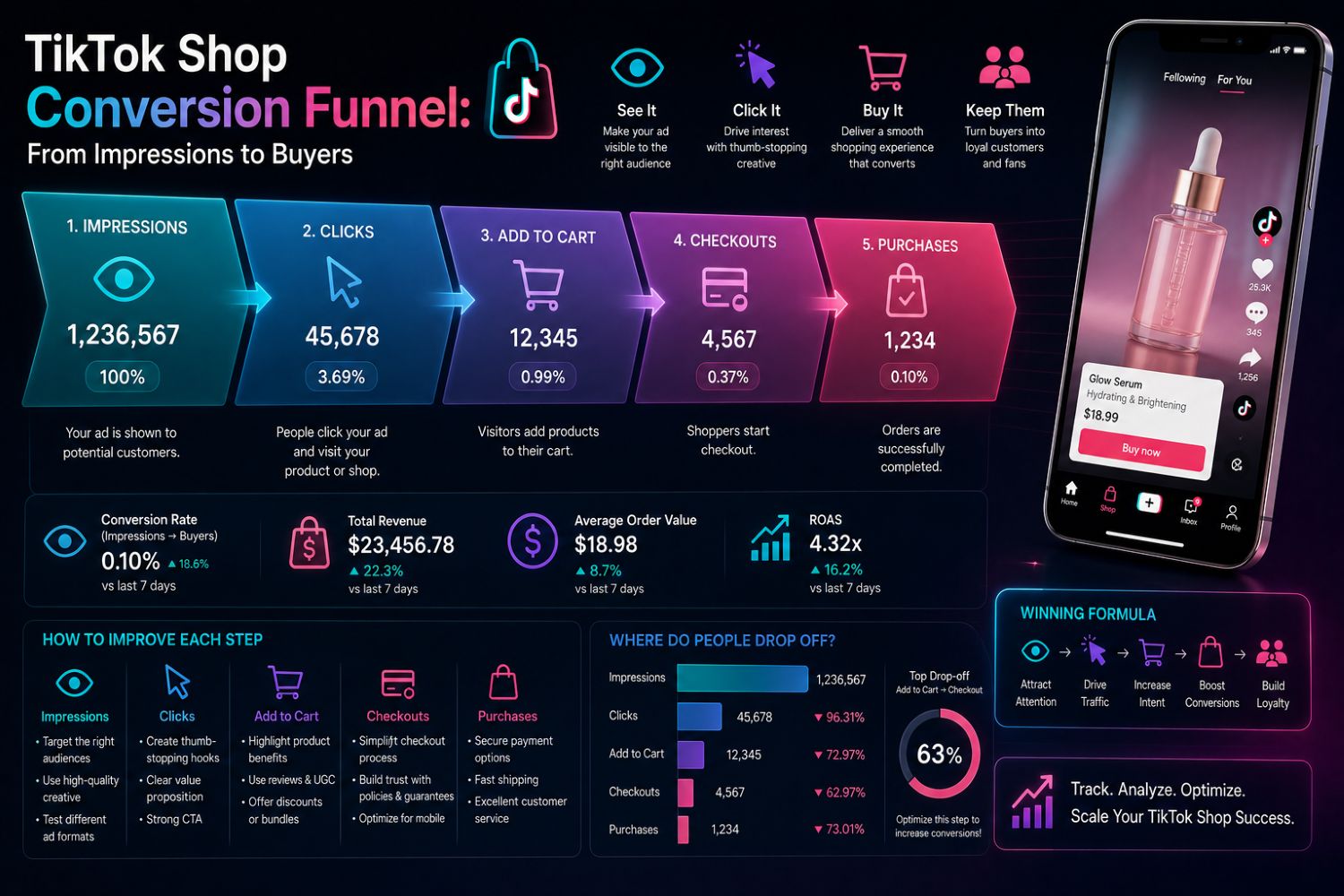
A TikTok Shop product can receive thousands of impressions without generating consistent sales.
The problem is usually not a lack of traffic. It is a conversion gap somewhere between product discovery, product page visits, and completed orders.
Understanding the TikTok Shop conversion funnel helps sellers see where potential buyers leave. It also helps you decide which products, traffic sources, creators, and campaigns deserve more budget.
This guide breaks down the metrics at every stage and shows how to turn performance data into practical decisions.
What Is the TikTok Shop Conversion Funnel?
The TikTok Shop conversion funnel is the path from someone seeing a product to becoming a buyer.
Not every viewer will click. Not every visitor will add the product to their cart. And not every cart will turn into an order.
A simple funnel looks like this:
Product Impressions
        ↓
Product Clicks
        ↓
Product Page Views
        ↓
Add-to-Cart Activity
        ↓
Orders
        ↓
Buyers
        ↓
GMV
The goal is not just to get more traffic at the top. The goal is to reduce drop-off at each stage.
A product with lower impressions and stronger conversion can be more valuable than a product that gets a lot of attention but rarely sells.
TikTok Shop Conversion Funnel Metrics
Each metric answers a different question. Looking at only GMV can hide the real issue.
Funnel stage | Metric | What it tells you |
|---|---|---|
Discovery | Product impressions | How often shoppers see the product |
Interest | Product clicks | How many people want to learn more |
Consideration | Product page views | How many shoppers reach the product page |
Intent | Add to cart | How many visitors show buying intent |
Purchase | Orders and buyers | Whether interest turns into sales |
Revenue | GMV | The transaction value generated by the product |
A strong product does not need perfect numbers at every stage. It needs a funnel that makes sense.
For example, a high-ticket product may get fewer clicks but still produce strong GMV. A low-priced impulse product may need very high click volume to generate meaningful revenue.
Product Impressions vs. Product Page Views
This is one of the most useful comparisons in TikTok Shop product analytics.
Impressions show that people are seeing your product. Product page views show that they were interested enough to click.
If impressions are high but clicks are low, the issue is usually near the top of the funnel.
Possible reasons include:
The product image does not stand out.
The title is unclear or too generic.
The price looks too high at first glance.
The product was shown to the wrong audience.
The video gets views but does not make viewers curious about the item.
If clicks are strong but product page views or orders are weak, the problem is probably on the product page.
Look at the product images, price, reviews, delivery promise, variants, and product description. Shoppers clicked because something caught their attention. The page needs to finish the job.
If page views are high but orders remain low, check whether the offer is competitive. Shipping time, missing reviews, weak bundles, and unclear product details can all stop a purchase.
How to Calculate TikTok Shop Conversion Rate
There is no single TikTok Shop conversion rate. Each step has its own conversion rate.
Use these formulas to find the weak point.
Product click-through rate =
Product clicks ÷ Product impressions × 100
This shows whether your product listing, video, or product card creates enough interest to earn a click.
Product page conversion rate =
Product buyers ÷ Product page visitors × 100
This shows whether shoppers who reach the page become buyers.
Order conversion rate =
Orders ÷ Product page visitors × 100
This shows how efficiently page visits become orders.
Keep the measurement period consistent. Different markets, dashboards, and reporting views may count traffic and visitors differently. Compare the same product, the same market, and the same date range whenever possible.
Why TikTok Shop Products Lose Buyers
Most conversion problems are not mysterious. They usually come down to a few common issues.
The video promises one thing, but the product page looks different. The shopper clicks expecting a clear result, then sees weak images or unclear details.
The product title may be too long, poorly translated, or focused on features that shoppers do not care about. A title should quickly tell people what the product is and why it helps.
Price is another common issue. You do not always need to be the cheapest option. But the value needs to feel obvious. Reviews, bundles, free shipping, and product proof can justify a higher price.
Trust matters too. Weak ratings, too few reviews, unclear shipping times, and unanswered questions create hesitation.
Creators can also send the wrong kind of traffic. A funny video may get strong engagement, but viewers may not be ready to buy. That is why views alone are not enough when evaluating creator performance.
How Traffic Sources Affect Conversion
TikTok Shop traffic does not all behave the same way.
Seller videos can work well when a brand knows its audience and can show a clear product benefit. Affiliate videos can create fast discovery, especially when creators make the product feel credible.
LIVE traffic often has stronger purchase intent because shoppers can ask questions, see the product in real time, and respond to limited-time offers.
Product cards, Shop Tab traffic, and search traffic can be more direct. These shoppers may already know what they want, so the product page, price, and reviews matter even more.
Paid ads can scale reach quickly, but they should be evaluated by buyers, orders, and GMV—not just impressions.
When comparing traffic sources, ask:
Which source drives the most product page visits?
Which source produces the most buyers?
Which source has the strongest order conversion rate?
Which source generates the most GMV after discounts and costs?
Which creator, video, or LIVE session is behind the traffic?
Use TikTok Shop data to compare product, creator, video, shop, and market performance in one place. This helps you see whether traffic is creating real sales or simply adding views.
How to Find the Biggest Conversion Gap
Do not try to fix everything at once. Pick one product and follow the data.
Choose one product and one date range.
Record impressions, clicks, page views, buyers, orders, and GMV.
Compare the results with the previous period.
Compare each traffic source.
Check which creator, video, or LIVE session brought in the traffic.
Find the stage with the biggest percentage drop.
Change one variable and measure the result again.
For example, if a product gets plenty of impressions but few clicks, test a new cover image, title, price display, or opening hook.
If clicks are strong but page conversion is weak, improve the product page first. Add better images, answer common questions, clarify shipping, or test a stronger bundle.
If orders are coming from one creator but not another, look at the audience and creative angle before deciding where to invest more.
What Good TikTok Shop Performance Actually Looks Like
Good performance is not one universal benchmark.
A beauty product may depend on creator demos and repeat purchases. A home appliance may need longer videos, clearer proof, and customer reviews. A low-cost accessory may benefit from bundle offers and fast checkout.
The best benchmark is your own recent performance.
Track whether your click-through rate, page conversion rate, order volume, and GMV are improving over time. Then compare your best-performing product with your weaker ones.
This gives you a realistic standard for what “good” looks like in your category.
Turn Funnel Data Into Better Decisions
The conversion funnel should guide your next action.
Low impressions may mean the product needs better distribution, stronger content, or a better creator match.
Low clicks may mean the listing or video is not making shoppers curious enough.
Low page conversion usually points to product-page trust, price, offer, or shipping problems.
Low GMV with healthy orders may mean the average order value is too small. Test bundles, related products, or a higher-value offer.
Every stage gives you a different answer. That is why a full funnel view is more useful than looking at sales alone.
Final Takeaway
TikTok Shop performance is not just about traffic. It is about what happens after the impression.
Track how shoppers move from discovery to clicks, page views, carts, orders, buyers, and GMV. Find the biggest drop-off point, make one focused change, and measure again.
That is how sellers turn TikTok Shop data into better product decisions—and more consistent sales.