TikTok Data API: How to Automate Product Sourcing and Competitor Spying in 2026

Outline
Quick Answer
TikTok Data API
What Is a TikTok Data API?
TikTok Data API vs Official TikTok APIs
EchoTik Data You Can Use This Month
Step-by-Step Workflow
Practical Use Cases
FAQ
Quick Answer
A TikTok Data API helps teams access TikTok-related data programmatically instead of checking products, creators, videos, shops and live streams manually.
For ecommerce sellers, agencies, brands, SaaS teams and data analysts, the real value is not “getting data.” The real value is building repeatable market intelligence: product discovery, creator scoring, competitor monitoring, live stream analysis, shop tracking and trend detection.
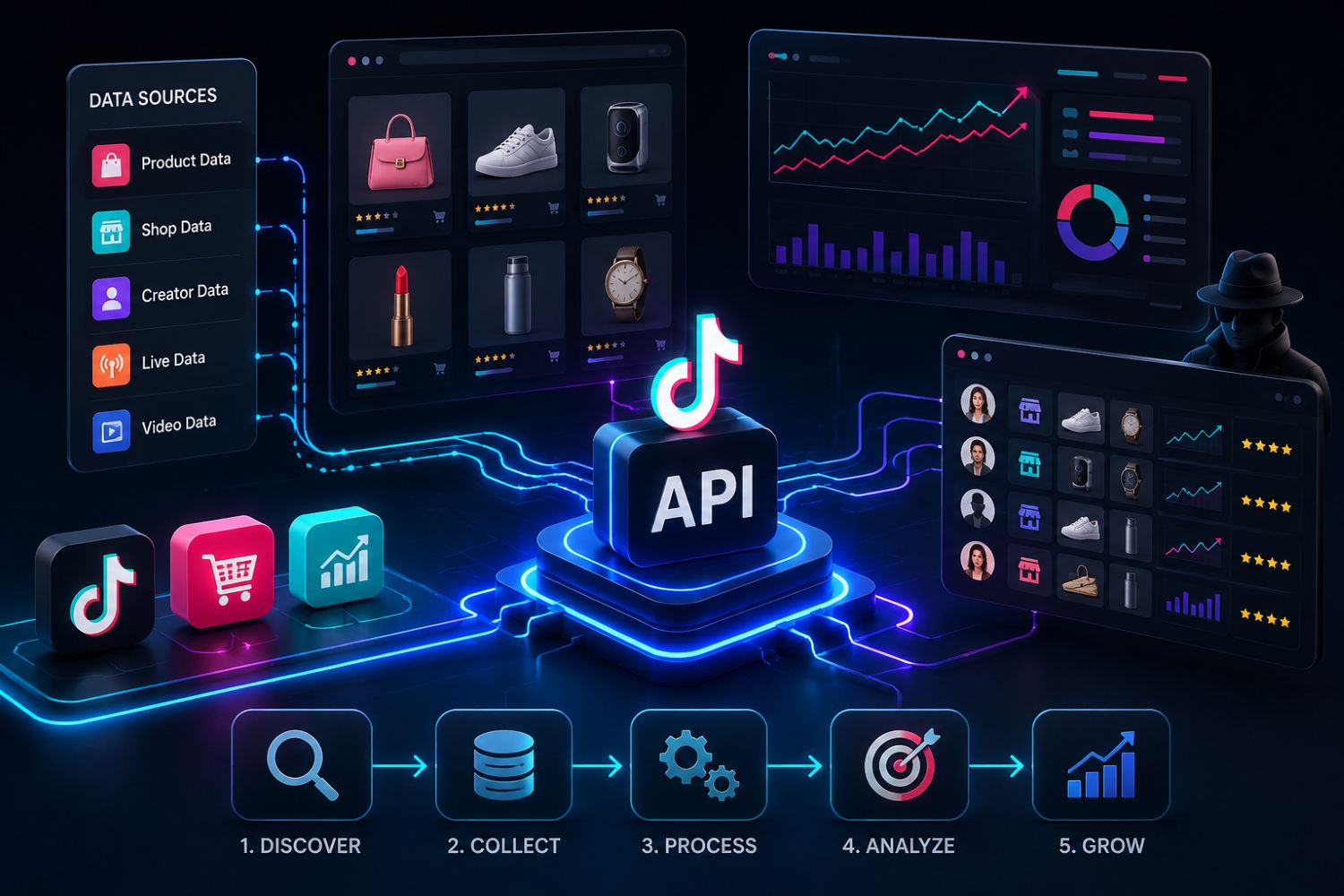
EchoTik TikTok Data API is built for this workflow. Its public API page shows coverage across creator data, video data, live stream data, product data, shop data and market trends. It also supports real-time and historical analysis, with trend tracking available up to 1,000 days back. EchoTik’s homepage also publicly shows large-scale coverage, including 1B+ influencer data and 1.8B+ product data.
If your team wants to build a TikTok Shop intelligence dashboard, automate product research, score creators, monitor competitor shops or feed TikTok commerce data into internal BI systems, EchoTik is a strong API layer to evaluate.
EchoTik TikTok Data API
They may be:
Searcher Type | Real Intent |
|---|---|
SaaS builder | Wants to build a TikTok analytics or ecommerce intelligence product |
Agency | Wants to automate creator, product and competitor reports |
Brand team | Wants to monitor competitors, creators and category trends |
TikTok Shop seller | Wants to track products and shops without manual research |
Data analyst | Wants structured TikTok commerce data for dashboards |
AI startup | Wants video, creator, product or trend data for model training |
Investment or consulting team | Wants market signals for category and brand research |
The real question is not “Does an API exist?”
The real question is:
Can this API give me enough TikTok commerce data to make faster, better business decisions?
That is why this article focuses on workflows, not just endpoint names.
What Is a TikTok Data API?
A TikTok Data API is a structured way to retrieve TikTok-related information through software.
Instead of manually opening TikTok, searching creator profiles, watching videos, saving product links and checking live rooms one by one, a data API lets your team pull structured fields into your own system.
For TikTok commerce, useful API data may include:
Creator profiles
Follower count
Engagement trends
Video views and comments
Top commerce videos
Product details
Product price trends
Associated creators and videos
Shop product lists
Shop sales trends
Live stream viewers
Peak live traffic
Live GMV signals
Category trends
Keyword insights
Trending topics and music
The difference between manual research and API-based research is scale.
Manual research gives you screenshots.
API research gives you systems.
TikTok Data API vs Official TikTok APIs
It is important to be precise here.
TikTok provides several official developer products, but they serve different purposes. TikTok’s Research Tools are designed for qualifying researchers in eligible regions and organizations. Its Commercial Content API focuses on commercial content and ad transparency data. TikTok Shop Partner APIs are used by sellers and partners for shop operations such as managing seller-side workflows.
These official APIs are valuable, but they may not solve every TikTok commerce intelligence use case.
For example:
API Type | Best For | Limitation |
|---|---|---|
TikTok Research API | Academic and public-interest research | Eligibility is restricted |
TikTok Commercial Content API | Ad and commercial content transparency | Focused on ads and commercial content |
TikTok Shop Partner API | Seller-side shop operations | More focused on your own shop workflows |
EchoTik Data API | Product, creator, video, live, shop and market intelligence | Best used as a third-party TikTok commerce data layer |
EchoTik’s role is not to replace every official TikTok API. Its stronger position is ecommerce market intelligence: helping teams understand what is happening across products, creators, shops, live rooms and trends.
EchoTik Data You Can Use This Month
Public EchoTik data points checked in June 2026:
EchoTik Public Data Point | How Teams Can Use It |
|---|---|
1B+ influencer data | Build creator discovery, creator scoring and outreach systems |
1.8B+ product data | Analyze product trends, category demand and TikTok Shop opportunities |
Creator data | Access GMV performance, audience profiles, engagement trends, follower count, video and live lists |
Video data | Analyze likes, views, engagement trends, comments, captions and commerce video ranking |
Live stream data | Track real-time live details, total viewers, peak viewers, follower growth during live and live GMV |
Product data | Review product details, price trends, associated creators, associated videos, lives and category insights |
Shop data | Track shop details, sales trends, product lists, related creators, videos and live streams |
Market trends | Monitor category trends, viral topics, breakout patterns, ad insights, keyword insights and trending music |
Historical trend tracking | EchoTik API states trend history can go up to 1,000 days |
Free testing | EchoTik API page says users can receive 100 test requests |
For monthly reporting, do not copy display-only demo numbers from public pages. Pull data from EchoTik API, EchoTik dashboard exports or your internal verified dataset.
Step-by-Step Workflow
Step 1: Start With the Business Question
Do not start by pulling every possible endpoint.
Start with one business question:
Which products are growing in my category?
Which creators should we contact this month?
Which competitor shops are gaining momentum?
Which live rooms are producing repeatable sales signals?
Which TikTok trends are worth building content around?
A clean question prevents API chaos.
Step 2: Choose the Right EchoTik Data Layer
Use EchoTik Data API as the main data layer.
For product intelligence, pull product details, price trends, associated creators, videos, lives and category insights.
For creator intelligence, pull follower count, engagement trends, video lists, live lists and audience profile signals.
For shop intelligence, pull shop details, product lists, sales trends and associated creators or videos.
For live commerce, pull live stream details, total viewers, peak viewers, follower growth during live and live GMV signals.
For market research, pull category trends, viral topics, breakout patterns, keyword insights and trending music.
Step 3: Build a Product Research Dashboard
Connect EchoTik product data to your internal dashboard.
A useful product dashboard should show:
Product name
Category
Price trend
Ranking movement
Related creators
Related videos
Related live rooms
Comment intent
Shop adoption
Trend durability
Then connect this to EchoTik E-commerce Analysis for manual review and deeper category exploration.
Step 4: Build a Creator Scoring Model
Creator selection should not depend on follower count alone.
Use EchoTik creator and video data to score creators by:
Follower count
Engagement trend
Recent video views
Comment quality
Product category fit
Live activity
GMV performance signals
Past commerce videos
This is useful for agencies and brands that need to contact many creators but still avoid low-quality outreach.
Step 5: Monitor Competitor Shops
Use shop data to monitor competitor product lists, sales trends, associated creators, videos and lives.
A strong competitor dashboard should answer:
What did competitors add this month?
Which products moved up?
Which creators are repeatedly connected to their growth?
Which live rooms are worth studying?
Are competitors winning through pricing, creators, content or live selling?
This is where TikTok Data API becomes a growth system, not just a data feed.
Step 6: Add Live Stream Intelligence
For live commerce teams, connect API data with EchoTik Live Monitor.
EchoTik Live Monitor publicly states that it provides minute-by-minute live data, analyzes live traffic, products, audience and sales pitch, automatically extracts product lists, calculates sales volume and GMV based on big data, and cross-analyzes pitch, traffic and sales.
That gives live teams a sharper view of what happened inside a competitor live room.
Step 7: Turn Data Into Weekly Decisions
At the end of each week, your team should not only export charts. It should produce decisions:
Products to test
Products to avoid
Creators to contact
Competitors to monitor
Live rooms to review
Content angles to produce
Keywords to target
Categories to watch next
That is the real value of a TikTok Data API.
Practical Use Cases
For TikTok Shop Sellers
Use EchoTik API to track product trends, competitor shops, creator activity and live-room signals before deciding what to sell.
For Agencies
Build automated client reports that show product movement, creator performance, competitor activity and category trends.
For Brands
Monitor brand category visibility, competitor shops, creator networks and content trends across TikTok commerce.
For SaaS Teams
Use EchoTik data infrastructure to build TikTok analytics dashboards, creator discovery tools or market intelligence products.
For AI Teams
Use structured TikTok data, video metadata, captions, comments and trend fields to support model training, content clustering and trend prediction workflows.
Why EchoTik Is Strong for TikTok Data API Users
EchoTik’s main advantage is coverage across the commerce chain.
A basic API might only show video data.
A seller tool might only show your own shop data.
A social analytics tool might only show creators and engagement.
EchoTik connects products, creators, videos, shops, live streams and market trends. That makes it more useful for teams trying to understand TikTok Shop as a market, not just as a social platform.
If your goal is to build a real TikTok commerce intelligence system, EchoTik gives you the data structure to start.
FAQ
What is a TikTok Data API?
A TikTok Data API lets developers and teams access TikTok-related data programmatically, including creators, videos, products, shops, live streams and market trends.
Is EchoTik Data API the same as TikTok’s official API?
No. TikTok has official APIs for research, ads, shop operations and other developer use cases. EchoTik is a third-party TikTok analytics and data platform focused on ecommerce intelligence, product research, creator analysis, live monitoring and market trends.
What data can I access with EchoTik API?
EchoTik’s API page lists creator data, video data, live stream data, product data, shop data and market trends.
Who should use TikTok Data API?
SaaS teams, agencies, brands, sellers, consultants, investment teams and AI startups can use TikTok Data API to build dashboards, reports, scoring models and market intelligence systems.
Can I test EchoTik API before building?
Yes. EchoTik’s API page says users can get 100 test requests.