TikTok Shop GMV vs Revenue: What Sellers Actually Earn

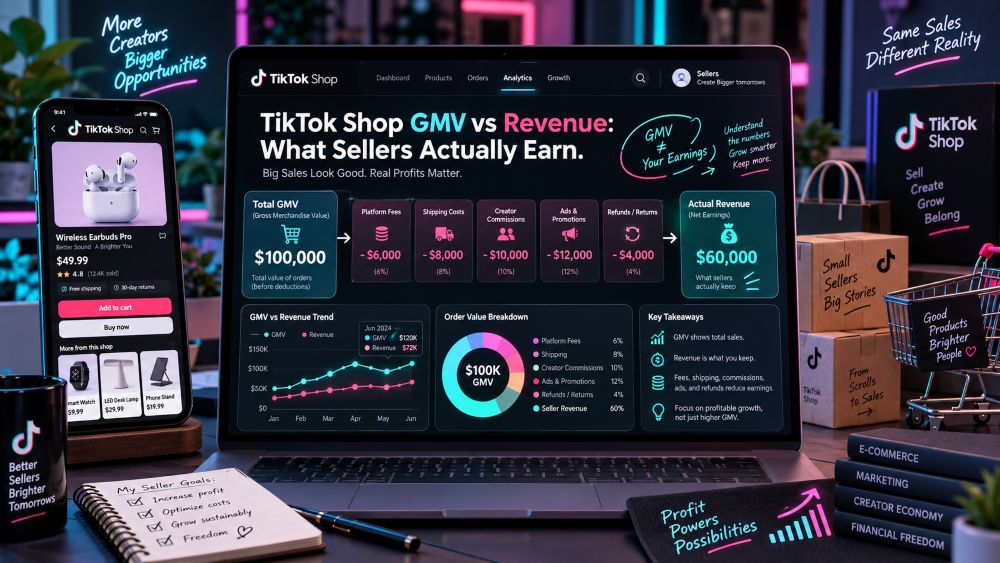
A shop can post $50,000 in GMV and still have a rough month.
That is not unusual. GMV is the number that gets attention because it is big, easy to share, and useful for measuring sales activity. But it is not the same thing as the money a seller gets to keep.
Product cost, affiliate commission, shipping, discounts, refunds, ad spend, and platform charges all show up after the sale. Sometimes they take a small bite. Sometimes they change the whole story.
If you are deciding whether a product is worth scaling, GMV is where you start. It should not be where you stop.
GMV is the top-line sales number
GMV means gross merchandise value. On TikTok Shop, it generally refers to the value of paid product orders during a selected period.
The quick version looks like this:
GMV = Items Sold × Selling PriceThat is fine for a quick estimate. The actual number in Seller Center can be more detailed.
TikTok’s current Shop Analytics definition includes product value and shipping paid by the customer, then accounts for seller-funded discounts, platform-funded discounts, and tax. Its GMV view can also include canceled and refunded orders, depending on the report and the period being reviewed. TikTok’s Shop Analytics guide explains the current calculation.
That detail catches sellers off guard.
A customer may place an order on September 28, creating GMV for that period. If the refund is processed in October, the GMV and refund can appear in different reporting windows. TikTok notes this timing difference in its product analytics documentation.
So when someone says, “This product did $10,000 in GMV,” the first follow-up question should be: over what dates, and what happened after the orders were paid?
GMV, revenue, net earnings, and profit are different numbers
People use “revenue” to mean different things. That can create confusion when a shop owner, accountant, affiliate creator, and analytics platform are all looking at the same business.
This is a practical way to separate the terms:
Metric | What it usually describes | Has every cost been removed? |
|---|---|---|
GMV | Value of paid product orders in the selected report | No |
Sales revenue | Money generated from product sales; the exact definition can vary by report | Not always |
Net earnings | Funds settled to the seller after platform-side adjustments | Some costs and adjustments are reflected |
Profit | What remains after every business cost is counted | Yes |
GMV answers, “How much merchandise was sold?”
Profit answers, “Was selling it worth it?”
Net earnings sits somewhere in the middle. It is closer to the cash available for payout, but it still is not a full profit-and-loss statement. Your inventory invoice, warehouse bill, contractor costs, outside software, samples, taxes, and ad spend may live outside that one TikTok settlement figure.
TikTok Shop’s Finance area uses Net Earnings for settled funds that are waiting for payout or are pending under the shop’s payout schedule. A balance can also be affected by later adjustments, including negative balances tied to refunds or other charges. TikTok’s payout guidance gives a useful explanation of how that balance works.
The same $4,000 can look very different after settlement
Here is a simple example.
A seller receives 100 orders for a $40 product.
100 orders × $40 = $4,000 GMVThe shop had a strong sales week. Nobody is disputing that.
But then the seller starts taking out the costs tied to those orders:
$4,000 GMV
- $240 platform-related charges
- $600 creator affiliate commission
- $1,400 product cost
- $500 shipping and fulfillment
- $300 advertising
- $160 estimated return cost
= $800 estimated profit
These are example numbers. They are not a TikTok Shop fee schedule, and they will not apply to every seller.
The point is that $4,000 in GMV did not become $4,000 in income. In this case, it produced an estimated $800 before other overhead the seller may still need to cover.
That can still be a healthy product. An 800-dollar return on 100 orders may support a growing shop, especially if the product also brings repeat buyers or helps creators discover the brand.
But it is a very different business conversation from “we made four grand.”
Discounts can make GMV look better than the unit economics feel
TikTok Shop is a promotion-heavy environment. A product may sell because the seller funded a coupon, TikTok added a subsidy, a creator offered a special deal, or a LIVE host pushed a temporary bundle.
Those promotions can be worth it. They may help a new product build reviews or push inventory during a slow period.
The issue is forgetting to look at the discounted selling price.
A product listed at $29.99 may usually sell for $23.99 after coupons. If the seller pays a 15% creator commission based on the discounted order and also covers shipping, the margin may be much smaller than it appears from the listing price.
This is why product-level reporting matters. A shop can have steady overall GMV while one particular SKU is slowly becoming unprofitable because discounts are doing too much of the selling.
When reviewing a product, look at the price customers actually paid over the selected period. Then compare that to the product’s normal cost structure. Do not build a pricing plan around the full list price if most customers never pay it.
If you need to check the cost side of a product before increasing a discount or affiliate rate, use the TikTok Shop fee calculator. It is more useful to enter your own shipping, commission, and product-cost assumptions than to rely on a generic margin percentage.
High GMV does not prove a product has a good business case
A product can have high GMV for several reasons:
It is genuinely useful and priced well.
A large creator made it viral.
The shop ran a deep discount.
TikTok traffic picked it up for a short period.
The product has a low price and sells a lot of units.
The seller is spending heavily on ads.
Those situations can look similar in a leaderboard.
They are not similar once you are deciding whether to source the same product.
Take two products with the same $20,000 GMV. Product A sold at a stable price, had modest creator commission, and kept return rates low. Product B needed a constant coupon, large affiliate payouts, and aggressive ad spend.
Product B may be the louder product. Product A may be the better business.
That is why sellers should look beside GMV instead of directly at it. Check units sold, average selling price, recent growth, active creators, price movement, and how concentrated sales are among the top shops.
If one shop owns most of the category’s visible GMV, it may be a brand-led market with limited room for a new seller. If several smaller shops are moving similar products, there may be room to compete—but you still need to understand why customers choose one listing over another.
Estimated GMV is useful, but it is not another seller’s bank statement
Your own Seller Center data is first-party data. It reflects the orders, refunds, settlements, and financial adjustments inside your shop.
Competitor GMV shown by market analytics platforms is different. It is normally estimated from observable product, shop, video, LIVE, and marketplace signals.
That does not make it useless.
Estimated GMV can help you spot a category that is growing, a product that keeps appearing in creator content, or a shop that is gaining traction faster than the rest of the market. It is good for deciding where to investigate.
It is not proof of a competitor’s confirmed revenue, margin, advertising spend, inventory cost, or payout.
A competitor could have $100,000 in estimated GMV and still be under pressure from high shipping costs, creator commissions, returns, and discounting. You cannot see those costs from public market data alone.
For a wider explanation of the metrics available across shops, products, creators, and content, read our guide to TikTok Shop data and analytics.
How to use GMV when deciding whether to test a product
GMV is most useful when you compare it with nearby signals.
If you are researching a product, pull up the last seven days and the seven days before that. Look at whether sales are rising, flat, or falling. Then check whether the product price has changed.
A sharp GMV increase alongside a steep price drop may mean the product is moving because the seller cut margin. A slower but steady increase at a stable price can be more interesting.
Then look at who is driving the sales.
If creators are doing most of the work, watch the videos. Are they showing a real use case? Are people asking buying questions in the comments? Are several creators selling the product, or is one viral video carrying everything?
LIVE activity matters too. Some products need explanation before people buy. A beauty device, high-ticket home item, or product with sizing questions may convert better in LIVE than in a short video. That can affect how much creator support and commission budget you need.
Also keep country and currency consistent. Comparing a U.S. product’s 30-day GMV with a seven-day result from another market tells you very little. Compare the same category, time range, currency basis, and sales definition before deciding one country has “better demand.”
A few reporting traps worth avoiding
The most common mistake is writing GMV as if it were profit.
The second is comparing total lifetime GMV when the market has already cooled off. A product may have sold well three months ago and now be losing traffic, creators, and pricing power.
Another is treating a refund figure from one date range as if it perfectly matches the GMV from that same range. Refund timing can lag behind the original sale, so the two numbers often do not line up neatly.
Finally, do not assume a product with big estimated GMV is automatically safe to copy. You still need to know whether you can source it, ship it, price it, and promote it without giving away the margin.
GMV is a useful signal. It tells you where money is moving. The rest of the work is figuring out how much of that movement can become a durable business for your shop.
To compare current product, shop, and creator performance across the market, explore the EchoTik TikTok Shop analytics dashboard.