TikTok Shop NBFR: How to Calculate and Reduce Your Return Rate

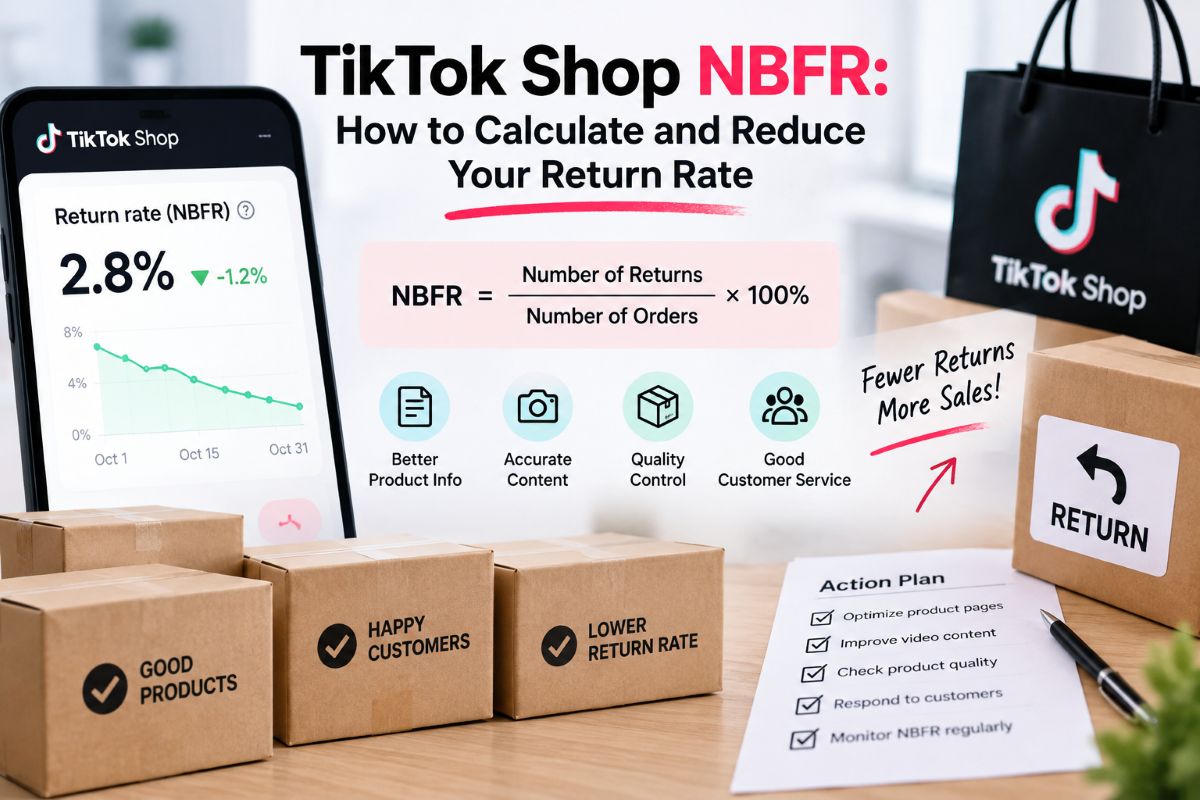
TikTok Shop NBFR stands for Non-Buyer Fault Return and Refund Rate.
It measures the share of delivered orders that led to a return or refund because something went wrong on the seller or logistics side. A damaged item, missing part, wrong product, inaccurate listing, or late delivery can all create an NBFR issue.
For U.S. sellers, TikTok currently reviews delivered orders from the prior 60 days. NBFR is part of a shop’s Shop Performance Score, so a high rate can affect benefits and product visibility. TikTok’s current NBFR requirements are the source to check if you sell in the U.S.; other markets may use different rules or time windows.
This metric is worth paying attention to because it points to problems that may not show up in your reviews right away. A customer who quietly requests a refund is still telling you something about the product or the order experience.
How TikTok Shop calculates NBFR
The basic calculation is straightforward:
NBFR =
Delivered orders returned or refunded for seller- or logistics-related reasons
÷
Eligible delivered orders
× 100
If a shop delivered 500 eligible orders during the review period and 15 of them had a seller- or logistics-fault return or refund request, the NBFR would be 3%.
15 ÷ 500 × 100 = 3%The important detail is that NBFR is not the same as your total return rate.
A buyer can return an item because they changed their mind, no longer need it, or made the wrong purchase. Those cases may still cost the seller money, but they are not automatically proof that the shop caused the problem.
TikTok’s current U.S. definition focuses on delivered orders with seller- or logistics-related issues. Orders canceled before delivery are not part of the NBFR calculation. The platform can also update responsibility assignments as its logistics programs and policies change, so check the reason codes in Seller Center instead of assuming every refund hits the metric the same way.
Which return reasons can affect NBFR?
The return request reason matters.
Customer issue | Could count toward NBFR? | What the seller should investigate |
|---|---|---|
Wrong item sent | Usually yes | Pick-and-pack process, SKU labels |
Missing parts or accessories | Usually yes | Packing checklist and supplier quality |
Damaged product | Usually yes | Packaging, warehouse handling, supplier defects |
Product does not work | Usually yes | Quality control and product testing |
Product does not match the description | Usually yes | Listing copy, images, variants, creator claims |
Package marked delivered but not received | It can | Carrier scans, address handling, shipping method |
Delayed delivery | It can | Dispatch times and logistics performance |
Buyer changed their mind | Usually not an NBFR issue | Product appeal, pricing, customer expectation |
Buyer selected the wrong size | Depends on the reason | Size chart, listing clarity, fashion fit guidance |
A “wrong size” return is a good example of why the reason code alone is not always enough.
If the buyer ignored a clear size chart and ordered the wrong size, that may be buyer-driven. If the size chart was inaccurate, the product was mislabeled, or the creator described the fit incorrectly, the problem may sit with the seller.
TikTok’s return policy gives buyers several reasons to request a return or refund, including inaccurate descriptions, damaged goods, missing parts, defective products, delayed delivery, and products that do not fit in eligible fashion categories. The policy details are worth reviewing when you see a repeated reason in your order list.
NBFR is not the same as every other “bad order” metric
Sellers sometimes group every negative order event together. That makes it harder to fix the real issue.
NBFR covers delivered orders that resulted in a return or refund request tied to seller or logistics fault.
Seller-fault cancellation rate is different. That applies when an order is canceled before delivery because the shop could not fulfill it, often due to stock problems or late handling.
Overall return rate is broader. It may include buyer-choice returns as well as seller-fault returns.
Refund without return describes how the customer received money back. It does not automatically tell you who was at fault.
A shop can have a manageable overall return rate but a serious NBFR problem if too many customers report damage, missing contents, or inaccurate descriptions. The reverse can also happen: customers may return a lot of fashion products for fit reasons without every order being treated as a seller-fault issue.
That distinction matters when you decide what to fix. A product-quality problem needs a different response than a buyer-remorse problem.
Where to find NBFR in Seller Center
For U.S. sellers, TikTok’s current path is:
Log in to TikTok Shop Seller Center.
Open Account Health.
Select Shop Performance Score.
Go to the Customer Service section.
Open Non-Buyer Fault Return and Refund Rate.
Review the Problem Order Details list.
TikTok’s own NBFR best-practices page uses this path and recommends reviewing the affected orders rather than only watching the overall percentage. Its Seller Center walkthrough also explains that FBT logistics-related issues may be excluded from the seller’s Shop Performance Score calculation.
Do not stop at the rate.
Open the order list and sort it by SKU, return reason, fulfillment method, and date. A 2% NBFR means very different things if it comes from 10 unrelated items versus one product that keeps arriving damaged.
The fastest way to find the real problem
Most high-NBFR patterns come from one of four places: the product, the listing, the creator content, or fulfillment.
A product issue is usually easy to spot once you read enough return reasons. Missing chargers, loose lids, broken parts, poor battery life, inconsistent sizing, or material quality complaints tend to repeat. If the same complaint appears across several SKUs from one supplier batch, do not keep sending more inventory into the same problem.
Listing problems are more subtle.
A product may technically work, but customers may still say it was “not as described.” Maybe the photos made it look larger. Maybe the listing implied a feature that only exists on one variant. Maybe the product description buried a limitation that should have been near the top.
Creator content can cause the same kind of issue. A video may show a product under perfect lighting, make a benefit sound guaranteed, or demonstrate a version the buyer does not actually receive.
That is why it is worth watching the content connected to a high-return SKU. If a creator is driving sales with a claim the product page cannot support, the listing alone will not fix the problem.
Then there is fulfillment.
If packages arrive with crushed boxes, missing items, or incorrect products, look at the warehouse and carrier data before rewriting the listing. If orders are delayed, inspect dispatch times and shipping performance. When the problem is operational, better product photos will not help.
A small weekly review can prevent a bigger problem
You do not need a complicated report to keep NBFR under control.
Once a week, export or review the problem-order details and make a short list of the products generating the most seller- or logistics-fault requests.
A working sheet can be this simple:
SKU | Delivered Orders | NBFR Orders | NBFR Rate | Repeated Reason | Owner | Next Step |
|---|---|---|---|---|---|---|
Product A | 500 | 15 | 3.0% | Damaged in transit | Fulfillment | Replace outer packaging |
Product B | 300 | 12 | 4.0% | Not as described | Listing/content | Update images and creator brief |
The goal is not to make a prettier spreadsheet. It is to assign the issue to someone who can actually change it.
If Product A is arriving damaged, someone needs to test packaging. If Product B is being returned because the color looks different than expected, the listing team needs new photos and creators need better guidance.
Leave the product alone for 14 to 30 days after the change, then check whether the reason code dropped. Changing five things at once makes it hard to know what worked.
Reducing NBFR usually starts before the order ships
The cheapest return is the one that never happens.
For product issues, inspect samples and incoming inventory before it reaches customers. Confirm that every promised accessory, instruction sheet, cable, or replacement part is in the box. Check random units, not just the supplier’s best sample.
For listing issues, show the product clearly. Include dimensions, material, quantity, compatibility limits, and anything that could surprise a buyer. If a product is smaller than it looks in video, say so. If the color shifts in different lighting, show that too.
For creator content, provide a short briefing document. It should cover what the creator can claim, what they should not promise, which variant they are showing, and which customer questions they need to answer honestly.
For logistics, use packaging that can survive the real journey, not just a warehouse shelf. Track damaged-item reasons by warehouse or carrier when possible. If one route or fulfillment process is causing repeated trouble, move quickly before the issue spreads across more orders.
Returns are also part of the financial picture. A product with high order volume can still become a poor bet if it keeps generating refunds, reverse shipping, damaged inventory, and customer-service work. Review our TikTok Shop fees guide to see how returns fit into the wider cost of an order.
Before ordering more inventory for a product with repeated NBFR issues, use our TikTok Shop product research process to look at product quality, price pressure, competition, and margin risk together.
What a high NBFR is telling you
A high NBFR does not always mean the shop is failing. It can appear after a supplier change, a warehouse mistake, a bad creator campaign, or a product launch that moved faster than the operation could handle.
But it should never be treated as background noise.
It is a record of buyers receiving something that did not meet the order expectation. The longer it continues, the more expensive it gets—through refunds, lower Shop Performance Score, reduced product visibility, and less confidence from creators and customers.
Use the EchoTik product and market research dashboard to compare products, shops, pricing, and creator activity before scaling inventory. Then use Seller Center to make the final call on the quality and fulfillment issues happening inside your own shop.