How to Find Winning Products in the TikTok Shop Product Marketplace

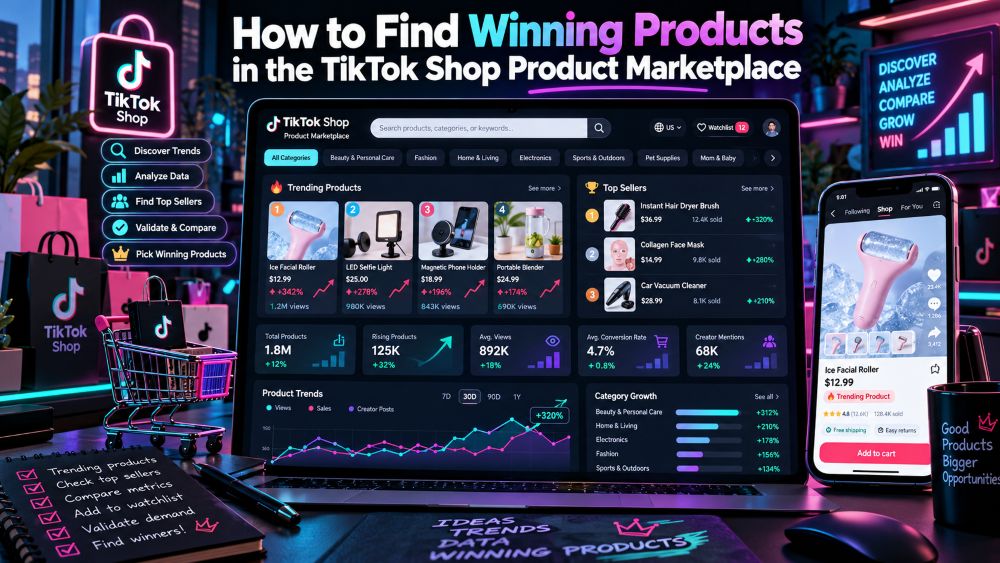
The TikTok Shop Product Marketplace makes it easy to find something to promote.
That does not mean every product in it is worth your time.
You can sort by commission, browse trending items, check new arrivals, and add products to your Showcase in a few taps. The harder part is figuring out whether a product fits your audience, can earn after the content work involved, and still has room for another creator.
A high commission rate gets attention. It does not guarantee sales.
The better question is: can you make content around this product that people will actually watch, trust, and buy from?
What the Product Marketplace Is Really For
Product Marketplace is a creator-side discovery area inside TikTok Shop.
It is where eligible creators can search for products, browse categories, review commission offers, request samples where available, and add products to their Showcase for shoppable videos or LIVE streams.
Think of it as a catalog for affiliate promotion, not a list of guaranteed winners.
Some products are already selling through hundreds of creators. Some are brand new. Some offer a strong commission because the seller wants exposure. Others have a lower commission but a product that is easier to sell because buyers already know what it does.
You are choosing a product to put your name behind. That makes the decision different from simply finding the highest number on the screen.
Getting Into Product Marketplace
Access is usually through Creator Center and the creator tools area in TikTok Shop.
Once inside, you can search by product name, brand, or category. You may also see featured campaigns, rankings, new products, sample opportunities, and curated product suggestions.
Some products can be added directly. Others may have brand terms, sample requirements, or eligibility rules attached.
Do not assume a product is available just because you saw another creator promoting it. Brand requirements can vary, and some sellers may limit access to certain creators or campaign participants.
When you find an item that looks promising, open the product page before adding it. The listing tells you more than the marketplace card ever can.
Start With Products You Can Actually Explain
A product might be popular and still be wrong for your account.
If your content is about home organization, a random beauty gadget with a high commission rate may not make sense. Your audience can usually tell when a product is being pushed only because the payout looks good.
The best starting point is a product you can show naturally.
Can you demonstrate it? Can you explain why you use it? Does it solve a problem your audience already talks about? Can you make more than one video without repeating the exact same pitch?
Products that work well on TikTok often have a visible use case. They save time, make something easier, create a clear before-and-after, or fit into a familiar routine.
That does not mean every product needs a dramatic transformation. A simple item can sell if the video makes the value clear quickly.
Use Filters, but Do Not Let Filters Make the Decision
Filters are useful for narrowing a big marketplace.
You can sort by category, price, and commission. That helps you remove products that are obviously outside your niche or outside what your audience is likely to spend.
Price matters because it affects buyer behavior.
A low-priced product may be easy to add to cart, but the commission per sale can be small. A more expensive product may pay better, but buyers may need stronger proof before they order. Products in the middle often depend on how clearly the video answers, “Why is this worth it?”
Commission is worth filtering for, but do not use it as the main ranking signal.
A 20% commission on a product that rarely sells is still less valuable than a 10% commission on something that consistently converts. You also need to think about returns. If the product looks great in a video but disappoints after delivery, the short-term earnings may not be worth the damage to audience trust.
Check the Product Like a Buyer Would
Before you promote a product, look at the actual listing.
Read the title. Check the product photos. Look through reviews. Notice whether the description answers the questions buyers will ask in the comments.
What is included? How large is it? How long does delivery take? Are there different versions? Is the listing clear about materials, compatibility, size, or limitations?
A product can look strong inside Product Marketplace and still have a weak product page.
That becomes your problem once you make the video. Your audience will ask about delivery, sizing, quality, return rules, and whether the product works as shown. If the listing is confusing, you may drive clicks without driving many completed orders.
Read the negative reviews, too. A few complaints are normal. Repeated complaints about missing parts, poor quality, inaccurate photos, or slow shipping are different.
Those are not small details. They can turn a promising affiliate product into a stream of frustrated comments.
Sales and GMV Need Some Context
Sales and GMV can help you see whether buyers are spending money on a product.
But a large number is only the beginning of the story.
A product may have strong GMV because one large creator posted a viral video. It may be moving because a seller is running a deep discount. It may be doing well because the category is seasonal. None of those things are automatically bad. They just mean you should look a little closer before assuming the demand is stable.
Check whether the product has been active over more than a few days. Look for ongoing creator posts, new content angles, and more than one shop or seller driving the product forward.
Use TikTok Shop data to compare product movement, related shops, creator activity, and recent selling content within the same market.
For affiliate creators, the most useful signal is not simply “this product sold.” It is whether the product still gives a new creator a reasonable chance to earn.
Creator Competition Can Be Healthy or Crowded
A product with many creators is not always too competitive.
Sometimes it means the product is easy to explain and works for different audiences. One creator may show it as a gift. Another may use it in a tutorial. Someone else may promote it during LIVE. That is usually healthier than a product that only works through one viral format.
The risk comes when every creator is making the same video.
If every post uses the same hook, the same before-and-after, and the same script, viewers may already be tired of it. You will need a genuinely different angle to stand out.
Look at recent content before adding a product to your Showcase.
Ask yourself whether you can make a better video, not just another version of the same video. Maybe you can show a different use case, compare it with a common alternative, explain a problem it solves, or show what the product is really like after a week of use.
If you cannot find a fresh angle, the product may already be too crowded for your audience.
Commission Is Not the Same as Earnings
A product offering 25% commission can look much better than one offering 10%.
But the payout only matters after a sale happens.
A $15 product at 25% commission pays $3.75 per completed order. A $45 product at 10% pays $4.50. The second product may be harder to sell, but it could still produce more income with fewer orders.
There is also the issue of refunds, cancellations, and the work involved in creating good content.
Some products require a detailed demo, careful filming, and repeated follow-up videos. Others can be shown naturally in a routine you already post. That difference affects the real value of the commission.
Before you promote an item, think about these three things together:
What is the likely commission per completed order?
How hard will it be to explain honestly?
Would you still feel comfortable recommending it after reading the reviews?
If the answer to the last question is no, it is probably not worth chasing the payout.
Look for Demand That Does Not Depend on One Video
The best affiliate products are not always the ones with the biggest daily ranking.
A product with steady orders, several active creators, a reasonable price, and room for different content angles can be more useful than a product that explodes for two days and disappears.
Look for products where new videos continue to appear without every sale being tied to one creator. Watch whether the product can work in short-form content and LIVE. See whether people in the comments are asking practical buying questions instead of only reacting to the video.
Questions such as “Does this work with an iPhone 15?” or “Is it available in a larger size?” usually show more purchase intent than a comment section full of “I need this.”
You also want enough demand to support your effort without joining a category that is completely saturated.
That balance takes a little research. It is better than filling your Showcase with products you never end up promoting.
Red Flags Worth Taking Seriously
Some products deserve a pass, even if the commission looks generous.
Be careful with products that have vague descriptions, inconsistent reviews, unclear shipping information, or claims that sound too good to be true. The same goes for listings where the photos, videos, and customer reviews seem to describe different products.
Another warning sign is a product that only sells during heavy promotions. If the offer disappears and demand falls off immediately, the commission may not be as dependable as it first looks.
Watch for content fatigue as well. If hundreds of creators are using identical scripts, you may be arriving late.
The most practical red flag is simple: you cannot imagine recommending the product to someone you know. That is usually enough reason to move on.
Give a Product a Week Before You Commit
You do not need to turn every product into a long research project.
After adding a few possible products to your list, give them a short validation period. Watch recent creator content. Read reviews. Check whether the listing changes. See if new videos keep showing up or if the activity was tied to one short burst.
During that week, make a small number of test videos only if the product genuinely fits your content.
Pay attention to the response. Do viewers ask useful questions? Do they click? Do they save the video or return to ask where to buy it? Does the product feel natural in your content, or does it feel like an interruption?
A product that gets a modest response but fits your audience can be worth improving. A product that gets views but creates no buying interest may not be worth forcing.
Use Creator Data When the Decision Gets Bigger
Once you begin working with brands, choosing products for LIVE, or building a larger affiliate strategy, creator performance data becomes more useful.
You may want to compare which accounts are actually selling in your category, what kinds of videos they post, whether their results are consistent, and which product partnerships appear to be active.
TikTok creator analytics can help brands, sellers, and agencies look beyond follower counts when evaluating creator fit and sales potential.
The goal is not to copy another creator’s product list. It is to understand what works in your niche and where you can create something more useful for your own audience.
Frequently Asked Questions
Who can use TikTok Shop Product Marketplace?
Product Marketplace is designed for eligible TikTok Shop creators. Access, product availability, samples, commission offers, and brand requirements can vary by market and account status.
Can I promote a product without ordering it first?
In some cases, yes. Creators can add eligible products to their Showcase without purchasing them. But promoting a product you have not handled can make it harder to create credible content. Some products also offer sample options, subject to the seller’s terms.
Should I choose the highest-commission product?
Usually not. A strong affiliate product needs a realistic chance of converting, a listing buyers can trust, and a content angle that fits your audience. Commission matters after those things are in place.