How to Find Winning Products on TikTok Shop Using Real Sales Data

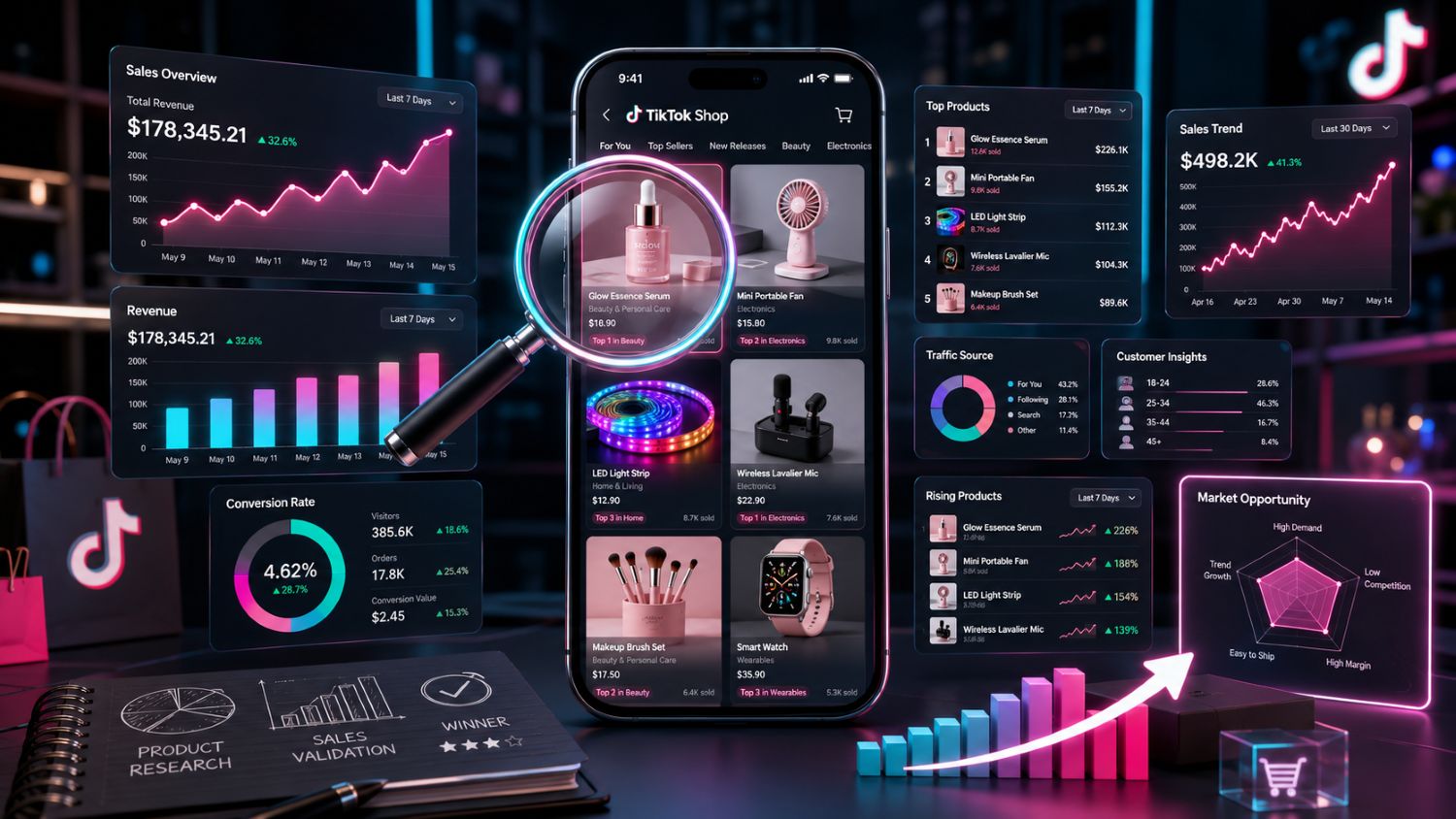
Finding a winning product on TikTok Shop is not about guessing what looks popular.
It is about checking what is already selling, who is selling it, how fast it is moving, which creators are pushing it, and whether the demand is still growing.
That is where real sales data matters.
A product with views but no sales is just content.
A product with steady GMV, creator activity, repeat videos, and live-room traction is much closer to a real opportunity.
If you are a seller, brand, agency, or product researcher, this guide will show you how to find better TikTok Shop products using real sales data from EchoTik.
The Short Answer
To find winning products on TikTok Shop, start with products that already show sales momentum.
Then check five things:
Product GMV, shop performance, creator activity, video traction, and live-room sales behavior.
If only one signal looks strong, be careful.
If several signals move together, the product is worth testing.
Why Real Sales Data Beats Guessing
A lot of sellers still choose products by watching viral videos.
That is risky.
A video can go viral for entertainment reasons. It does not always mean people are buying.
Real sales data gives you a cleaner view.
You can see which products are actually creating GMV, which stores are ranking, and which categories are moving across markets.
For example, in EchoTik weekly ranking data from July 6-12, 2026, beauty, baby care, health, and home products all showed strong movement across different countries.
That tells sellers something useful.
Demand is not only coming from one market or one product type.
It is spreading across categories with clear use cases.
Start With Shops That Are Already Selling
Before looking at single products, look at the shops.
A strong shop tells you what kind of products are already working in that market.
Here is a quick view from EchoTik weekly ranking data:
Market | Leading Shop | Category | Estimated Weekly GMV |
|---|---|---|---|
United States | medicube US Store | Beauty & Personal Care | $17.3M-$21.1M |
Indonesia | Zwitsal | Baby & Maternity | $32.2M-$39.4M |
Malaysia | ANAS | Beauty & Personal Care | $35.5M-$43.3M |
Thailand | EVE’S CORPORATION | Beauty & Personal Care | $4.4M-$5.4M |
United Kingdom | plmakeupacademy | Beauty & Personal Care | $3.3M-$4M |
Mexico | LIFTOR | Beauty & Personal Care | $489.6K-$598.4K |
Source: EchoTik weekly ranking data, July 6-12, 2026.
The pattern is clear.
Beauty is still strong, but not every beauty product is worth selling.
The winning products usually have a simple promise.
Better skin. Easier routine. Clearer result. Stronger before-and-after story.
That is what sellers should study.
Look for Products With Sales Momentum
After you find strong shops, go deeper into their product rankings.
Do not only look at the top product.
Look at the category pattern.
If one shop has several products ranking, the shop may have a working supply chain, creator network, or live-selling system.
That matters.
Here are a few product signals from EchoTik data:
Market | Product Type | Estimated Weekly GMV |
|---|---|---|
United States | medicube PDRN eye mask | $6.5M-$8M |
Indonesia | Zwitsal baby bath gift set | $27.6M-$33.7M |
Malaysia | ANAS lip set | $35.4M-$43.2M |
United Kingdom | P.Louise makeup set | $2.2M-$2.6M |
Mexico | Karcher pressure washer | $367K-$448.5K |
Source: EchoTik weekly ranking data, July 6-12, 2026.
This is useful because the products are not all the same.
Some are beauty. Some are baby care. Some are home tools.
The common point is simple.
They solve a clear problem and are easy to show in video.
Ask One Question First: Can This Product Be Demonstrated?
TikTok Shop rewards products that can be explained quickly.
If the product needs a long sales page, it may struggle.
Good TikTok Shop products usually have one of these hooks:
They show a visible result.
They solve an annoying daily problem.
They create a clear before-and-after.
They are easy to bundle.
They fit creator storytelling.
That is why beauty, baby care, home tools, cleaning products, and small gadgets often work well.
They are easy to demonstrate.
They do not need a complicated pitch.
Check If the Category Is Too Crowded
A high GMV product can still be a bad choice.
Why?
Because it may already be too crowded.
If every seller is copying the same product, your margin gets squeezed fast.
This is where you need competitor data.
Use EchoTik E-commerce Analysis to check:
How many shops are selling similar products.
Whether sales are concentrated in one brand or spread across many sellers.
Whether new sellers are entering the category.
Whether prices are dropping.
Whether the same creators are promoting many competing products.
If the product is growing but not fully crowded, that is better.
If the product is already everywhere, you need a sharper angle.
Do Not Ignore Smaller Markets
Many sellers only watch the U.S. market.
That is a mistake.
The U.S. is competitive. It is also expensive to test.
Markets like Indonesia, Malaysia, Thailand, the U.K., and Mexico can reveal product trends earlier or show different buying behavior.
For example, Week 28 EchoTik data showed:
Indonesia had strong baby and family care demand.
Malaysia was highly active in beauty and personal care.
Thailand showed movement in beauty, health, food, and daily-use products.
Mexico had smaller GMV ranges, but health, sports, and beauty products showed clear testing opportunities.
That gives sellers more angles.
You do not have to copy the biggest product.
You can find a category pattern, then adapt it to your target market.
Check Creator Activity Before You Test
A product needs creators.
If creators cannot explain it, the product is harder to scale.
Before testing, look at creator activity around the product.
Ask these questions:
Are multiple creators promoting this product?
Are the videos getting comments from real buyers?
Do viewers ask where to buy it?
Do creators show the product in use?
Do the videos look natural or forced?
If only one creator drove sales, be careful.
That may be a creator-specific win, not a product win.
With EchoTik Data API, teams can pull creator, video, product, shop, and market trend fields into their own research workflow.
That helps agencies and brands compare products faster.
Watch Live-Room Performance
Some products look good in short videos but fail in live rooms.
That is a warning sign.
Live selling tests whether the product can handle real-time objections.
People ask questions. Hosts explain. Products get compared. Discounts are tested.
Use EchoTik Live Monitor to check:
Live-room GMV.
Peak viewers.
Product list changes.
Sales rhythm.
Which products were pushed hardest.
Which products actually converted.
If a product sells in both short video and live rooms, it is stronger.
That means the product is not just getting attention.
It is creating buying action.
Use Hashtags as Demand Clues, Not Final Proof
Hashtags are useful, but they are not enough.
For example, EchoTik Week 28 hashtag data showed large traffic around tags like fyp, ad, dealsforyoudays, tiktokshop, tiktokmademebuyit, and summersale.
That tells us users are still engaging with shopping and deal-based content.
But hashtags do not prove product demand by themselves.
Use them to understand content context.
Then check sales data.
A hashtag can tell you where attention is.
GMV tells you where money is.
A Simple Workflow for Finding Winning Products
Here is the workflow I would use.
Start with the market.
Pick one country first. Do not research every market at the same time.
Then check top shops.
Look for stores that are growing in your category.
Next, check their best-selling products.
Do not copy blindly. Look for the reason they sell.
Then check creators.
Find out whether sales came from one big creator or many smaller creators.
Then check live rooms.
If the product works in live selling, it may scale better.
Finally, compare competitors.
If the category has demand but low saturation, it is worth testing.
What a Good Product Test Looks Like
A good test does not need to be huge.
Start small.
Pick one product angle.
Find creators who match that buyer.
Prepare three video hooks.
Test one live-room script if possible.
Track the data daily.
You are looking for early signals.
Comments. Saves. Clicks. Product views. Add-to-cart behavior. Sales. Creator response.
If the first test gets attention but no sales, fix the offer.
If it gets sales but low views, fix the content.
If it gets both, then you can scale.
Common Mistakes Sellers Make
The first mistake is copying the top product too late.
By the time everyone sees it, the margin may already be gone.
The second mistake is choosing only by views.
Views are not sales.
The third mistake is ignoring creator fit.
A good product with the wrong creator will look weak.
The fourth mistake is not checking live data.
Live rooms show real buyer objections faster than normal videos.
The fifth mistake is using only one market as proof.
A product may be hot in one country but weak in another.
How EchoTik Helps Sellers Find Better Products
EchoTik helps sellers move from guessing to data-backed decisions.
You can use it to find product rankings, shop rankings, creator performance, live-room data, category movement, and viral videos.
That is useful because winning products rarely come from one signal.
They come from patterns.
A product is more interesting when:
Top shops are selling it.
Creators are making content around it.
Videos are getting real engagement.
Live rooms are converting.
The category is still growing.
That is the kind of product worth testing.
Final Takeaway
A winning TikTok Shop product is not just a viral item.
It is a product with sales proof, content proof, creator proof, and market proof.
Use real sales data first.
Then use content signals to understand why buyers care.
That is how you avoid random testing.
And that is how you find products before the market gets too crowded.