How to Track TikTok Shop Products: Build a Weekly Watchlist

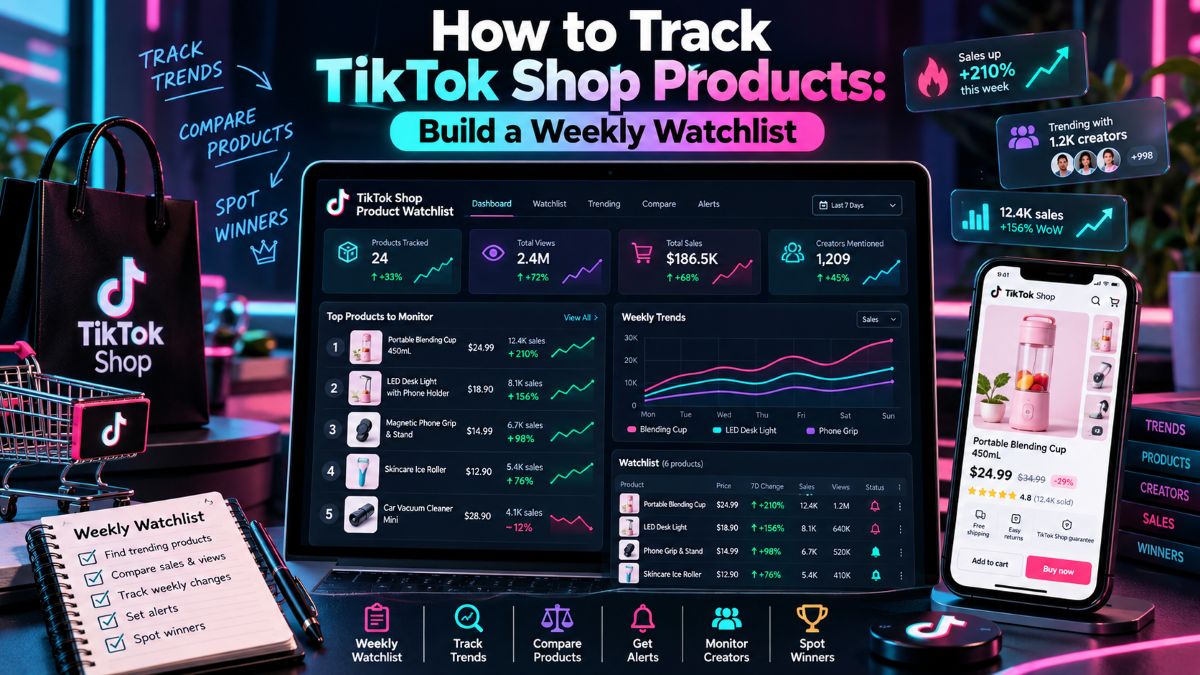
A product can look like a clear winner on TikTok Shop and still be a bad inventory decision.
Maybe it had one big creator video. Maybe a seller ran a deep discount for a few days. Maybe it is selling well, but the price has already started sliding because every shop in the category is carrying the same thing.
That is why it helps to watch products for a while instead of reacting to one sales number.
Keep a list of 10 to 20 products in one country and one category. Check them once a week. You are not building a giant report. You are trying to answer a few simple questions: Is demand still there? Is competition getting worse? Is there enough room left to test this product?
Start Narrow, or the Numbers Get Useless
Do not put U.S., UK, and Southeast Asian products in the same watchlist.
The same product can have a different price point, creator audience, shipping expectation, and buying pattern in every market. A phone accessory that moves quickly in Indonesia may not work at all in the UK. Comparing the two will not tell you much.
Pick one country first. Then choose a category where the products are close enough to compete for the same buyer.
For example, you might track U.S. beauty products, UK kitchen tools, or Malaysian phone accessories. Keep the first list manageable. Ten good products are more useful than 100 names you never check again.
Start with current TikTok Shop data from the same market and category. The date range matters, too. If one product is measured over seven days and another over 30, the comparison is already off.
What Is Worth Watching Each Week
Sales and estimated GMV are a starting point. They show whether people are buying and how large the product opportunity may be.
But they do not tell the whole story.
Look at the direction of sales over the last seven days and the last 30 days. Check whether the price is holding. See whether new creators are joining in or whether the product is still living off an older viral post.
Reviews matter more than people think. A product can look great from the outside, then turn into a headache once you notice the same complaints about size, quality, missing parts, or delivery.
You should also keep an eye on new videos and LIVE activity. Some products sell because they are easy to understand in a short video. Others need a strong demonstration, which means they may depend heavily on creators or LIVE hosts.
The numbers do not need to be perfect. You are looking for change over time.
The Seven-Day Number Can Fool You
A sharp seven-day jump gets attention. It should. But it does not automatically mean a product is ready to source.
Sometimes a product is growing because one creator found the right angle. That may turn into a broader trend. It may also disappear when the next video takes over the feed.
Looking at the past month gives you a little more context.
What you see | What it usually suggests |
|---|---|
Sales are up over both seven and 30 days | Demand may be building in a more stable way |
Seven-day sales are up, but 30-day sales are flat | A recent video, campaign, or creator may be driving the lift |
Seven-day sales are down while the 30-day view is still positive | The product may be cooling after a strong run |
Both periods are falling | It may be time to stop treating it as a priority |
This is not a prediction model. It is a way to avoid getting overly excited by a single good week.
Pay Attention to Creator Momentum
Creator totals can look impressive and still mean very little.
A product may have hundreds of creators connected to it, but only a small group may be posting now. Another product may have fewer creators overall but gain new people every week. That is usually the more interesting signal.
Watch whether creator growth and sales growth happen together.
If several creators are finding different ways to sell the same item, that is a healthy sign. It means the product is not dependent on one personality or one video format.
If every sale comes from one major creator, be careful. That creator may be great, but the product is more exposed than it looks. Once the content slows down, the sales could slow down with it.
Watch the videos, too. A product may get lots of views because the content is funny or dramatic. That does not always mean the audience wants to buy it.
Price Tells You When a Category Is Getting Crowded
A product can have good sales and still be a poor opportunity.
If the price drops every week, sellers may already be fighting for the same customer. More shops enter, coupons get heavier, bundles get bigger, and creator commissions climb.
That is not always a reason to walk away. Some products have enough demand to support competition. But you need to understand what kind of market you are entering.
When you update your watchlist, write down the current price and note any major promotion. Then look at the same product next week.
A stable price with growing sales is usually more encouraging than a product that needs constant discounts to keep moving.
Also look at what competitors are doing around the product. They may not be cheaper, but they may have clearer photos, faster shipping, better review volume, or a bundle that feels like a better deal.
Some Products Need LIVE to Sell
LIVE activity is useful to watch, but it needs context.
Products that need a demo often perform well through LIVE. Think of kitchen tools, skincare devices, apparel, or anything buyers want to see used before they pay for it.
That can be a good sign if you have creators who can host or demonstrate the product well.
It can also be a warning. If the product only sells during aggressive LIVE promotions, it may not perform as well through regular shoppable videos or search traffic.
There is nothing wrong with a LIVE-driven product. Just be honest about what it needs. Do not assume a product with strong LIVE sales will automatically work with a few short videos.
Use a Method You Will Actually Stick With
For a short product list, a spreadsheet is enough.
It is not fancy, but it forces you to look at the same products on the same day each week. That consistency matters more than having a complicated dashboard on day one.
For your own shop, Seller Center is where you confirm real orders, refunds, stock, and fulfillment results. It will not show you the full market, but it is the data you should trust for your own business.
When you are tracking products outside your store, an analytics dashboard can make the job quicker. It is especially helpful when you need to compare product movement, creator activity, shops, pricing, and content without opening dozens of listings manually.
If you are comparing platforms for product research, exports, and longer-term reporting, see our guide to the best TikTok analytics tools.
A Watchlist You Can Update in Ten Minutes
Keep the sheet plain. The decision column is the important part.
Product | Country | 7-day movement | 30-day movement | Price | Creator activity | Notes | Next move |
|---|---|---|---|---|---|---|---|
Product A | US | Up | Up | Stable | Growing | More creators posting different angles | Validate |
Product B | US | Up | Flat | Dropping | Flat | One creator driving most sales | Watch |
Product C | US | Down | Down | Dropping | Slowing | Reviews mention quality issues | Remove |
“Validate” means it is time to look at sourcing, shipping, margins, reviews, and possible content angles.
“Watch” means there is something there, but the product has not earned a bigger commitment yet.
“Remove” does not mean the product can never work. It just means you are done spending attention on it for now.
Know When a Product Is No Longer Worth Following
It is easy to stay interested in a product because it looked good when you first found it.
Try to be more practical. Move a product down the list when the same problems keep showing up: sales are declining for more than a week, prices are falling quickly, creator activity has dried up, or reviews point to product issues that will be hard to solve.
Another red flag is when the market gets crowded but overall demand does not grow with it. That usually means more sellers are splitting the same pool of buyers.
You do not need to make a dramatic decision every time a product dips. Just stop treating weak products as priorities while you have stronger options to watch.
Let the List Do the Work Over Time
Product research gets better when you see the same category week after week.
After a month, you may notice that certain products repeatedly attract creators, keep their price, and continue adding sales. You may also see that some “winning” items were really just short spikes tied to one video.
That kind of pattern is hard to spot in a single search.
A simple watchlist will not remove every risk from product selection. It will help you spend less time chasing noise and more time looking at products that still have momentum.