How to Analyze TikTok Competitors

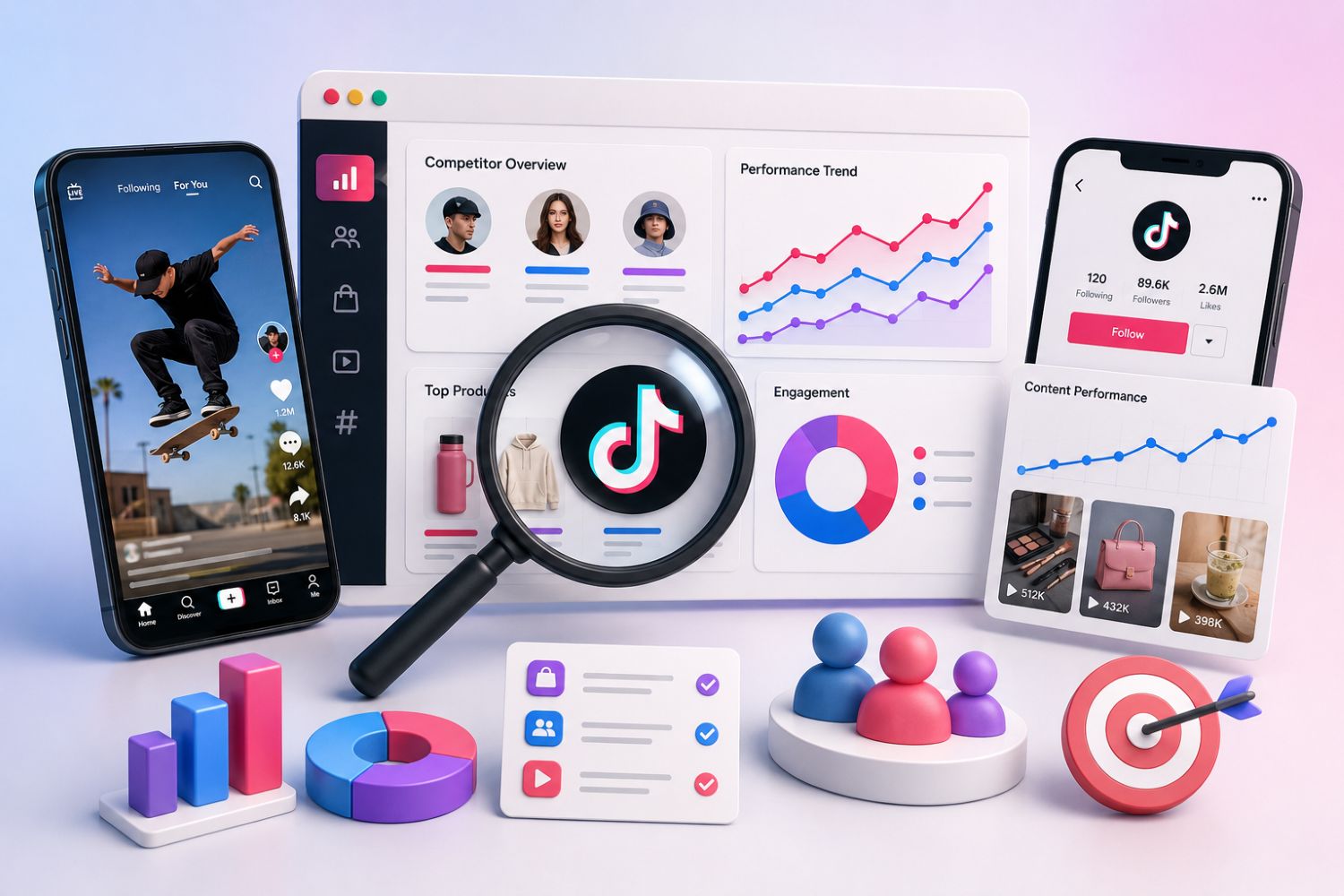
Analyzing TikTok competitors is not about copying their videos.
It is about finding the patterns behind their growth. Which topics get attention? Which hooks hold viewers? Which creators, products or formats keep appearing?
If you need software for account, competitor and ecommerce research, compare the best TikTok analytics tools.
A good competitor review gives you ideas you can test. It also helps you avoid wasting time on formats that are already crowded or not working in your category.
What Is TikTok Competitor Analysis?
TikTok competitor analysis means tracking similar accounts to understand their content and growth strategy.
For a creator or brand account, you may review video views, engagement, posting frequency and audience comments.
For a TikTok Shop seller, you can also track products, creator partnerships, shoppable videos and shop performance.
The goal is to answer practical questions:
What content does the audience respond to?
What makes certain videos work?
Which topics are gaining momentum?
Which creators are actively promoting similar products?
What can you test next week?
You do not need to track every competitor. You need a few useful benchmarks.
Choose the Competitors You Want to Track
Start with five to ten accounts.
Choose a mix of direct competitors and strong accounts in your category.
Include:
Brands selling similar products
Accounts targeting the same audience
Fast-growing smaller creators
Established category leaders
TikTok Shop sellers with active creator campaigns
Do not choose accounts only because they have many followers.
A smaller account with strong engagement may offer better lessons than a large account posting generic content.
For product-led research, use this guide to TikTok Shop competitor analysis to compare products, sales signals and creators.
Compare Account Growth and Posting Frequency
Start with the account-level picture.
Track:
Follower count
Recent follower growth
Number of videos posted
Posting days
Average video views
Engagement on recent videos
Posting frequency matters, but more content does not always mean better results.
A competitor posting twice a week may outperform an account that posts three times a day. Look for the frequency that produces consistent results.
Review this over several weeks. One active week does not always reflect the account’s normal strategy.
Analyze Top-Performing Videos
Open the competitor’s top recent videos.
Do not stop at the view count. Look at what happens in the video.
Check:
The first sentence or visual
Video length
Topic
Caption
Product shown
Creator or speaker
Comments
Shares
Whether the video uses a trend
Ask one simple question: why did someone keep watching?
The answer may be a strong result, a relatable problem, a surprising statement or a useful demonstration.
Then compare that video with their weaker posts. The difference often shows you what the audience cares about.
Compare Hooks, Formats and Content Topics
Most successful TikTok accounts repeat a few content formats.
They may change the product or story, but the structure stays familiar.
Common formats include:
Before-and-after results
Product demonstrations
Customer reactions
“You need this if…” hooks
Tutorials
Founder or behind-the-scenes content
Comparisons
Creator reviews
Trend-based videos
Do not copy the exact script.
Instead, note the structure. For example, a skincare brand may perform well because it starts every video with a specific skin problem, shows proof quickly and keeps the explanation short.
You can use that structure for your own audience without copying the content.
Review Comments and Audience Intent
Comments are one of the best sources of competitor research.
They show what viewers actually want to know.
Look for repeated questions:
“Where can I buy this?”
“Does it work for sensitive skin?”
“What size should I get?”
“Is this available in the UK?”
“Can you show how it works?”
“How much is it?”
These comments reveal buying intent and objections.
If people repeatedly ask a competitor for the same missing detail, make sure your own videos answer it early.
Also pay attention to negative comments. Complaints about price, delivery, quality or unclear instructions can reveal an opportunity.
Analyze Hashtags and Trends
Hashtags help you understand how competitors position their content.
Look at the hashtags used in strong videos, but do not assume hashtags created the success.
Separate them into three groups:
Broad discovery tags, such as
#fypCategory tags, such as
#skincaretipsProduct or purchase-intent tags, such as
#tiktokshopfinds
Category and product tags are usually more useful for research.
They help you find similar content, competing products and creators already active in the same space.
Trends can create short-term reach. But a good product video should still make sense without a trending sound or meme.
Compare Creators and Product Promotions
If a competitor sells through TikTok Shop, creator activity can explain a large part of its growth.
Track:
Which creators promote the brand
What products they feature
How often they post
Their video formats
Recent views and engagement
Whether they repeat the partnership
Whether they go LIVE
A repeat creator partnership is often a stronger signal than one sponsored post.
It may mean the creator is getting good results, the audience responds to the product or the brand is investing in a relationship that works.
For broader shop, creator and product research, explore EchoTik.
Build a Weekly Competitor Tracking Workflow
Competitor research works best when it becomes a simple routine.
You do not need to spend hours checking every account every day.
Use this weekly workflow:
Review five competitors in the same market.
Record new videos and top-performing posts.
Note any new products or offers.
Identify active creators and repeat partnerships.
Check hashtags and content topics.
Read comments on the strongest videos.
Write down three ideas worth testing.
Your final notes should be useful.
For example:
Test a stronger first-line hook.
Make a product demonstration video.
Answer a common customer question.
Work with smaller niche creators.
Add a bundle instead of lowering the price.
TikTok Competitor Analysis Checklist
Use this checklist before finishing your review:
I chose direct competitors in the same category.
I compared the same date range for each account.
I reviewed recent growth, not only total followers.
I studied both strong and weak videos.
I identified repeated hooks and formats.
I checked audience comments for questions and objections.
I reviewed relevant hashtags.
I identified creators promoting similar products.
I selected a few clear actions to test.
The checklist keeps your research focused.
Without it, competitor analysis can become endless scrolling.
Final Takeaway
The best TikTok competitor analysis is simple.
Track a small group of relevant accounts. Study their strongest content, audience comments, creator partnerships and product promotions. Then test the useful patterns in your own way.
Do not copy competitors.
Use their data to understand the market faster and make better content decisions.