How to Check TikTok Shop Product Rankings

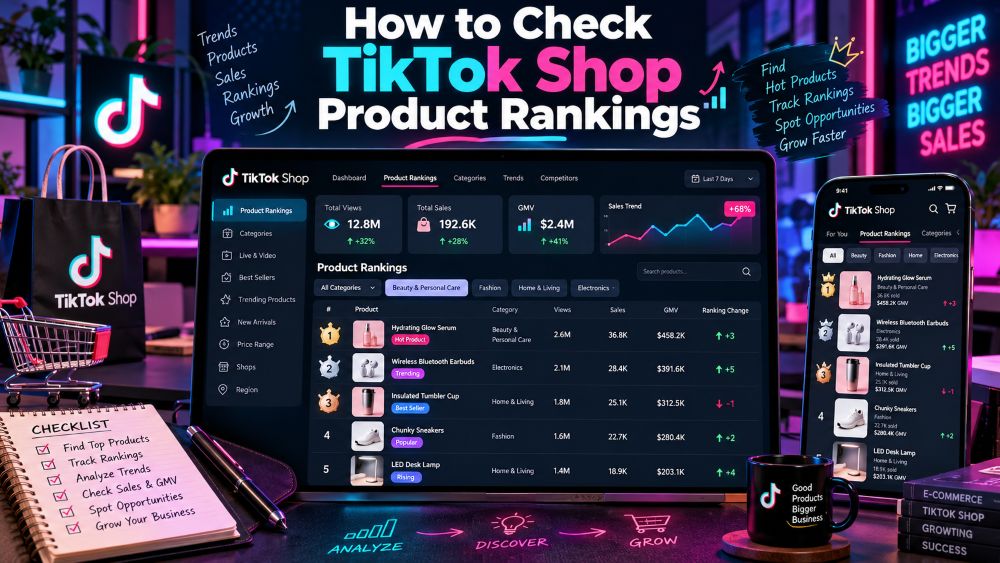
A product ranking is useful when you know what question you are asking.
If you want to see what is selling in a category right now, a daily ranking can help. If you want to know whether a product is still gaining demand, a weekly view is usually more useful. If you are deciding whether to source a product, one ranking position is not enough on its own.
The product may be riding one big LIVE. It may be running a deep discount. It may have a high average selling price and fewer actual orders than the product below it.
That is why checking TikTok Shop product rankings is less about finding the number-one product and more about understanding why it moved there.
What a TikTok Shop Product Ranking Shows
A TikTok Shop product ranking puts products in order for a selected market, category, and time period.
Depending on the dashboard or ranking view, the order may reflect estimated GMV, units sold, sales growth, or another commercial signal. Always check which metric is driving the list before drawing conclusions.
A ranking tells you what is happening inside a defined slice of the market.
It does not tell you whether the product is profitable, easy to source, safe to sell, or likely to stay popular next month. Those are separate questions.
A product can rank highly because it is expensive. Another product may rank lower by GMV but sell far more units. Both can be worth researching, but they present different opportunities.
Where You Can Check Product Rankings
There are three main places to look, and each one answers a different question.
TikTok Shop’s public shopping experience can show products, promotions, seller listings, and creator content. It is useful for seeing how the offer looks to buyers. It does not give you a full market-level ranking history for every competing product.
Seller Center gives sellers first-party data for their own store. You can review your own products, orders, traffic, conversion, affiliate activity, and refunds. It is the most reliable place to understand what happened inside your account.
For category-wide ranking research, market analytics platforms are more useful. They can help you compare products, shops, creators, videos, LIVE activity, estimated sales movement, and ranking changes across the wider market.
The source matters because competitor sales figures and GMV estimates are not the same as private Seller Center records. Use them to compare market direction, not as audited revenue.
How to Check TikTok Shop Product Rankings Step by Step
Start by selecting the country where you plan to sell.
Do not compare U.S. products with UK products and assume the ranking means the same thing. Price points, shipping expectations, creator behavior, and buyer demand can be very different.
Next, choose a category. “All products” is usually too broad to make a useful decision. A beauty tool, a kitchen appliance, and a fashion accessory may all rank well for completely different reasons.
Then choose a date range.
A daily ranking is useful for catching new movement. A weekly ranking gives you a little more confidence that a product is not just having one lucky day. A monthly ranking is better for seeing established demand, but it can hide a recent slowdown.
Once you have the list, open the product details instead of stopping at rank position. Check the selling price, estimated sales, GMV, shops carrying the item, related creators, shoppable videos, and LIVE activity.
That is where the ranking starts to become useful.
Filter by Country and Category Before Comparing Anything
A ranking without filters can create bad assumptions.
A product may be a bestseller in one country because it fits local pricing, shipping, climate, culture, or creator trends. That does not mean it belongs in every market.
Keep the comparison clean:
Use one country at a time.
Stay within one category or close product type.
Compare the same date range.
Check similar price bands.
Make sure bundles and single items are not treated as identical offers.
A $15 single-item beauty tool should not be compared directly with a $40 three-piece set. The GMV may look higher for the set, but the buyer behavior, margin, and content angle could be completely different.
Narrow filters make rankings less exciting at first. They also make them much more useful.
Daily, Weekly, and Monthly Rankings Answer Different Questions
There is no single best ranking period.
Daily TikTok Shop product rankings are good for spotting sudden changes. A product that jumps quickly may have received a boost from a creator video, a LIVE session, a promotion, or a seasonal event.
That makes it worth watching. It does not make it a safe inventory decision.
Weekly rankings are often the most practical for product research. They give you enough time to see whether sales and creator activity continued after the first spike.
Monthly rankings are useful when you want to understand the larger category. They can show which products have stayed active over time. The downside is that a product may still rank well for the month even if it started falling last week.
Use the period that matches the decision you need to make.
If you are looking for a product to test next week, daily and weekly movement matter. If you are planning a larger category move, look at several weeks or months before committing.
Product Rankings Are Only One Part of the Picture
Product rankings answer one question: what products are moving?
They do not explain who is selling them, who is promoting them, or what content is creating the demand.
Ranking type | What it helps you understand |
|---|---|
Product ranking | Which products are generating commercial activity |
Shop ranking | Which stores are performing strongly in a category |
Creator ranking | Which creators appear to be driving product sales |
Video ranking | Which shoppable content is attracting buyers |
LIVE ranking | Which live sessions are creating commercial momentum |
A product may rank highly because one shop has a strong pricing strategy. Another may be carried by affiliate creators. A third may depend on LIVE demonstrations.
Looking at the related shop, creator, video, and LIVE signals gives the ranking some context.
For example, if one product climbs quickly but only one creator is promoting it, you may be looking at a short burst. If the product is being sold by several shops and new creators are making different types of content, demand may be more broadly supported.
Read Sales, GMV, and Movement Together
GMV is useful, but it can be misleading when viewed alone.
A premium product can generate strong GMV with fewer sales. A low-price item may sell thousands of units and still rank lower by GMV. Neither result tells you much about margin without looking at price, cost, discounts, shipping, returns, and commissions.
Ranking movement is often more useful than rank position.
A product that sits at number 15 for several weeks may be healthier than a product that appears at number two for one day and disappears a few days later.
When a product rises, ask what changed around it:
Did the price fall?
Did a new creator post about it?
Did more videos start appearing?
Was there a large LIVE event?
Did the seller launch a bundle or coupon?
Did similar products lose availability?
The answer may be more valuable than the ranking itself.
How to Spot a Short Spike
One of the easiest mistakes is seeing a product rise quickly and assuming demand will keep going.
A short spike often has a narrow source. One creator posts a viral video. A seller runs a heavy coupon. A LIVE host moves a large volume in a few hours. The product looks unstoppable until the activity ends.
Sustainable movement usually looks less dramatic.
You may see several creators posting the product over time. More than one shop may be selling it. Videos may use different angles instead of copying the same script. The price may hold reasonably steady instead of falling every few days.
Look at the comments, too.
Are people asking practical questions about size, shipping, compatibility, or use? Those comments can suggest real buying interest. A comment section full of “I need this” can be positive, but it does not always turn into orders.
No single sign proves a product is sustainable. You are looking for several signals that point in the same direction.
A High Ranking Can Still Be a Bad Opportunity
A high-ranking product may already be too crowded.
The market could be controlled by a few major shops. Prices may be falling because sellers are competing heavily. The product may have quality complaints, difficult shipping requirements, or high return risk.
Some products are also hard to promote responsibly. They may depend on exaggerated claims, unclear before-and-after content, or product results that are difficult to explain honestly.
Before treating a top-ranked item as a product opportunity, check whether you can source it reliably, price it profitably, explain it clearly, and support it after the sale.
A ranking is a research signal. It is not a purchase order.
A Quick Product Ranking Check Before You Add It to Your List
When you find a product worth saving, run through a short review:
Confirm the country, category, and ranking period.
Check whether the rank is moving over several days or weeks.
Compare estimated sales with GMV and selling price.
Review the shops carrying the product.
Look for creator concentration or broad creator coverage.
Watch a few recent selling videos.
Check whether LIVE activity is involved.
Look at price changes, bundles, and coupons.
Read reviews for repeated quality or delivery complaints.
Decide whether the product is worth watching, testing, or ignoring.
This takes less time than chasing every new product that appears near the top of a ranking.
Where to Go After You Find a Product
If you need a live view of category and product movement, explore current rankings through EchoTik TikTok Shop data.
After you identify a product, sales data helps you determine whether the movement is real or short-lived. Read our guide on how to find TikTok Shop sales data for a closer look at sales signals, GMV, shop activity, and market estimates.
For a broader view of the metrics behind products, shops, creators, videos, and LIVE content, use this guide to understand TikTok Shop data.
Frequently Asked Questions
Where can I check TikTok Shop product rankings?
You can research market-level product rankings through TikTok Shop analytics platforms that cover products, categories, shops, creators, videos, and LIVE activity. Seller Center is best for confirming ranking-related performance inside your own shop.
Can I filter TikTok Shop rankings by country?
Yes. You should select one country before comparing rankings. Products, prices, creator activity, and buyer demand can vary widely across markets.
Is a high-ranking TikTok Shop product always profitable?
No. A high rank may reflect sales or GMV, but it does not include your product cost, platform charges, creator commission, shipping, refunds, advertising, or inventory risk.