TikTok Competitor Analysis for 2026 and Beyond

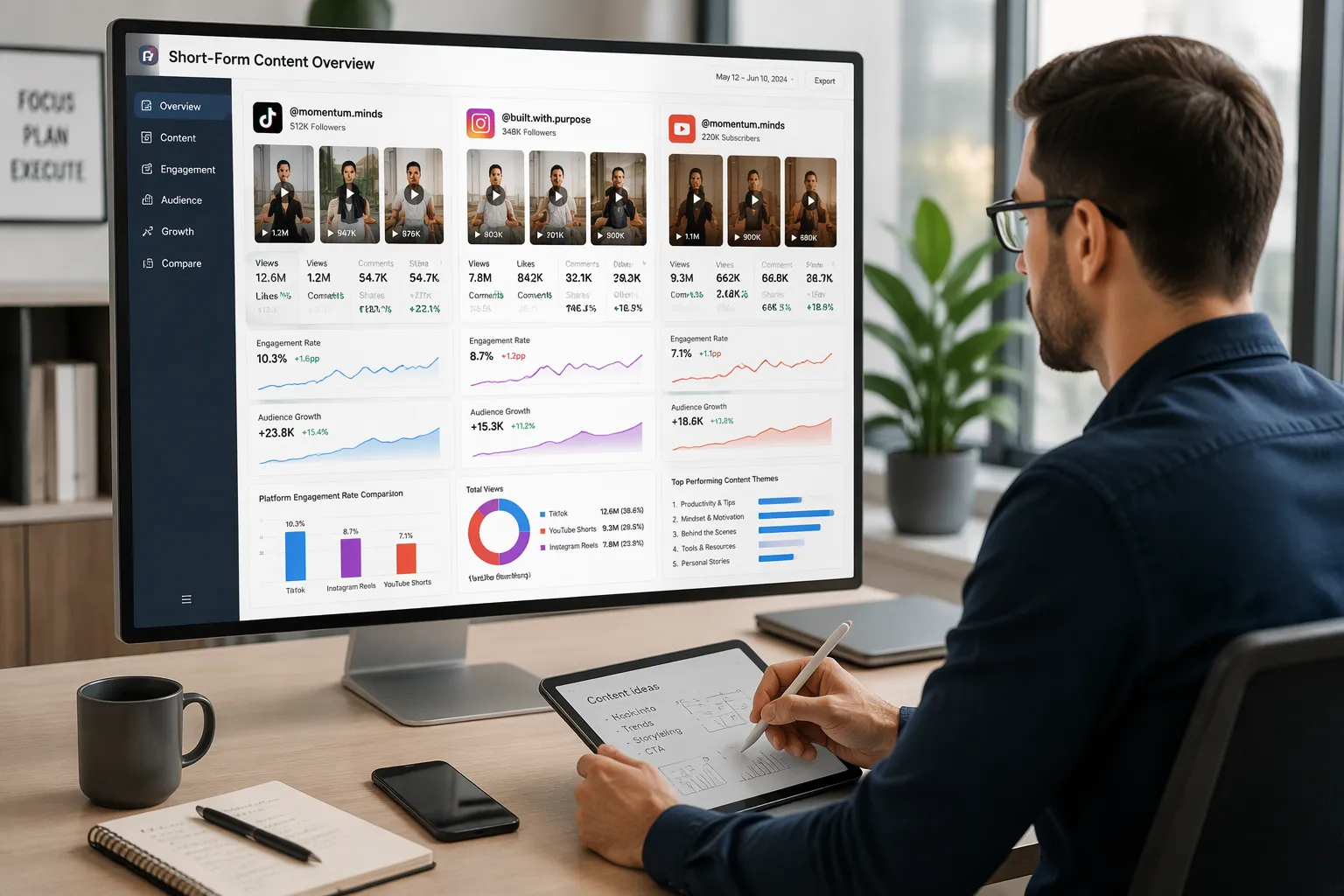
A TikTok competitor analysis answers one question: why is their growth faster than yours? You find competitors, track key metrics, study their content and engagement, and turn findings into strategy. The work follows a clear path: identify, track, analyze content, analyze engagement, use tools, derive insights, and look ahead.
Picture your views staying flat for weeks while a rival's climb. That gap is data, not luck. As TikTok changes toward 2026, algorithm shifts, new formats, and changing audience behavior make this work more valuable than ever. You need a repeatable method, not guesswork. This guide gives you that method, step by step.
Key Takeaways
Find 5–10 competitors by searching TikTok and using tools. Write down why each account is on your list.
Track followers, views, and engagement rate for each competitor. Use a simple spreadsheet to record the numbers.
Study your competitors' content themes, formats, and hooks. Look for gaps you can fill with your own videos.
Read comments and shares to understand what audiences want. Spot trends early by checking your competitor list weekly.
Turn your data into a simple SWOT and benchmark. Set one or two testable goals for the next 30 days.
Identify Your Competitors
Define Competitor Criteria
You can't track everyone on TikTok. Start by clearly defining who counts as a competitor. Three groups matter most. Direct competitors sell a similar product to a similar audience. Indirect competitors solve the same problem in a different way. Aspirational accounts are outside your niche but set the creative bar you want to reach.
Write your criteria down before you search. Note your product category, your target audience, and the size range you care about. A small brand with strong engagement teaches you more than a giant account with millions of passive followers. Keep the list short. Five to ten accounts give you enough signal without drowning you in data. This focus is the foundation of any useful TikTok Competitor Analysis.
Find Competitors With Search and Tools
Begin with TikTok's own search bar. Type your product category, your main keywords, and the phrases your customers use. Watch which accounts repeat across results. Check the hashtags on those videos and follow them to more creators. The platform's suggestions often surface rivals you missed.
Then widen the net with tools. Hashtag research tools show related tags and their volume. Social listening platforms catch brands that talk about your category without using your keywords. Creator marketplaces let you filter by niche and follower count. Cross-check every name against your criteria before you add it. A quick manual review of each profile saves hours later. Build a simple spreadsheet with columns for handle, category, follower count, and why the account made the list. That sheet becomes your tracking base for every step that follows.
Track Key Metrics
Followers, Views, and Engagement Rate
Follower count tells you the size of an audience. It says little about the health of that audience. Track views next, and look at the typical range across recent posts rather than one viral hit. A steady view floor matters more than a single spike.
Engagement rate shows how actively people respond. Calculate it as engagement rate = (likes + comments + shares) / views x 100. Run the math on the last ten to twenty posts and average the results. Rough benchmarks vary by niche and account size, so treat any published range as a loose reference point. Compare your rate against your competitors' rates instead. That side-by-side view is the real signal in a TikTok Competitor Analysis.
Hashtags and Posting Cadence
Log the hashtags each competitor uses and how often they repeat them. Separate broad tags from niche tags. Note which tags appear on their strongest posts. Patterns emerge fast, and they show you where a rival finds reach.
Posting cadence needs patience. Observe it over at least two to four weeks for accuracy. A single week can mislead you. One account might post daily for five days and then go quiet. Count posts per week, note the days and times, and record the format of each post. Build this into your spreadsheet next to the metrics from the previous step. After a month, you will see a reliable rhythm. You can then judge whether their frequency drives their results or simply fills the feed.
Analyze Content Strategy
Content Themes and Formats
Sort every competitor post into themes. Common themes include product demos, behind-the-scenes clips, customer stories, and trend-driven skits. Count how many posts fall into each theme. You will quickly see which themes dominate a rival's feed. Note the formats too. Short talking-head videos, voiceovers, duets, and carousel posts each demand different production effort. Match the theme to the format and record the pairing in your spreadsheet.
Look for gaps as well as strengths. A competitor may lean heavily on one theme and ignore another. That gap is your opening. If a rival never shows the product in real use, you can own that angle. This kind of pattern spotting sits at the heart of a sharp TikTok Competitor Analysis.
Hooks and Posting Frequency
Watch the first few seconds of each top-performing video. Write down the exact opening line or visual. Group these hooks by type: a bold claim, a question, a visual surprise, or a direct callout. Strong hooks repeat across an account. Collect them and test similar openers in your own posts.
Then compare posting frequency against results. You already logged cadence over two to four weeks. Now line that cadence up with view counts and engagement. Ask a simple question: do their best posts cluster around a certain day or time? A rival who posts often may still see uneven results. Frequency alone does not guarantee reach. Use the pattern to set your own schedule, and let the data guide the pace.
Analyze Audience Engagement
Comments, Shares, and Sentiment
Comments and shares reveal more than likes ever will. Likes cost a viewer almost nothing. A comment takes effort, and a share puts a person's reputation behind your post. Read the comment sections on a competitor's top videos. Note the questions people ask and the complaints they raise. Those questions show you what the audience still needs. Those complaints show you where a rival falls short.
Sentiment matters as much as volume. Sort comments into positive, neutral, and negative groups. You do not need software for a first pass. Read a sample of recent posts and tally what you see. Watch for a shift in tone across weeks. A sudden rise in negative comments often signals a misstep you can avoid. Shares deserve their own column in your spreadsheet. Track which posts people forward most, then study what those posts have in common.
Spotting Trends Early
Trends start small. A sound, a format, or a joke appears in a few videos before it floods the feed. Your competitor list acts as an early warning system. Check it weekly and look for formats that appear across several accounts at once. One account trying a new style is noise. Three accounts trying it in the same week is a signal.
Record the date you first see each trend. This habit builds a timeline you can review later. You will learn how fast trends move in your niche and how long they last. Speed matters here. A brand that joins a trend in its first days gains reach that latecomers miss. This ongoing observation is the practical core of a TikTok Competitor Analysis. Set a fixed day each week for this review, and keep the notes short.
Use Analytics Tools
Native TikTok Analytics
Start with the analytics you already have. A TikTok Business account gives you the built-in dashboard, and it shows your own performance in useful detail. You can see follower growth, video views, watch time, and traffic sources for every post. These numbers show how your audience reacts to each format. Use them as your baseline before you study anyone else.
The native dashboard has one clear limit. It reports on your account, not your rivals' accounts. You cannot pull a competitor's watch time or retention curve from it. Think of the native view as a mirror. It tells you how your own content does against the patterns you find elsewhere. That comparison makes every TikTok Competitor Analysis you run sharper.
Third-Party Tools by Fit
Third-party tools fill the gap the native dashboard leaves open. Match the tool category to the job at hand. Analytics platforms track public metrics for competitor accounts, like follower trends and average views. Hashtag research tools map related tags and show which ones bring reach in your niche. Social listening platforms scan conversations across the platform and catch mentions your keyword search misses.
Each category fits a different stage of your workflow. Reach for analytics platforms when you build your tracking spreadsheet. Turn to hashtag research when you plan a posting calendar. Use social listening when you want to spot trends early or judge sentiment at scale. Many tools bundle several of these features, so test a free tier before you pay for a plan. Pick the option that matches your budget and your team's time. No single tool does everything well, and a mix often serves you best.
Turn TikTok Competitor Analysis Into Insights
Run a Quick SWOT and Benchmark
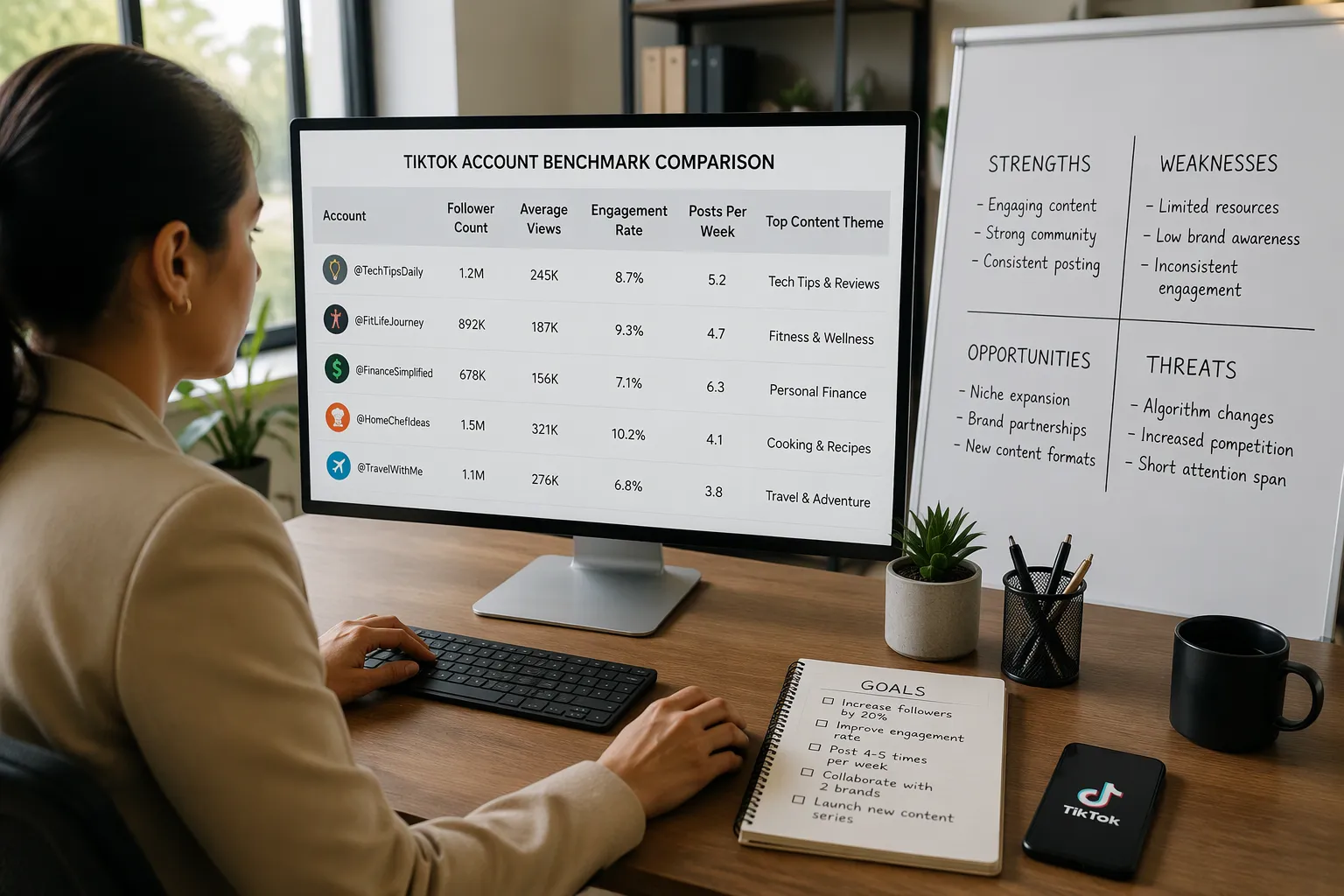
Data sitting in a spreadsheet changes nothing. You need to convert it into a clear picture of where you stand. A lightweight SWOT gives you that picture in under an hour. Grab your tracking sheet and list your strengths first. Strong hooks, a loyal comment section, or a format you own all count. Next, write your weaknesses. A thin posting cadence or a theme you never cover belongs here. Then scan your competitors for opportunities. An untapped theme, a trend they missed, or a question their audience keeps asking points to one. Finally, note threats. A rival with a fast-growing audience or a format they dominate deserves attention.
Now build a side-by-side benchmark. Picture a table with one row per account and one column per metric. The columns hold follower count, average views, engagement rate, posts per week, and top content theme. Fill in your own row next to your competitors' rows. Read across each line and ask where the gap is widest. That widest gap tells you where to focus. A benchmark turns scattered numbers into a ranked list of priorities. This step is where a TikTok Competitor Analysis starts to pay off.
Set Goals and Test
Pick one or two gaps from your benchmark. Turn each gap into a testable goal for the next 30 days. A good goal names a specific action and a measurable result. "Post three product-in-use videos per week and lift average views" works. "Do better on TikTok" does not. Keep the count low. Two focused tests beat five scattered ones.
Write down your starting number before you begin. You already have it in the benchmark. State the result you expect and the date you will check it. Then run the test without changing other variables. If you test a new hook style, keep your posting cadence steady. That discipline lets you trust the result. At day 30, compare the new number against the baseline. Keep what worked and drop what did not. Then set the next round of goals. This loop of benchmark, test, and review keeps your strategy sharp month after month.
Look Ahead to 2026
Emerging Trends and Formats
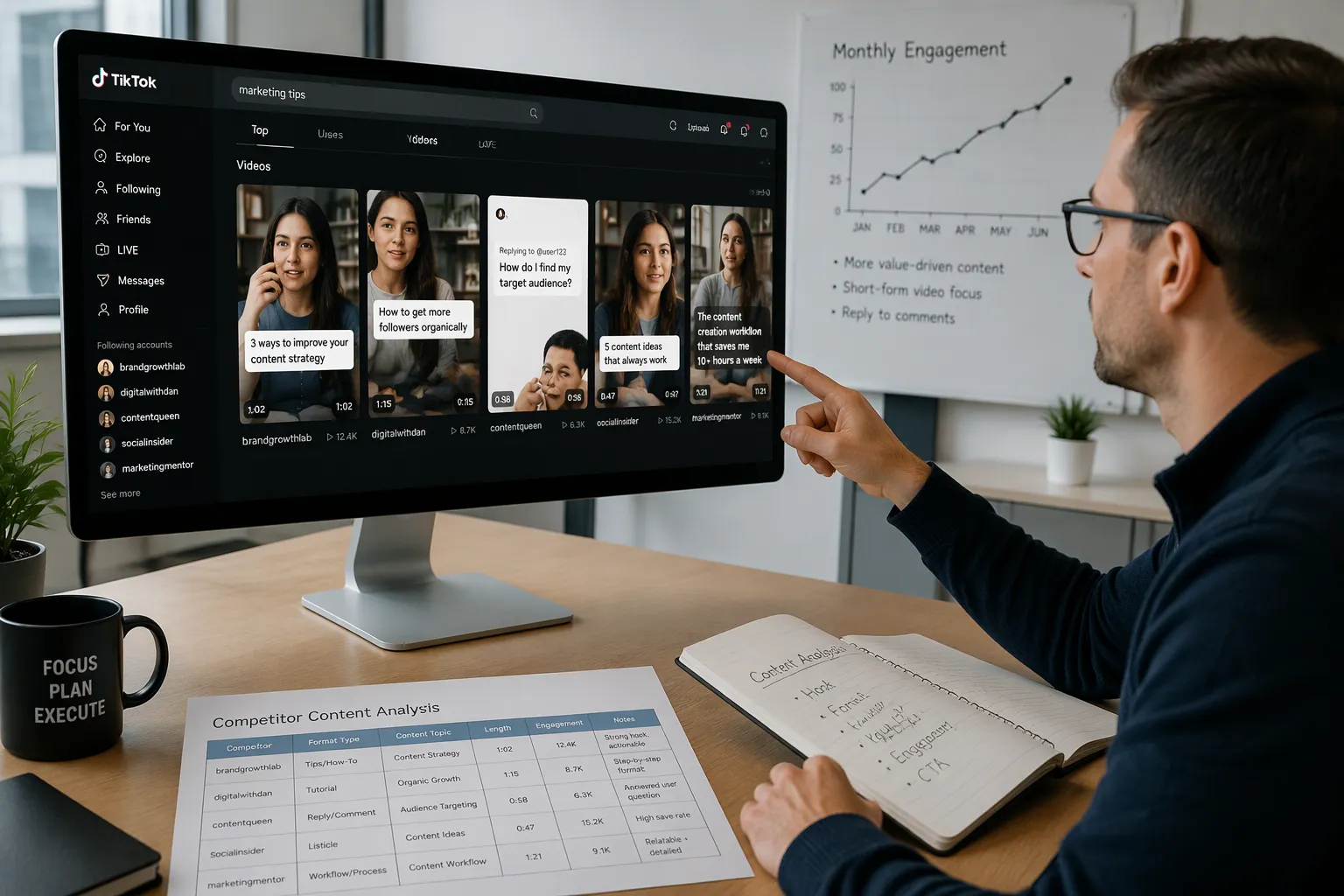
Format shifts rarely arrive with an announcement. They build quietly in the accounts you already track. Watch for longer videos gaining ground as viewers treat TikTok more like a search engine. People now type questions into the search bar and expect a useful answer. A competitor who posts tutorial-style clips with clear spoken answers is adapting to that habit. Study how they structure those videos and where they place the key information.
Search-driven discovery changes content design. Titles, on-screen text, and spoken keywords all help a video surface in results. Log which competitors use plain, question-shaped phrasing in their captions. Note whether their how-to posts outperform their entertainment posts. That comparison tells you where to invest effort.
Interactive formats deserve a place on your watch list. Photo carousels, longer story-driven clips, and comment-reply videos all give viewers a reason to stay. A rival who answers top comments in a follow-up video turns engagement into fresh content. Track these experiments in your spreadsheet and mark which ones repeat. A format that appears once is a test. A format that returns across weeks is a trend worth copying.
Algorithm and Platform Changes
The feed rewards watch time and repeat viewing. Treat that as a working principle, not a fixed rule. Platform teams adjust ranking signals often, and they rarely publish full details. Your competitor list gives you a live read on what the feed currently favors. When several rivals suddenly post shorter clips with fast hooks, the feed may be rewarding completion. When longer videos climb, retention may matter more.
Plan for shifts in how the platform surfaces content. Recommendation feeds, search results, and profile browsing each send you different viewers. A competitor's traffic mix can hint at which path drives their growth. Check whether their viral posts share a format or a topic. Then test that pattern on your own account.
Build a monthly analysis routine to stay current. Set a fixed date each month. Refresh your competitor list, update the metrics in your benchmark table, and review which formats gained or lost ground. Read platform announcements during the same session. Write three short notes: what changed, what it means for you, and one test for the coming month. This routine keeps your TikTok Competitor Analysis current through 2026 and beyond. Small, regular reviews beat one large annual audit. You will spot shifts while they are still cheap to act on.
You now have a full method in hand. Identify your competitors, track their key metrics, analyze their content and engagement, add the right tools, and turn the findings into testable goals. Each step feeds the next one, and the loop gets faster with practice.
The work does not stop there. Build a repeatable routine for your TikTok Competitor Analysis, and your strategy stays current through 2026. Small monthly reviews beat one big annual audit every time.
Start today. Pick one competitor, run the first two steps, and schedule a monthly review on your calendar. Your next round of growth begins with that first look.
FAQ
How often should you run a TikTok competitor analysis?
Do a quick check every week and a full update every month. Weekly checks help you spot trends early. The monthly pass updates your benchmark table and your competitor list. A steady routine works better than one big yearly audit, because you catch changes while they are still easy to act on.
How many competitors should you track?
Keep the list short. Five to ten accounts give you enough to learn from without burying you in data. Mix direct competitors, indirect competitors, and one or two aspirational accounts. A small brand with strong engagement often teaches you more than a huge account with passive followers.
What if a competitor hides their metrics?
Public view counts, likes, and comments stay visible on most posts. Use those. Skip watch time and retention, because no outside tool can pull them. Judge the hidden numbers through clues instead. Strong hooks, repeat formats, and steady view floors all hint at solid retention.
Should you copy a competitor's winning format?
Borrow the structure, not the content. Study why a format works, then apply that logic to your own product and voice. A direct copy looks stale to viewers. A smart adaptation shows your audience something familiar yet new. Test one borrowed format for 30 days and measure the result.
What if a competitor has a much larger audience?
Ignore the follower gap and study the ratio instead. Compare engagement rate and average views against follower count. A large account with weak engagement leaves room for you. Focus your benchmark on the metrics you can match, and target the themes that big accounts overlook.
See Also
Essential TikTok Analytics Tool For Data Driven Creators
Top Free TikTok Analytics Tools For Better Performance
Analyzing US TikTok Data Using EchoTik Platform
EchoTik Data Tool Versus Traditional TikTok Analytics Methods