TikTok Live Gift Calculator Guide

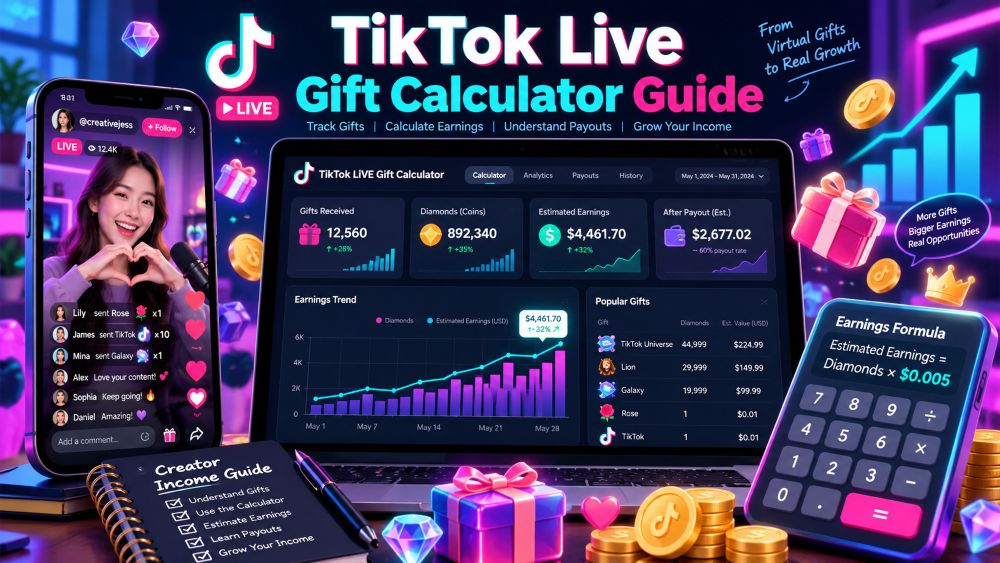
A tiktok live gift calculator turns any gift into coins, diamonds, and real USD. You instantly see how much a gift is worth without guessing. That matters for two people. Viewers avoid overspending on coins. Creators finally see what actually lands in their pocket. Here is the catch. The price you pay for a gift is not the same as creator income. TikTok takes a cut, and your region and tax rules change the final number. This guide walks you through the full math. You will learn the coin-to-USD chain, how to estimate single-stream revenue, and how to average earnings across your last 10 LIVES. No fluff. Just the numbers you need before you spend or set income goals.
What Is a TikTok Live Gift Calculator?
A tiktok live gift calculator is a free online tool that shows you what any gift is really worth. It converts coins into USD and then into creator earnings. You can also browse the full LIVE gift catalog by region. That means you see the exact coin cost for every gift available in your country. No more guessing what a Rose or a Galaxy costs in real money.
How the Calculator Works
The tool runs on a simple conversion chain. You enter a gift or a coin amount. The calculator then shows you the buyer cost and the creator value side by side. It also factors in TikTok's 50% commission when gift Coins convert to Diamonds. That step matters because it changes the creator's take-home pay.
Here is a quick example. One coin sent during a LIVE battle creates one battle point. That point converts to 0.5 diamonds and pays the creator $0.0025 before processing fees. Scale that up. Multiply 1,000,000 gift points by 0.5 to get 500,000 diamonds. Then multiply 500,000 diamonds by $0.005. The estimated creator value is $2,500.00 before processing fees. That figure excludes taxes, currency conversion, and withdrawal charges.
Free tools like Gift Points Calculator and Red Social's TikTok Coins Calculator handle this math for you. They also provide a 2025 gift price list showing Coin cost, estimated buyer cost, and creator value before processing fees.
Who Should Use It
Viewers get the most obvious benefit. You check a gift's price before you spend. That way you avoid overspending on coins during a hype moment. Creators use the same tool to estimate net earnings. The calculator accounts for TikTok's multi-step conversion fees and processing charges. It also helps creators decide which gift strategies drive profitable results before each battle.
Gift price is not creator payout. The calculator shows both sides so you never confuse the two.
Anyone who sends or receives live gifts should keep this tool handy. It turns vague numbers into real ones.
Coins, Gifts, and Diamonds Explained
Coins vs. Gifts vs. Diamonds
Three units power every TikTok Live transaction. Each one plays a different role, and mixing them up leads to bad math. Here is how they break down.
Term | Definition | Role in the TikTok Live Economy |
|---|---|---|
TikTok Coins | A virtual currency you buy with real money through the TikTok app. It shows as a gold balance next to your profile icon. | You use Coins to send Gifts during Live streams. Coins flow only from viewers to creators through Gifts. |
Gifts | On-screen emojis or animated items like Roses, Finger Hearts, Lion, Universe, or Whale. You send them with Coins during a Live stream, and they display your username. | Gifts are how viewers support creators. When a creator receives Gifts, TikTok turns them into Diamonds. |
Diamonds | The creator-side currency that comes from receiving Gifts. Creators cash them out for real money through linked payment methods. | Diamonds appear only on the creator side. They represent earnings after TikTok takes its cut. |
The full loop looks like this: real money becomes Coins, Coins become Gifts, Gifts become Diamonds, and Diamonds become real money again.
The Coin-to-USD Conversion Chain
You need one key rate to make sense of any gift price. One coin equals about $0.01 to $0.014 USD. So you multiply the coin cost by that rate to get the buyer's price in dollars. A 100-coin gift costs you roughly $1.00 to $1.40. That part is simple.
The creator side works differently. A tiktok diamonds calculator shows that Gifts convert into Diamonds at an adjusted rate. TikTok takes its cut during that step. So the coin-to-diamond conversion rate never matches the buyer's price one-to-one. A diamonds calculator helps you see both sides at once. You plug in the coin value, and it returns the diamond value after fees.
This is not a fixed conversion formula you can memorize once. The gift conversion system shifts based on region and platform rules. But the core idea stays the same. Coins measure what you spend. Diamonds measure what the creator keeps. A good diamond conversion tool handles the math so you never confuse the two. Use it before every big gift, and the numbers stop being a mystery.
TikTok Gift Price List and USD Values
Popular Gifts and Coin Costs
You probably want to know what the most common gifts actually cost. Here is a quick gift price list for 2025 that covers three popular options.
Gift | Coin price (2025) | Approx. USD value |
|---|---|---|
Rose | 1 coin | $0.01 |
Panda | 5 coins | $0.07 |
Lion | 20,000 coins | $270 |
The Rose is the entry-level gift. It costs just 1 coin, which runs about a penny. The Panda sits in the middle at 5 coins, or roughly seven cents. Then you have the Lion. At 20,000 coins, it carries a price tag of about $270. That is a huge jump from the Panda.
Gift prices swing based on where you live. Brazil offers the lowest coin costs. Your purchasing power goes further there, so gifts feel more affordable. The United States sits in the middle with balanced pricing. A 70-coin gift costs about $0.74 there. The United Kingdom looks similar to the US, but currency differences change how gifts feel. In India, higher diamond costs reduce what you can buy. The Philippines offers competitive coin rates, which makes gift exchanges more favorable.
One more thing affects what you pay. Desktop and web purchases are cheaper than mobile. App store fees can inflate mobile coin prices by up to 30%. So if you want the best deal, buy coins on a computer.
Converting Coins to USD
The math here is straightforward once you know the rate. TikTok Coins are valued at approximately $0.01 to $0.014 each. That range shifts based on your location and the package size you buy. Bulk purchases help stabilize the per-coin value across regions.
So how do you figure out what a gift is worth in real money? Multiply the coin cost by the coin value. A 100-coin gift at $0.01 per coin costs you $1.00. At $0.014 per coin, that same gift costs $1.40. The range matters.
Now here is where creators need to pay attention. Creators earn roughly $0.005 per coin after TikTok's commission cut. That cut ranges from 50% to 77% depending on region. So a gift that costs you $1.00 might pay the creator only a few cents. The gap between buyer cost and creator payout is real.
A tiktok live gift calculator handles this conversion for you. You plug in the coin amount, and it shows both sides. You see what you spend and what the creator receives in diamonds. That way you never confuse the two numbers.
Gift prices range from $0.01 for entry-level items like the Rose to over $500 for premium gifts like TikTok Universe. The spread is massive. Before you send anything big, run the numbers. Know the real cost and the real payout.
How to Buy Coins and Send Live Gifts
Buying Coins Step by Step
You need coins before you can send anything during a LIVE. Open the TikTok app and tap your profile. Find the coin balance near your profile icon. Tap it, and TikTok shows you the available coin packages. Pick the bundle that fits your budget. Pay through your app store or a linked payment method. Your coins appear in your balance right away.
Prices shift based on where you buy. Mobile app store fees can inflate what you pay. Desktop and web purchases usually cost less. According to TikTok's official platform, 7,000 coins are priced at $72.39 USD. That gives you a baseline for comparing other packages. Bulk bundles often give you a better rate per coin. So if you plan to send live gifts often, buying a larger package saves money over time.
Sending a Gift During a LIVE
The process takes just a few taps. Here is how it works.
During a TikTok LIVE, tap the Gift button in the bottom-right corner of the screen.
Choose the gift you want to send.
Tap Send below the selected gift.
If you do not have enough coins, tap Recharge next to the Gift button to buy more coins.
That last step matters. You do not want to miss a moment because your balance ran dry. Recharge first, then come back and send.
Gift prices vary a lot, so check before you tap Send. A Rose costs almost nothing. A Lion runs into the hundreds. Know what you are spending before the animation starts. Your wallet will thank you. And if you send live gifts regularly, keep an eye on your coin balance between streams. A quick check now prevents an awkward pause later.
Why Gift Value Is Not Creator Income
Every gift carries a price tag. That price rarely matches what the creator banks. TikTok takes a cut at every step. So when you ask how much creators can actually earn from a Lion or a Universe, the answer starts with fees, taxes, and location. Let's walk through the math.
TikTok's Platform Fee Explained
Every gift follows a set path. Coins become gifts. TikTok then turns those gifts into the currency that pays creators. Each conversion shaves off value. A viewer spends $1.00 on 100 coins. The creator does not see $1.00. Converting diamonds into real money happens at TikTok's rate, and the payout lands far below what the viewer paid.
The fee is steep. TikTok keeps a large share of every gift. The creator earns roughly $0.005 per coin after its commission cut, which ranges from 50% to 77% by region. A $1.00 gift can pay the creator only a few cents.
That is why asking how much creators earn per gift is the wrong question. The right question is how many diamonds the gift produces. Only that currency pays out. Coins and gifts never convert to cash. The diamond rate sits far below the coin price you paid.
Region, Tax, and Withdrawal Effects
Region changes the picture fast. TikTok weights payouts by viewer location and advertiser demand. The United States pays the highest rates. US creators earn the most from gifting during 7–11 PM EST. The UK and Canada deliver strong payouts, though below US levels. The European Union sits mid-tier, with thinner ad inventory and stricter rules. The Asia-Pacific region pays lower per-view rates, so creators there need more volume. Emerging markets offer moderate payouts with growing interest. China, Iran, North Korea, and other sanctioned countries prohibit monetization entirely. India's ban means no live gift earnings.
A 500K-follower creator might earn $200–$500 per 2-hour stream and $100–$250 per hour from gifting. Audience geography pushes that number toward the low or high end. Region matters to creator earnings.
Taxes carve away another slice. IRC Section 102 says money sent during a Live is not a true gift. It is payment for services. Self-employment tax hits LIVE income at 15.3% of net profit on Schedule C. Take $12,000 in LIVE income. The SE tax is $12,000 × 92.35% × 15.3%, which comes to $1,696. Federal income tax adds on top. Creators can deduct ring lights, microphones, streaming software, and agency fees.
Withdrawal rules add the final layer. TikTok issues a 1099-NEC or a 1099-K depending on payment structure and volume. The 1099-K threshold requires more than $20,000 in gross payments and more than 200 transactions. The 1099-NEC threshold starts at $600 and rises to $2,000 for payments made in 2026. Income is taxable even without a form. The path from diamonds into cash triggers one more check on what lands in your bank.
That is the full picture. The gift price you see is just the opening number. Platform fees, region, taxes, and withdrawal rules all chip away at it. Check gift values before you spend. Track the real impact on creator earnings before you set income goals. The calculator helps you see both sides, but remember what happens between the two.
Estimating Live Stream Gift Revenue per LIVE
To estimate live stream gift revenue, you need the full count of live stream gifts from one actual session. Don't guess. Open the LIVE's gift history after you end the stream, or jot down each gift as it lands. The number you're chasing is total coins received, not total gifts. A Lion and a Rose each count as one gift, yet their coin values sit miles apart.
Counting Gifts and Diamonds
Start by grouping every gift by type and adding the coin value. Suppose a stream collected 10 Roses at 1 coin each and 5 Pandas at 5 coins each. That gives you 10 plus 25 coins, so 35 coins before you add anything larger. Keep the running total until you have one clean sum for the whole LIVE.
Next, turn that coin total into creator-side currency. During a Live battle, one coin creates one battle point. That point converts to 0.5 diamonds. If you received 10,000 coins in a session, you walk away with 5,000 of those units. Counting live gifts this way separates what viewers spent from what you might withdraw.
Only after you make that conversion can you calculate earnings accurately. The buyer's coin price tells one story. Your conversion total tells another.
Applying Fees to Get Real Payout
Now apply the fee structure. The rate for the currency you earned sits near $0.005 per unit before processing fees. Take a large stream: 1,000,000 gift points becomes 500,000 of those units, which equals roughly $2,500. That number looks strong, but it's not your final payout.
TikTok's platform fee ranges from 50% to 77% depending on region. After that cut, the same 500,000 points pay somewhere between $575 and $1,250 before taxes and withdrawal charges. Your live streaming earnings also shift by country and by how TikTok processes the payment.
So the process for one LIVE is straightforward. Add coins, convert them, multiply by the diamond rate, then subtract the platform fee. What remains is what the creator earns. Track each stream with the same method. Over time, those totals show whether your gifts build income or just light up the screen.
Averaging Creator Gift Income from 10 LIVES
One stream tells you almost nothing. A big battle night can spike your numbers. A quiet Tuesday can tank them. To get a real picture of your creator gift income, you need a bigger sample. Ten LIVES gives you enough data to spot patterns without drowning in spreadsheets.
Tracking Gifts Across 10 Streams
Set up a simple log before your next stream. You need four columns: date, total coins received, total diamonds earned, and estimated payout after fees. Fill in each row right after you end the stream. Don't wait until the next day. Your memory will blur the details.
Here's a worked example. Say stream one brought 5,000 coins. That converts to 2,500 diamonds. Stream two brought 12,000 coins, which becomes 6,000 diamonds. Keep going until you have ten rows. Add up all the coin totals. Add up all the diamond totals. Now you have your raw numbers for the whole period.
Finding Your Average per LIVE
Divide your total diamonds by ten. That gives you the average per stream. Suppose your ten-stream total came to 40,000 diamonds. Your average sits at 4,000 diamonds per LIVE. Multiply that by the diamond rate near $0.005. Your gross average lands around $20 per stream before the platform fee.
Now apply TikTok's cut. The platform fee ranges from 50% to 77% depending on your region. At a 50% cut, that $20 becomes $10. At 77%, it drops to roughly $4.60. Taxes and withdrawal charges chip away more. So your real average per LIVE might sit between $4 and $10.
Run this calculation every month. Track whether your average climbs or stalls. A rising average means your engagement strategy works. A flat line means you need to change something. The calculator gives you the numbers. Your ten-stream log gives you the trend. Together, they turn guesswork into a real income plan.
Strategies to Earn More from Live Gifts
Boosting Viewer Engagement
You get more gifts when viewers feel seen. Call people out by name when they join. Thank every gifter out loud the moment their animation plays. This kind of personalized engagement improves session retention by 19%, according to Buffer. That means people stick around longer, and longer viewers send more gifts.
Make your stream interactive. Run polls, open a Q&A panel, or use filters and effects. Host multi-guest sessions with up to 8 participants. Collaboration-driven Lives grow followers twice as fast as solo streams, per Pew Research. You can also set fun gift goals like "Hit 100 gifts and we unlock a giveaway." Just keep it light so the stream never feels like a cash grab.
Timing and Consistency Tips
When you go live matters as much as what you do. Gen Z peaks between 7 and 11 PM, and streaming in that window can produce 2 to 3 times higher initial viewer counts. Thursday and Sunday evenings convert best. Weekend windows from 11 AM to 2 PM and 7 PM to 12 AM also capture heavy browsing activity.
Stream length plays a role too. Sessions lasting over one hour can generate 30 to 50% more revenue, with 60 to 120 minutes being ideal. Post your schedule in your bio. That simple step can boost viewership up to 25 times, based on Ignite Social benchmarks. Stick to the same days and times each week. Regular streams build a loyal community, and loyal viewers send live gifts without you asking.
Run every gift through the tiktok live gift calculator before you spend. You'll know exactly where your coins go. Creator income stops at the platform fee, which ranges from 50% to 77% by region. Taxes and withdrawal rules chip away at the rest. Your final payout relies on diamonds, not the sticker price.
Check the real USD value before tapping send. If you're a creator, log your last 10 LIVES, apply the fee math, and set income goals from the average.
A calculator shows both sides, but your pocket only sees the net result.
Use the calculator weekly. Track live gifts, review your payout, and adjust with data. That habit keeps your Live income honest.
FAQ
How much is a TikTok gift worth in real money?
Multiply the coin cost by roughly $0.01 to $0.014. A 100-coin gift runs about $1.00 to $1.40 for you. The creator sees far less. TikTok takes a cut during the coin-to-diamond conversion, so the payout lands near $0.005 per diamond before taxes and withdrawal fees.
Why does my gift pay the creator so little?
TikTok keeps a platform fee that ranges from 50% to 77% depending on your region. That cut happens before the creator ever touches the money. Taxes and withdrawal charges chip away more. So a gift that costs you a dollar might pay the creator just a few cents.
Can I estimate my earnings from one LIVE?
Yes. Add up every coin you received, convert that total to diamonds, then multiply by the diamond rate near $0.005. Subtract the platform fee. What remains is your rough payout. One stream gives you a snapshot, not a trend.
How do I average my gift income across 10 LIVES?
Log four things after each stream: date, total coins, total diamonds, and estimated payout. Add up all ten diamond totals. Divide by ten. That number is your average per LIVE. Apply the fee math and you have a realistic income baseline.
Do gift prices change by country?
Yes. Brazil offers the lowest coin costs. The US sits in the middle. India carries higher diamond costs, which reduces buying power. Desktop purchases also cost less than mobile because app store fees can inflate prices by up to 30%.
See Also
Discover Scientific Pricing For TikTok Products With EchoTik's New Online Calculator
Essential TikTok Analytics Tool For Tracking Performance And Growth
Learn How To Access And Use TikTok Analytics Effectively
Benefit's $30,000 GMV Live Stream: Building TikTok Live Operations Success
Top Free Tools For Analyzing TikTok Analytics And Performance