7 Best TikTok Product Research Tools for 2026


Thousands of products go viral on TikTok every week. How do you find winning products before they peak?
This post compares the 7 best tiktok product research tool options for 2026 on features, pricing, and best-fit use cases. You get a quick comparison table, a framework for choosing, and a research workflow you can run today.
Every serious TikTok Shop seller faces the same gap. Viral products move fast, and guesswork costs money. The right product research tools close that gap. They turn raw trend data into decisions you can defend.
Start with the table below. Then match a tool to your budget and your research style.
Key Takeaways
Choose a tool that fits your budget and research style.
Start with free tools like TikTok Creative Center to spot trends.
Upgrade to paid tools for sales estimates and deeper data.
Test any tool with five products you already know.
Combine free and paid tools to cover discovery and validation.
TikTok Shop Product Research Tools 2026: Quick Comparison
Comparison Table: Best For, Price, Free Trial
The table below shows all seven options side by side. Prices are the published 2026 rates when the vendor lists them.
Tool | Best For | Starting Price | Free Trial |
|---|---|---|---|
Kalodata | Broadest TikTok Shop dataset | Not published; signup required to see plans | |
FastMoss | Deep historical product data | $49/mo ($47/mo billed annually) | 7-day free trial |
EchoTik | Low-cost trend data | $13.90/mo ($9.90/mo billed annually) | |
TikTok Creative Center | Free trend discovery | Free | Free tier |
SmartScout | Category analysis | Paid plans; see vendor site | Not stated |
PiPiADS | TikTok Shop depth | Paid plans; see vendor site | Not stated |
Minea | Tracing viral content | Paid plans; see vendor site | Not stated |
Delzonic explains the price range well:
EchoTik is the cheapest way to get trend data at $9.90 a month on annual billing. FastMoss is the serious pick for deep history at $47. Kalodata has the broadest dataset, but it will not show you a price until you sign up
What the Table Tells You
Three patterns stand out. First, free access and paid depth do different jobs. TikTok Creative Center costs nothing and shows you what is trending. Paid shop analytics tools add sales estimates, creator data, and history you can act on.
Second, the starting prices are mostly low. EchoTik starts at $13.90 a month, according to Kalodata's 2026 roundup, and FastMoss sits at $49. A small budget still buys real data.
Third, the tools work well together. Many sellers use Creative Center to spot trends and one paid tiktok shop analytics tool to check them. That setup covers both ends of product research without overlap.
How to Choose a TikTok Product Research Tool
Match Your Budget and Stage
Your budget should follow your business stage. A new seller needs trend signals and a low entry cost. A growing seller needs sales estimates and creator data. An established seller needs history, category depth, and exportable reports.
Start with a free tier if you are still testing ideas. TikTok Creative Center costs nothing and shows you what is trending. Move to a paid tiktok shop analytics plan once you need numbers behind the trends. EchoTik starts at $13.90 a month, and FastMoss sits at $49 a month. Both figures come from the pricing table above.
Match Your Research Style
Think about how you actually work. Some sellers scan trends all day and want a fast feed. Others prefer to dig into one category for weeks. Your style decides which product research tool feels natural.
If you chase viral clips, pick a tool built for tracing content. If you validate demand before you buy inventory, pick a tool with sales estimates and history. Many sellers pair a free trend feed with one paid tiktok shop product research platform. That stack covers product discovery and validation without paying twice for the same data.
Run a small test before you commit. Pick five products you already know and check how each tool reports them. The tool that answers your questions fastest is the right fit for your tiktok shop workflow.
Kalodata: Best TikTok Shop Analytics Tool
Kalodata is a special analytics platform made for TikTok Shop sellers. It puts product research, creator analysis, content insights, and market analysis all in one dashboard. Many 2026 roundups name it the best tiktok shop analytics tool, and its dataset is the broadest in this category. You can study trending items, find creators who already drive sales, and track competitor shops without switching between platforms.
Key Features and Pricing
The platform covers the whole decision chain. Kalodata supports access to 365 days of data, and its plans range from a Basic Plan for market research and product validation to Professional or Enterprise Plans for deep analytics, unlimited exports, and team collaboration.
Category analysis: spot new segments through category GMV trends and sales growth rates.
Product research: rank items by GMV, sales volume, seller count, and sales channel.
Creator analytics: judge creators by real conversion performance and export contacts on higher tiers.
Video analytics: see which formats and storytelling styles drive engagement.
Shop and brand tracking: follow competitor launches, pricing, and creator partnerships.
Kalodata does not publish its pricing. Delzonic reports that the pricing page returns a signup form, and you can start a seven-day trial without a credit card.
Pros, Cons, and Best Fit
The strengths favor sellers who want to grow. FindNiche notes that Kalodata cuts down trial-and-error testing and supports scaling, not just trend spotting. Tipsonblogging calls the interface beginner friendly and praises the filters. The historical depth helps you tell a real trend apart from a one-week spike.
The limits are worth knowing. Revenue figures are estimates, so do not use them for accounting. The Starter plan limits features, and creator contacts sit behind the Professional tier. Kalodata covers TikTok only, and the amount of tiktok shop data can overwhelm a complete beginner.
Best fit: you run a TikTok Shop business and want one shop analytics tool for product discovery, competitor tracking, and creator outreach in a single place.
FastMoss: Best Kalodata Alternative
FastMoss is a TikTok Shop analytics platform that works worldwide. It covers product research, finding creators and shops, video and ad analysis, and live tracking of livestream GMV in real time. Hubfluence calls it a research layer, not a workflow tool. It reports on what happens in TikTok Shop. It does not contact creators, ship samples, or run an affiliate program.
Key Features and Pricing
FastMoss makes its prices public, and that openness is a real plus. Nolyn.ai lists the 2026 tiers below, checked on October 18, 2026.
Plan | Monthly | First Month | Yearly | History | Detail Views/Day |
|---|---|---|---|---|---|
Basic | $49 | $29 | $558 | 90 days | 150 |
Pro | $89 | $53 | $854 | 180 days | 500 |
Ultimate | $139 | $99 | $1,084 | 1,200 days | Unlimited |
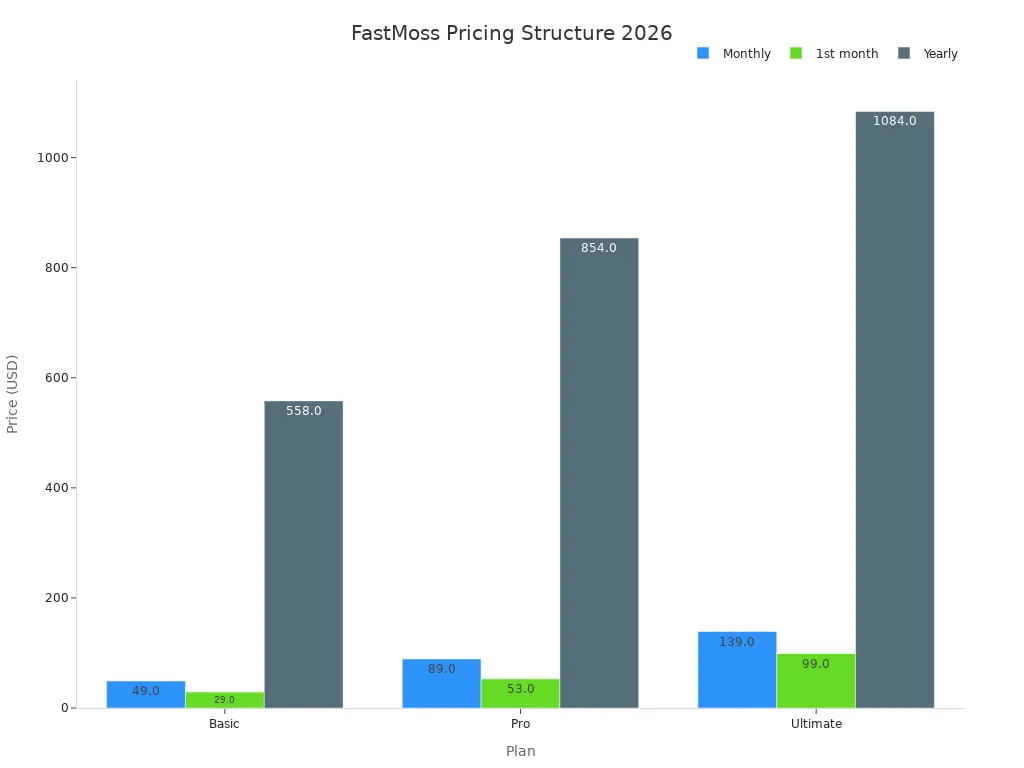
Carouscale puts the choice simply:
"FastMoss and Kalodata do the same job: global TikTok Shop analytics, billed in dollars. Pick FastMoss if you want a public price before paying ($47 a month billed yearly on October 18, 2026); pick Kalodata if its dataset already runs your workflow, knowing its grid sits behind an account."
Pros, Cons, and Best Fit
Tipsonblogging likes the cheap first month at $29 on Basic and the real-time data updates. It also points out AI tools for video transcription and script writing. Entreresource finds FastMoss much stronger for brands and good at influencer research. The same review warns that the data volume can overwhelm a creator doing product discovery.
The trade-offs are clear. The full price after month one is higher than the entry rate. The longest history is only on Ultimate. Every TikTok Shop analytics figure is an estimate. FastMoss also covers TikTok only, with no cross-platform view.
Best fit: you want the freshest real-time data and livestream coverage among shop analytics tools, and you handle creator outreach somewhere else.
EchoTik: Top TikTok Shop Product Research Tool

EchoTik makes this list for one simple reason. It gives you real TikTok Shop data at the lowest starting price in this comparison. The platform covers live streams, short videos, competitor stores, creators, and regional hot rankings in one dashboard. EchoTik's own guide calls it a full tiktok shop product research tool for sellers who want signals without a big subscription.
Key Features and Pricing
EchoTik groups its features around the jobs you do each week. The table below comes from EchoTik's 2026 feature guide.
Feature | What It Does |
|---|---|
Real-time live stream monitoring | Tracks live and past streams, GMV, orders, unit price, and best-selling SKUs by region |
Trending short video tracker | Flags rising viral products and filters items with stable 3 to 7 day growth |
Competitor store intelligence | Shows rival daily sales, monthly GMV, launch frequency, and top products |
Influencer ROI analysis | Uses creator sales data to estimate cooperation return |
Cross-border hot rankings | Provides classified hot lists for the US, UK, Southeast Asia, and the Middle East |
AI product recommendation | Screens low-competition, high-margin items for your niche |
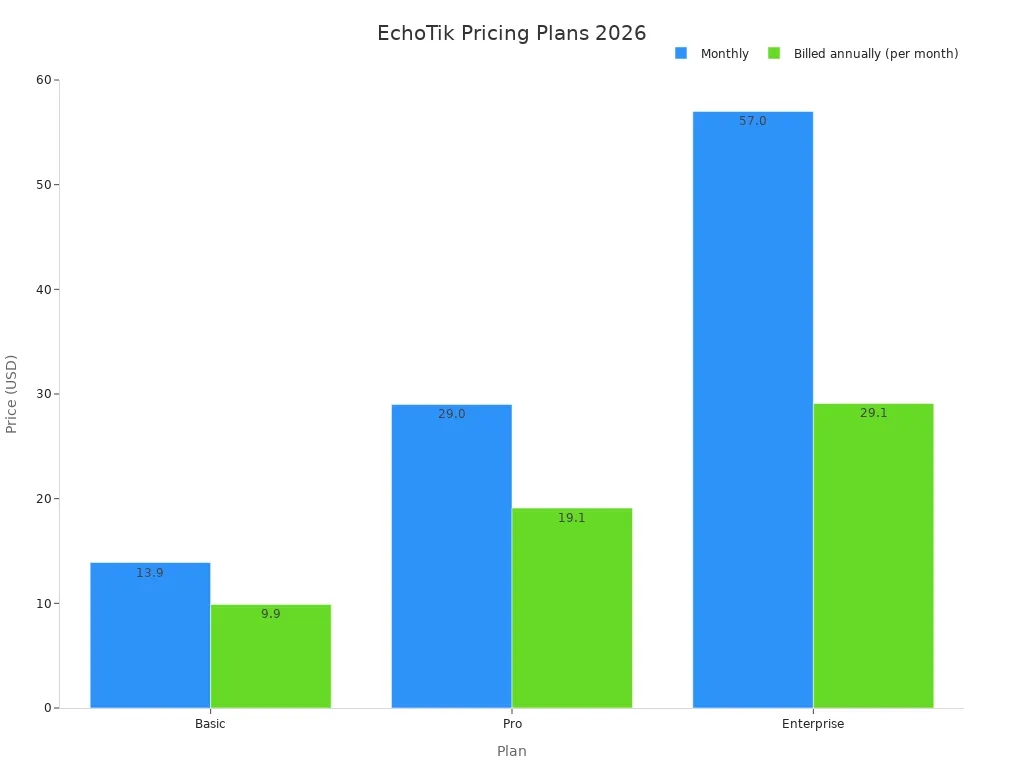
Pricing is where EchoTik stands out. Delzonic checked the plans in September 2026. The free plan costs $0 with limited daily views. Basic runs $13.90 monthly or $9.90 per month billed annually, with 30 days of history. Pro costs $29 monthly or $19.10 annually, with 90 days. Enterprise sits at $57 monthly or $29.10 annually, with unlimited history. Delzonic also notes a seven-day unconditional refund on selected paid plans.
Pros, Cons, and Best Fit
EchoTik's strengths are all about access. A free plan needs no credit card, so you can try the tool before you spend. The Chrome extension shows revenue and engagement figures right on the TikTok feed. Core features stay the same for sellers under $50K monthly GMV, according to EchoTik's own review.
The limits matter too. Advanced views sit behind higher tiers, and history is thinner than premium rivals offer. Some sellers question how closely the figures match TikTok's own numbers. EchoTik's review could not confirm or deny those claims.
Best fit: you are learning tiktok shop analytics and want a low-cost starting point for product discovery, store research, and creator analysis.
TikTok Creative Center: Best Free Starting Point
TikTok Creative Center is TikTok's own free platform. You can open it in any web browser. You don't need an ad account, business verification, or a payment method. Because it's so open, it's the easiest place to start your research.
Key Features and Pricing
The platform puts five features into one free dashboard. BetterMockups describes them in its 2026 guide.
Feature | Description |
|---|---|
Trends tab | Shows hashtags, songs, and creators that are rising, with momentum data so you can spot chances early |
Top Ads library | Filters by country, goal, and industry so you can study what competitors create |
Inspiration section | Picks out top-performing content for your business category |
Keyword Insights | Shows search volume and trending terms for TikTok Shop SEO |
Creative Guidance | Shares best practices for video length, hooks, and where to place a call-to-action |
Pricing is simple. Every feature above costs nothing. You get the same access as any advertiser, with no locked upgrades.
Pros, Cons, and Best Fit
The strengths work well for early-stage sellers. Fluxnote lists free access, real-time trending ad insights, direct connection with TikTok Ads Manager, and trending hashtag and audio discovery as the main pros. You can study what converts before you spend a dollar.
The limits are real. Fluxnote notes that Creative Center is an ad library and insights tool, not a video maker. It offers basic templates with limited customization, no AI voiceover, and no AI script writing. Copyfy states the bigger gap plainly: Creative Center "stops at research." It has no winning product database with sales figures and no analysis of competing stores.
Best fit: you want free inspiration and trend signals before you pay for a shop analytics tool. Use it to spot trending products, then check them somewhere else. It also works well as a free helper for product discovery when you pair it with a paid platform.
SmartScout: Best for Category Analysis
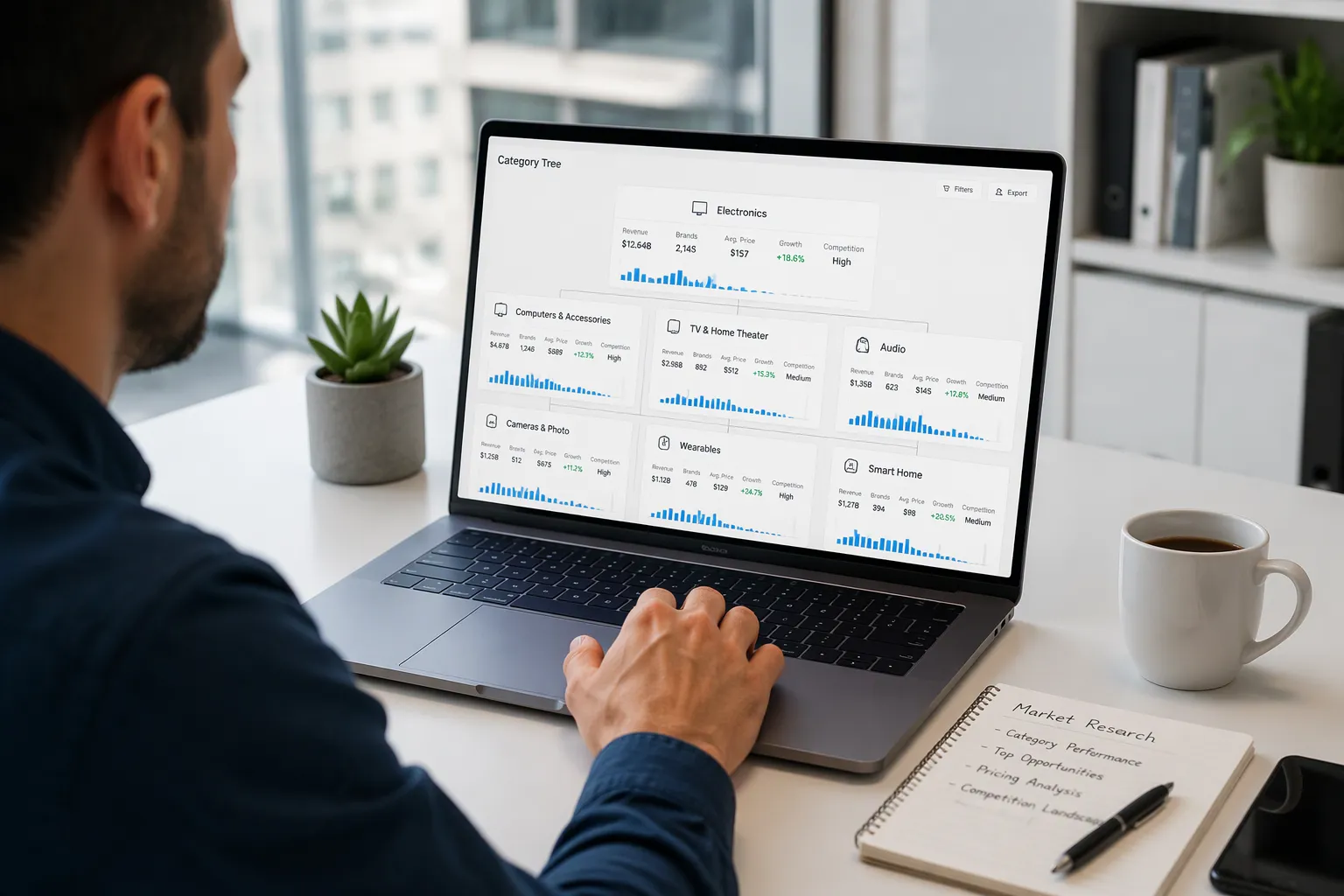
SmartScout is on this list because it does a different job. It maps Amazon categories in great detail, and that skill carries over well to TikTok product research. You can study how a niche works before you put money into a TikTok Shop listing. Think of it as a category lens you point at a market, not a TikTok feed reader.
Key Features and Pricing
The Subcategories tool is the main feature. Demandsage reports that it splits Amazon into more than 40,000 subcategories. Each one has sortable metrics for revenue, brand count, average price, growth, and competition. You browse from the top of the category tree down into brands and products.
Feature | Details |
|---|---|
Subcategories tool | Splits Amazon into 40,000+ subcategories |
Sortable metrics per subcategory | Revenue, brand count, average price, growth, and competition |
Plan requirement | Business plan; not accessible on Basic and Essentials |
Use case | Niche discovery and market validation; top-down browsing of category tree into brands and products |
The Subcategories tool covers 40,000+ Amazon subcategories. Helium 10 and Jungle Scout have nothing like it.
SmartScout also builds custom segments. You can measure market share inside a category or define a competitive set around brands you care about, according to SmartScout's own comparison page.
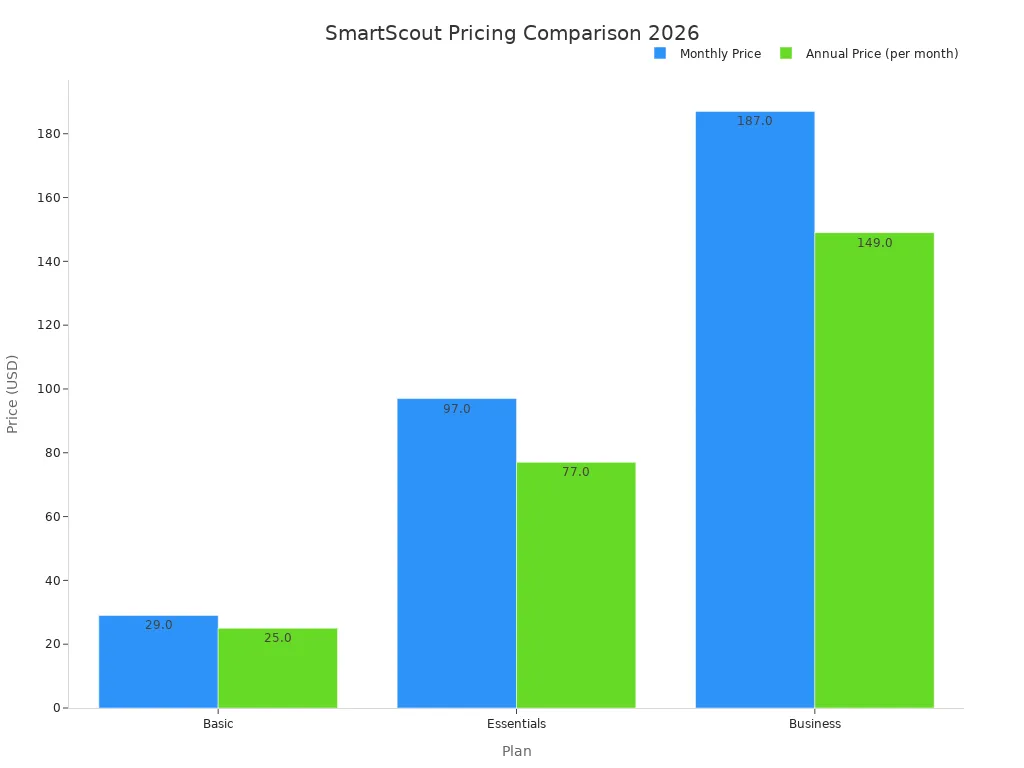
Ecommerceparadise lists the 2026 plans below. Every plan includes a 7-day money-back guarantee, and there is no free plan or free trial.
Plan | Monthly Price | Annual Price (per month) | Key Features |
|---|---|---|---|
Basic | $29 per month | $25 per month billed annually | Core subcategory and brand research tools with limited searches per day |
Essentials | $97 per month | $77 per month billed annually | Higher search limits, access to the Traffic Graph, more detailed brand analytics |
Business | $187 per month | $149 per month billed annually | UPC Scanner with up to 100,000 ASINs per month |
Enterprise | starts at $399 per month | custom pricing | API access, Data Lake integration, historical data suites, white-glove account management |
Pros, Cons, and Best Fit
The category depth is the main draw. You get a clear view of demand, competition, and price ranges inside a niche. That view helps you make product discovery choices you can explain to a supplier or a partner.
The limits are worth noting. SmartScout focuses on Amazon, so it does not replace a tiktok shop analytics tool. The Subcategories tool sits on the Business tier, and the entry price is higher than most shop analytics tools in this comparison. You also get no free trial, only a money-back window.
Best fit: you want category and market intelligence to support your TikTok research, and you already plan to pair it with a dedicated TikTok platform.
PiPiADS: Best for TikTok Shop Depth
PiPiADS focuses deeply on one ecosystem instead of trying to cover many. Admapix describes it as a platform that links a TikTok creative to the product it sells, the store running it, and the landing page it points to. That link matters for your product research. You see the ad and the sale in the same view.
Key Features and Pricing
The feature set centers on ads and the commerce layer behind them. Adlibrary lists the core tools below.
TikTok Ads Spy: search ads by keyword, category, country, language, and ecommerce platform.
Trending product library with rankings based on ad volume and engagement.
TikTok influencer search to find creators promoting similar products.
Ad tracker for watching competitors' creatives over time.
Image search to find creatives that look like an uploaded image.
Multi-language support and coverage across 200+ countries.
Admapix adds ad-to-product mapping and TikTok Shop workflows. You can follow ads into the commerce layer where a growing share of TikTok GMV now flows. The platform also covers app and game promotion for user acquisition teams.
PiPiADS runs on a credit system. Pipiads.coupons lists the 2026 plans in the table below.
Plan | Monthly Price | Annual Price | Credits | Users | Ad Tracker |
|---|---|---|---|---|---|
Basic | $49 | $34/mo | 10,000 | 1 | 2 |
Advanced | $99 | $69/mo | 100,000 | 1 | 10 |
Enterprise | $900 | $630/mo | 1,000,000 | 10 | 100 |
Flexible | From $180 | Custom | 200K+ | 2+ | 20+ |
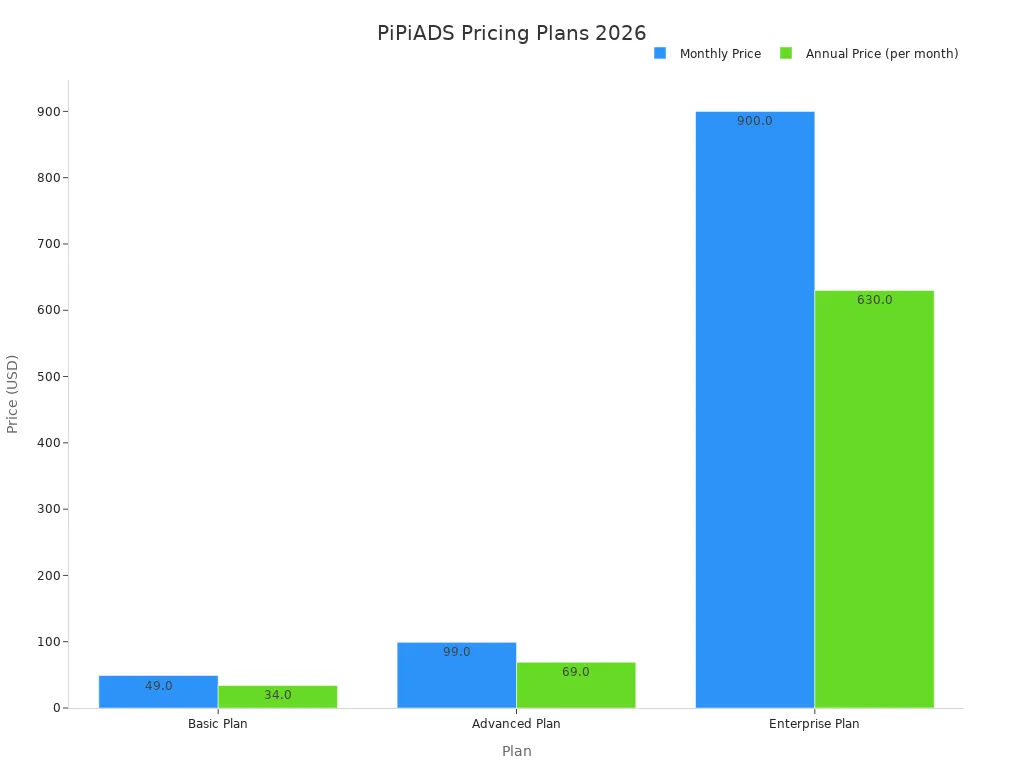
Pipiads.coupons reports that 1 credit covers a basic data point and 20 credits cover a detailed advertiser breakdown. Unused credits do not roll over. New users get 500 free trial credits with no credit card required.
Pros, Cons, and Best Fit
The depth pays off when you study ad creative. You can trace a winning video back to its store and landing page. That makes PiPiADS a strong tiktok shop competitor analysis tool for creative-led sellers.
The credit model needs attention. Heavy searching burns credits fast, and top-up packs cost extra. Trial terms also change with the vendor's current campaign, so check the live signup page.
Best fit: you want a shop analytics tool built for ad and creative depth on TikTok, and you plan to pair it with a broader tiktok shop analytics platform for sales estimates.
Minea: Best for Tracing Viral Content
Minea watches social platforms for you. It tracks ads across Facebook, TikTok, Instagram, and Pinterest in one feed. That makes it a strong pick for viral product tracking. You see a creative while it still has momentum, not after it peaks.
Key Features and Pricing
Autods describes three core strengths. A large creative library shows you the angles, hooks, and ad formats competitors use. Influencer insights reveal which creators push a product, how often they post, and how audiences respond. Competitor tracking shows what other stores test, scale, or drop.
Sellthetrend adds more detail. The Multi-Platform Spy Engine tracks over 10 million ads and updates its database up to 8 times daily. Success Radar AI gives each product a Success Score from 0 to 100. Products above 85 count as high-validation hidden gems. You can also download creatives to study hooks and calls-to-action.
Productlair lists the 2026 plans below.
Plan | Monthly Price |
|---|---|
Starter | |
Premium | $99/month |
Business | $199/month |
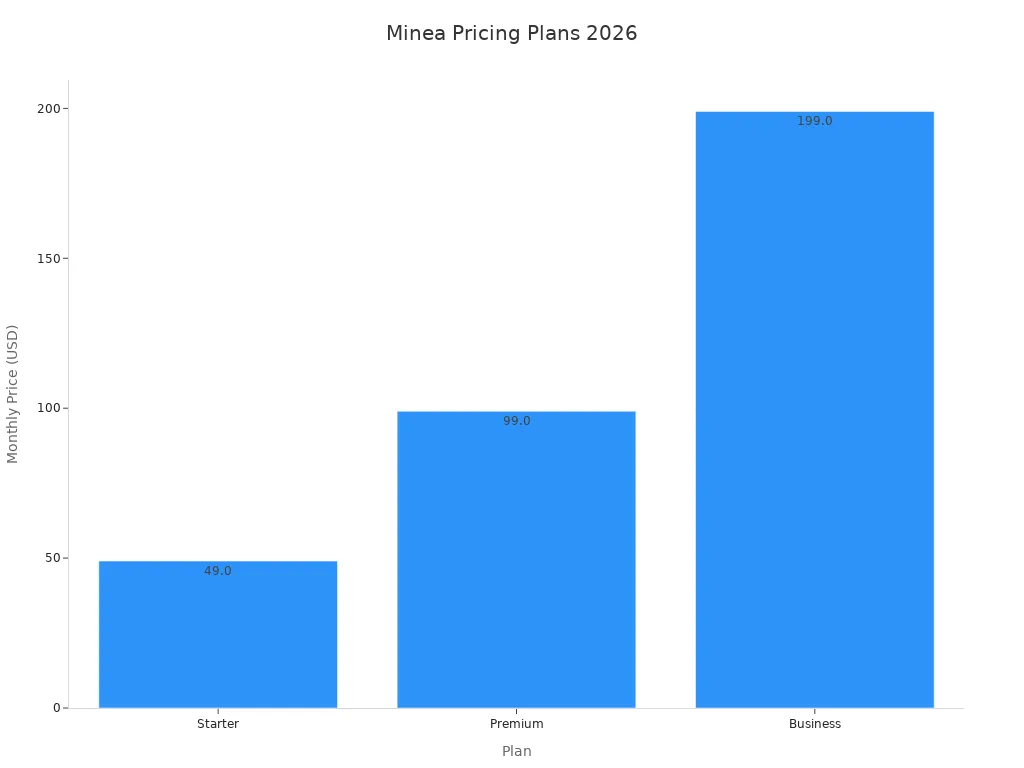
Trendtrack reports one catch. TikTok ad spy access sits only on the Premium plan, at $99/month or $99/month billed annually. The free plan blocks TikTok spying, and the vendor offers no refunds.
Pros, Cons, and Best Fit
The multi-platform view is the main draw. You can spot trending products on TikTok and compare them with what works on other networks. The Success Score saves time on early screening. Creative downloads help you learn from winning formats.
The limits deserve a check. TikTok data costs more than the entry plan suggests. You pay upfront with no refund path. Minea also leans toward ad creative, so pair it with a shop analytics tool for sales estimates.
Best fit: you want to trace viral products across several platforms and study the creatives behind them before you commit to inventory.
Best Free TikTok Product Research Options
What Free Tools Can and Can't Do
Free options give you a real starting point. TikTok Creative Center costs nothing and shows trending hashtags, songs, and top ads. The TikTok Ads Library lets you view active and historical ads at no cost. Both work in 2026 without a payment method.
Free tiers also have clear limits. SmartScout notes that TikTok Seller Center shows only your own shop data. You cannot research competitors or analyze category-level demand there. SmartScout also reports that EchoTik's free data does not go as deep as Kalodata or FastMoss on any single metric, and Shoplus offers only a limited free tier.
You can still run useful product research with free tools. Use them to spot signals, not to confirm demand. A free feed tells you what is moving. It does not tell you the sales volume behind the movement.
A few low-cost resources round out the free stack. Helium 10, Exploding Topics, Dropship Spy, and Pinterest Trends each add a different angle. Treat them as complements to a TikTok product research tool, not replacements.
When to Upgrade to Paid
Upgrade when free data stops answering your questions. If you need sales estimates, creator contacts, or long history, a paid tiktok shop analytics tool becomes necessary. Free tiers rarely carry those figures.
Watch for one clear signal. You keep checking the same trending products and cannot tell which ones sell. That gap is where paid shop analytics tool plans earn their cost. EchoTik starts at $13.90 a month, and FastMoss sits at $49, per the pricing table above.
Start small. Run a free trial, test five products you already know, and compare the numbers. Upgrade only when the paid data changes a decision you would otherwise guess at.
TikTok Shop Product Research Tools: A Step-by-Step Workflow
From Trend Spotting to Validation
You do not need every tool on this list. You need the right tool for each research job. Nexscope breaks the work into three questions: what is selling now, which product is worth testing, and how is that product being sold.
Spot trends first. TikTok Creative Center shows rising hashtags and top ads for free. Minea adds viral product tracking across several platforms, so you catch a clip while it still has momentum.
Validate demand next. Kalodata, FastMoss, and EchoTik give you sales estimates, creator counts, and history. Nexscope's medicube PDRN balm example shows the pattern: 73,404 weekly orders and $1.89 million weekly GMV on the US leaderboard, plus 5,600+ creators, a 15% commission, and a 4.3 rating. That product reached 570,000 orders and more than $12.45 million in GMV within two months.
Add category intelligence. SmartScout maps niche demand and competition. PiPiADS traces an ad back to its store and landing page.
Most 2026 sellers run a combined stack. Seller Center, Creative Center, Ads Manager, and Affiliate Center cover the basics. One or two paid tiktok shop product research tools add the depth.
Turning Research Into a Decision
A shortlist means nothing until you test it. Nexscope recommends checking creator videos for repeatable formats. Look at video length, hooks, and visible demonstrations. The medicube winners ran 60 to 90 seconds with product-led demos, not random trend clips.
Set a simple pass or fail rule. A product passes when demand, creator activity, and margin all line up. Nexscope's signals give you a checklist: enough sales volume, enough creators, a commission rate that supports promotion, and ratings that reduce customer risk.
Then commit. Order a sample, brief three creators, and track results for two weeks. This product research tool workflow turns tiktok shop analytics into profitable tiktok shop products instead of guesses.
Your pick depends on your scenario. Kalodata earns the best tiktok shop analytics tool label for sellers who want one dashboard. FastMoss works as the strongest alternative when you want a public price. TikTok Creative Center gives you a free starting point for trend signals.
No single tiktok product research tool wins for everyone. Budget, research style, and business stage decide the fit. Start with a free trial and test five products you already know. Paid plans begin near $13.90 a month, so a small test costs little.
Pick one tool this week. Run the workflow above, validate a product, and let real tiktok shop data guide your next order.
FAQ
Which TikTok product research tool works best for a beginner?
Start with TikTok Creative Center. It costs nothing and needs no payment method. You can study trending hashtags, songs, and top ads right away. Move to a paid plan once you need sales estimates. EchoTik starts at $13.90 a month, so the first step stays cheap.
How much do paid TikTok Shop analytics tools cost in 2026?
Entry prices stay low. FastMoss starts at $49 a month, and EchoTik starts at $13.90 a month. Kalodata does not publish its plans, so you must sign up to see them. Most vendors offer a free trial or a money-back window before you commit.
Can I validate products with free tools alone?
Free options spot trends, not demand. TikTok Creative Center and the TikTok Ads Library show what is moving. They do not show sales volume behind the movement. Use free tools to build a shortlist. Then check that shortlist with a paid platform before you order inventory.
How do I test a tool before I pay?
Pick five products you already know. Run each one through the tool during its free trial. Compare the sales estimates, creator data, and history against what you know is true. The tool that answers your questions fastest earns your subscription.
Should I use more than one tool?
Yes, for most sellers. Many 2026 sellers pair a free trend feed with one paid platform. Creative Center spots the trend, and a paid tool confirms the demand. That stack covers discovery and validation without paying twice for the same data.
See Also
Essential Tips for Beginners Choosing Products on TikTok
The Complete Guide to Using TikTok Analytics Tools
Top Free Tools for Analyzing TikTok Performance