Echotik Review: What TikTok Shop Sellers Need to Know


TikTok Shop sellers face a relentless pace. Trends spike overnight, competitors undercut prices, and gut instinct alone rarely keeps up with the feed. That pressure raises a practical question: does Echotik deliver the analytics edge a TikTok Shop seller needs?
This review answers that question directly. It examines what Echotik does, how the platform performs under real use, and the pros and cons that matter most. Hands-on testing, seller feedback, and a Kalodata comparison inform the assessment. The price question gets equal weight throughout. A clear best-for and skip-if verdict closes the evaluation, so sellers can decide fast.
Key Takeaways
Echotik offers affordable TikTok Shop analytics starting at $10.19 per month, with a free plan to test the tool.
Small sellers and solo founders benefit most from Echotik's easy-to-use dashboard and quick product research.
Echotik provides practical features like product tracking, creator insights, and competitor analysis.
The tool lacks deep historical data and advanced features, so large operations may need a different platform.
Try Echotik's free plan first to see if it fits your needs before committing to a paid tier.
Quick Verdict
Our Score and Best-For Pick
Echotik earns a solid 7.5 out of 10 in this review. The platform gives TikTok Shop sellers a workable set of research tools at a price that undercuts several rivals, and it handles the basics well: product discovery, creator lookup, and competitor tracking all live in one dashboard. The tool does not lead the category on data depth, and some of its more advanced features sit behind higher plan tiers. Still, a seller who needs affordable, usable analytics without a steep learning curve will find real value here. Echotik is worth the money for the right user, and that user is usually a small or mid-sized seller who wants fast answers rather than exhaustive datasets.
Echotik fits best with sellers who run a lean operation. A solo founder or a two-person team can open the dashboard, scan trending products, and shortlist creators in a single sitting. The interface rewards that kind of quick, practical use. Sellers who already know their niche and want to validate a product idea before committing inventory will get the most from it. The same holds for merchants who need a cheaper entry point into TikTok Shop analytics and plan to upgrade only after revenue justifies the cost.
Skip Echotik If
Echotik is not the right pick for every seller. Large operations that depend on deep historical datasets, granular attribution, or enterprise-grade reporting should look elsewhere. The same applies to teams that need every advanced feature unlocked from day one. Echotik gates several capabilities behind its upper tiers, and a seller on the entry plan may hit those limits quickly. Data-hungry analysts who want to slice years of market history will likely find the coverage thinner than they need.
Sellers who already pay for a premium platform with broader data coverage should also pause. Switching tools costs time, and Echotik does not clearly beat the top-tier options on raw data volume. A seller who values proven accuracy over price should compare carefully before moving. The honest summary is simple: Echotik suits budget-conscious sellers who want practical answers, and it frustrates users who demand maximum depth. That trade-off defines the verdict, and the sections below explain how the testing led to it.
How We Tested
Testing Criteria
The evaluation followed a hands-on process. The reviewer opened a working Echotik account and exercised the core features directly: product research, creator lookup, competitor shop tracking, and video performance views. Each feature got a practical task rather than a casual click-through. For product research, the test involved scanning trending categories and shortlisting items for a sample niche. For creator insights, the test involved filtering creators by engagement signals and building a shortlist for outreach. Competitor tracking and video views received the same treatment.
Comparison formed the second pillar of the test. The reviewer ran the same research tasks inside Echotik and inside Kalodata, then noted where each tool returned faster answers or richer context. Pricing pages for both platforms were checked against the features each plan actually unlocks. The review also weighed publicly available seller feedback to balance first-hand use with outside experience. No single session decided the score. The verdict reflects the full set of tasks and the consistency of results across them.
What We Couldn't Verify
Some claims resisted independent confirmation. Echotik publishes figures about its data coverage, and this review could not audit those numbers against an outside source. The same limitation applies to data refresh speed. The reviewer observed updates during testing, yet a short testing window cannot prove long-term refresh reliability. Uptime and server stability also fall outside what a hands-on review can measure without extended monitoring.
Seller sentiment carries a similar caveat. Public reviews and community posts informed the user sentiment section, and those sources skew toward strong opinions at both ends. Quiet, satisfied users rarely post. The review therefore treats praise and complaints as directional signals, not as a representative survey. Where Echotik's analytics accuracy could not be checked against TikTok's own seller data, this article says so rather than guessing. Readers should weigh the score with those gaps in mind.
What Is Echotik? A TikTok Shop Analytics Tool
Core Purpose
Echotik is a tiktok shop analytics tool. It collects public data from TikTok Shop and presents it in a readable dashboard. Sellers use it to see what products sell well, which creators drive sales, and how competitor shops perform. The platform turns scattered marketplace signals into a single view. A seller new to analytics software can open Echotik and understand the layout without training. The tool focuses on practical questions: what is trending, who is selling it, and what content works.
Echotik functions as a tiktok shop product research and analytics tool for sellers who need fast answers. It does not replace TikTok's official Seller Center. Instead, it adds market context that the official tools do not show. The platform supports product research and analytics across categories, creators, videos, and live rooms. This makes it a useful e-commerce intelligence tool for sellers who want to spot opportunities before competitors do.
Where It Fits
Echotik slots into a seller's daily workflow at three points: research, listing, and creator outreach. During research, a seller narrows the scope to one market and category. They use Echotik to find products with repeated momentum across rankings, shops, creators, videos, and live rooms. This avoids one-off viral hits. The seller then studies the content behind the product — hooks, demo formats, comment questions — and turns that into a content strategy.
For listing, the seller reviews competitor shops for product mix, listing style, and selling angles. They check live selling signals through Echotik Live Monitor to see featured products, host talking points, and recurring buyer objections. Before listing, they build a test plan with a product page angle, short-video hooks, and a compliance review.
For creator outreach, the seller assesses creator fit by category relevance, product history, audience comments, and competitor overlap. The Echotik Browser Extension supports this while browsing. The tool fits best as part of a broader stack. A new seller in the first 90 days might pair Echotik with Seller Center, Affiliate Center, Creative Center, and CapCut. A growing seller with steady daily orders might use Echotik alongside Ads Manager, Kalodata or FastMoss, and Canva Pro. Echotik serves as the research layer in each setup.
User Sentiment
What Sellers Praise
Seller feedback on Echotik leans positive on the practical basics. Users frequently highlight the clean dashboard and the short learning curve. A seller can open the tool and find trending products without watching a tutorial series first. That ease of use matters for solo founders and small teams. They value a tool that answers a question in minutes rather than hours.
Pricing draws consistent praise as well. Sellers describe Echotik as an affordable entry point into TikTok Shop analytics. Many compare it favorably to premium platforms on cost alone. The creator lookup feature also earns positive mentions. Sellers report that filtering creators by category and engagement signals saves time during outreach. The browser extension gets similar credit for keeping research close to the browsing workflow. Overall, users treat Echotik as a dependable research layer, not a replacement for official seller tools.
Common Complaints
Complaints cluster around depth and plan limits. Some sellers report that advanced features sit behind higher tiers. A user on the entry plan may find the tool thinner than expected once the basics run out. Others describe the historical data as less extensive than what premium rivals offer. These users want to study longer trend windows and find the coverage limited.
A second theme involves data confidence. Some sellers question how closely Echotik's figures match TikTok's own numbers. The review could not verify those claims either way, and public reviews skew toward strong opinions at both ends. Quiet, satisfied users rarely post. Readers should treat this feedback as a directional signal rather than a representative survey. The pattern is clear, though: sellers praise accessibility and price, and they push back on depth and tier gating.
Key Features

Product Research
The product research module forms the core of Echotik's value for sellers. It tracks live streams in real time and reports GMV, order quantity, unit price, and best-selling SKUs across regions. A trending short video tracker surfaces rising viral items and filters for stable growth over a three-to-seven day window. Full competitor store intelligence covers daily sales, monthly GMV, launch frequency, top products, and content strategies. An influencer ROI view uses creator sales data to calculate cooperation returns. Cross-border hot rankings cover the US, UK, Southeast Asia, and the Middle East. An AI recommendation engine screens low-competition, high-margin items based on the seller's niche.
Capability | What it does for sellers |
|---|---|
Real-time live stream monitoring | Tracks live streams, GMV, orders, unit price, and best-selling SKUs |
Trending short video tracker | Surfaces viral items with stable three-to-seven day growth |
Competitor store intelligence | Analyzes rival daily sales, monthly GMV, and top products |
Influencer ROI analysis | Calculates cooperation returns from creator sales data |
Cross-border hot rankings | Provides classified hot lists by region |
AI product recommendation | Screens low-competition, high-margin items by niche |
These capabilities support tiktok shop product research across the full workflow. Sellers can find products gaining momentum, compare items within a category, research competing shops, and monitor ranking changes. The same module supports best-selling product identification and cross-country opportunity comparison. Advanced views sit behind higher plans, so entry-tier users should confirm access before subscribing.
Creator Insights
Creator insights help sellers judge partnership fit before outreach. Echotik ranks influencers and reports performance stats for evaluation. A promotion email generator produces ready-to-send outreach messages. Detailed product and influencer metrics track sales, GMV, and product trends alongside creator performance. Sellers can weigh category fit, content style, comment quality, product promotion history, live selling potential, audience-market match, repeat performance, and competitor overlap.
A browser extension lets users analyze creators and tiktok shop products while browsing the platform, then save findings into their workflow. This supports influencer discovery through direct review of creator activity and product relevance. The creator tools serve as a practical analytics and product research tool for outreach planning. Sellers researching tiktok shop products can shortlist partners with confidence. These features reward sellers who plan campaigns carefully.
Competitor and Video Analytics
Tracking Rival Shops
Echotik gives sellers a structured view of rival stores. The platform tracks competitor shops at the SKU level and pairs sales insight with market context. Sellers can see which products other stores push, how pricing and assortment shift, and where growth patterns emerge. This supports competitor benchmarking, traffic analysis, product insights, and tiktok market data in one place.
Tracking Capability | What Echotik Provides |
|---|---|
Competitor store tracking | SKU-level tracking of rival stores with sales insight and market context |
Pricing and assortment | Visibility into competitors' pricing and assortment changes |
Product focus | Shows which products other stores actively push |
SKU analysis | Analysis of competitor SKUs, pricing strategies, and growth patterns |
Sales-context visibility | Store monitoring and sales-context data for product and pricing strategy |
The tool also offers full competitive benchmarking. A seller can compare their shop against rival shops and identify improvement areas. Echotik states that it provides real-time updates, so changes in shop results appear without delay. The source describes this generally and does not tie real-time updates explicitly to competitor tracking. Sellers should confirm refresh behavior on their plan before relying on it for fast-moving categories.
Video Performance
Video analytics help sellers connect content to tiktok shop sales. Echotik recommends tracking metrics by goal. Reach covers views, unique viewers, and profile views. Content quality covers average watch time and completion rate. Engagement covers likes, comments, shares, and engagement rate. Audience growth covers new followers and follower growth rate. Conversion covers product clicks, orders, and GMV. Creator campaigns cover posts, views, clicks, and sales contribution.
Engagement Rate = (Likes + Comments + Shares) ÷ Views × 100
Echotik explains that this formula lets sellers compare videos with different view counts. A video with 600 interactions on 10,000 views yields a 6% engagement rate. Echotik also publishes benchmarks. An engagement rate of 4-6% counts as average, 8-10% as strong, and 12% or higher as viral territory. A like-to-view ratio of 4% is average, 5-10% is strong, and 10% or higher is viral. Echotik states that the average conversion rate on TikTok Shop sits between 0.3% and 0.6%. Tracking which videos and tiktok shop products turn interest into sales matters for growth. Sellers can review trending products, influencers, videos, and livestream performance through this analytics layer, and the resulting tiktok shop data and trends inform the next content push.
Echotik Pros and Cons

A fair review of any analytics platform rests on a balanced look at its pros and cons. Echotik brings clear strengths to the tiktok shop research workflow, and it carries real limitations. The table below pairs each strength with the corresponding trade-off, so sellers can judge fit at a glance.
Strength | Corresponding Limitation |
|---|---|
Entry pricing at $10.19/month, roughly 75% below Kalodata's ~$45/month | Advanced views sit behind higher tiers, so entry users hit limits |
Free plan available with no credit card required | Free and entry tiers offer less historical depth than premium rivals |
Chrome extension overlay shows revenue and engagement on the TikTok feed | The overlay is exclusive to Echotik, so teams standardized on other tools lose it |
Data refresh every 15 minutes, matching Kalodata's interval | A short testing window cannot prove long-term refresh reliability |
Core feature parity for sellers under $50K monthly GMV | Large operations need deeper datasets than the core plans supply |
Where Echotik Wins
Echotik wins on accessibility and price. The starting plan costs $10.19 per month, roughly 75% below Kalodata's ~$45 monthly entry point. A free plan requires no credit card, which lets a new seller test the tool before spending anything. The Chrome extension overlay is exclusive to Echotik. It layers revenue and engagement figures directly onto the TikTok feed, so a seller can size up a product or creator without leaving the browse session. Data refreshes every 15 minutes, the same interval Kalodata reports. Core feature parity holds for sellers under $50K monthly GMV, which covers most small and mid-sized shops.
The platform also earns credit for profit visibility. Real-time profit dashboards show earnings as they happen. The tool tracks all fees to reveal true profits and hidden costs. Alerts fire when profit margins drop, so sellers can act before problems grow. Detailed product-level analytics help sellers decide which products to promote or change. Automatic shop data syncing removes manual uploads and spreadsheets. These key features position Echotik as a strong choice for sellers who need profit tracking, cost discovery, and product performance in one place. The platform targets individual sellers and small teams, and its pricing and layout reflect that focus. A two-person team can open the dashboard, scan trending items, and shortlist creators in one sitting. The free tier also serves as a low-risk entry point for sellers who want to compare tools before committing.
Where It Falls Short
The cons center on depth and tier gating. Advanced views sit behind higher plans, so a seller on the entry tier may find the tool thinner than expected once the basics run out. Historical coverage trails premium rivals, and data-hungry analysts who want to slice long trend windows will notice the gap. These are fit issues rather than flaws. A solo founder validating a product idea rarely needs years of history. A scaling brand with a dedicated analytics team usually does.
The browser overlay cuts both ways. Sellers who standardize on another platform lose that convenience. The 15-minute refresh interval matches Kalodata, yet a short review window cannot confirm long-term reliability. Sellers should weigh these pros and cons against their own workflow. Echotik fits budget-conscious operators who want fast, practical answers. It frustrates users who demand maximum depth from day one. That trade-off defines the verdict, and it keeps the tool honest about its place in a seller's stack.
Pricing and Value
Plan Tiers
Echotik sells a permanent free tier plus three paid plans. The free plan costs nothing and never expires, yet it caps detail views and filters. A seller can use it as a no-expiry demo, not a working research plan. Basic runs $13.90 per month, or $9.90 per month billed yearly. Pro runs $29 per month, or $19.10 billed yearly. Enterprise runs $57 per month, or $29.10 billed yearly. Prices reflect a public one-user configuration checked in October 2026, and API plans carry separate terms.
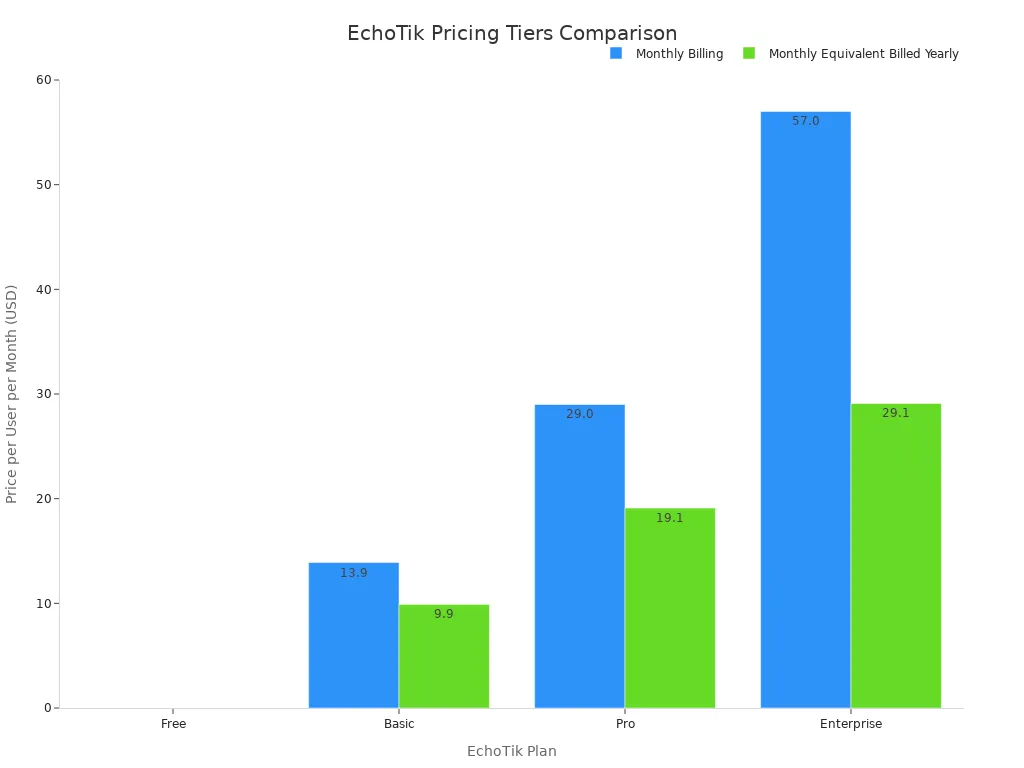
The entry price sits far below Kalodata's $45.90 to $45.99 monthly starting point. That gap matters for a seller who spends under $50K monthly GMV, where every subscription competes with ad spend. The trade-off is a narrower data window. Basic offers 30 days of history, and Pro offers 90 days. Echotik gates volume rather than features. Pro and Enterprise share similar capabilities, and they differ mainly in daily search and detail-view ceilings. Influencer email export stays Enterprise-only.
Value by Seller Stage
A new seller gets the most from the free tier and Basic. The free plan lets them test the platform before paying, and Basic unlocks the fuller research experience at a low cost. A seller validating a first tiktok shop product idea rarely needs long history. They need fast answers about demand and creator fit. Basic covers that job, and the 30-day window suits short trend checks.
A scaling shop should look at Pro. The 90-day window supports real trend analysis, and the higher search ceilings fit daily research across many categories. An agency or data-heavy operation needs Enterprise. Influencer email export and the largest export allowances live there. Echotik's entry plan costs about $9.90 per month billed yearly, and that price makes the analytics layer easy to justify. Sellers researching tiktok shop products should match the plan to their research volume, not to the feature list alone.
Echotik vs. Kalodata: TikTok Shop Intelligence Compared
Data Coverage and Credibility
The two platforms differ most in how much data they publish and how deep the history runs. Kalodata was built by ex-TikTok insiders, and it reports 200M+ product records, 250M+ creator profiles, and 400M+ video and livestream records. Echotik publishes its coverage by dimension instead of by count. Its official API page lists creators, videos, live streams, products, comments, shops, music, keywords, ads, and topics, with up to 1,000 days of history. This review could not confirm equivalent Echotik counts for products, creators, or videos, so readers should treat the two datasets as differently documented rather than directly measured.
Metric | Kalodata | Echotik |
|---|---|---|
Product records | 200M+ | Not published by count |
Creator profiles | 250M+ | Not published by count |
Video and livestream records | 400M+ | Not published by count |
Historical depth | Up to 1,000 days (90-day view on Starter) | Up to 1,000 days |
Credibility cuts both ways. Kalodata's insider pedigree supports its authority, yet sellers have raised data precision concerns about its starter plan, where the 90-day view limits historical work. Echotik's 1,000-day window looks generous on paper, and its dimension list is broad. Neither claim was independently audited here.
Which Fits Your Shop
Fit depends on the job, not the feature list. Kalodata suits pre-launch sellers who want the deepest US category browsing and the cleanest path from category to winning SKUs. It also fits agencies recruiting creators from actual sales history and teams running competitive benchmarking reports. Echotik works as a lighter, cheaper alternative for solo sellers and small teams who need visibility rather than analysis. It covers the basics of tiktok shop intelligence at a lower entry point and gives up depth, not the core view.
A budget-constrained seller watching one or two named competitors will find either tool adequate, since single-shop tracking is commoditized. A seller running a real program at scale should run two tools and cross-check, the only accuracy control available. Both platforms qualify as serious e-commerce intelligence tools. Echotik's key features favor monitoring and trend spotting; Kalodata favors merchandising and creator sourcing. That split, more than any score, decides which platform earns a place in a shop's stack.
Who Should Use Echotik for TikTok Shop?
Best-Fit Sellers
Echotik serves a defined audience. The platform is built for TikTok Shop sellers, product researchers, affiliates, e-commerce creators, brands, influencer marketing teams, TikTok Shop agencies, and cross-border sellers. Independent sellers gain the most from its pricing model. Free access plus affordable paid tiers makes Echotik a strong entry point for individual and small operators. A solo founder can run tiktok shop product research without a large budget. A two-person team can shortlist creators and check competitor shops in one session.
The price band confirms that focus. Echotik starts at $10.19 per month, placing it among the lowest-cost options for individual TikTok Shop operators. Enterprise brand teams typically negotiate quote-based contracts with platforms built for large organizations. Echotik does not target that segment. Sellers who run their own accounts and want practical product research and analytics will find the tool well matched to their needs.
When to Skip It
Several scenarios call for a different tool. Sellers centered on Southeast Asia should favor a platform with deep regional signal, since Echotik leans toward the US market. US sellers facing regulatory uncertainty should avoid depending on a single US-only shop-analytics tool, which creates concentration risk. Cross-border sellers should judge tools region by region and consider pairing two tools, one strong per market. Trial discipline matters too: test each tool in each market the seller operates in.
Capability gaps also drive the skip decision. Echotik offers no automated outreach, no sample seeding, no first-party GMV tracking, and no program management layer. Sellers who need to message creators at scale, track samples end to end, or attribute revenue to their own outreach should choose a tool with those workflows. Agencies managing many brands should not rely on Echotik alone.
Agencies need broader tooling, and the evidence points to Shoplus for their feature depth. Agencies that manage many brands can still use EchoTik for creator discovery, then pair it with a deeper agency suite.
Sellers who need execution support beyond cheap, broad research on tiktok shop products should skip Echotik and pair it with a deeper suite.
Support and Reliability
Support Quality
Support quality shapes how quickly a seller resolves a data question during a live campaign. Echotik offers help through its dashboard and documentation, and the platform publishes guides on metrics such as engagement rate and conversion benchmarks. A seller who needs a fast answer on a metric definition can often find it in those resources without contacting anyone. This review did not run a structured support test, so it cannot report response times or resolution rates. Readers should treat support as an open question and test it during a trial.
The practical advice is simple. A seller should open a ticket during the free plan and note how long a reply takes. That small test reveals more than any marketing page. Teams that depend on daily tiktok shop intelligence should confirm support hours before they commit to a paid tier.
TikTok Shop Analytics Accuracy
Accuracy deserves careful framing. Echotik states plainly that its market figures should be treated as estimates. The company notes that the numbers are not audited financial statements and that GMV figures serve market comparison and trend analysis. It also acknowledges a gap between third-party estimates and first-party Seller Center data.
EchoTik statement | What it means for accuracy |
|---|---|
Figures "should be treated as estimates" | Not exact; no claim of matching real sales |
Figures "are not audited financial statements" | Not verified against actual revenue |
GMV figures are "estimates used for market comparison and trend analysis" | Built for relative comparison, not absolute precision |
"Do not present it as audited income" | Warns against treating estimates as real revenue |
EchoTik advises writing figures as an "estimated GMV range" (for example, $500,000–$600,000) rather than asserting an exact amount like $550,000, unless verified first-party records are available.
That guidance tells sellers how to read the tiktok shop data. Use it to compare shops and spot trends, not to book revenue. A seller who tracks tiktok shop performance against Seller Center will see the difference. This review could not audit Echotik's figures against TikTok's own numbers, so the honest position is caution. The tiktok shop analytics platform earns trust through relative signals, and any tiktok shop analytics claim about absolute sales needs first-party confirmation. Sellers who need exact figures should pair this analytics platform with their own records.
Echotik earns its place as an affordable research layer for lean tiktok shop operations, and it falls short on data depth for heavy analytical work. New sellers gain a low-risk entry point, scaling shops get practical trend checks, and data-heavy teams should look to Kalodata's deeper coverage. The pros and cons favor budget-conscious operators over enterprise analysts who need maximum depth.
Readers should weigh these strengths against their own research volume. A free-tier trial answers most questions quickly and costs nothing. Comparing Echotik against one alternative, such as Kalodata, settles the rest. That two-step test turns the verdict into a decision.
FAQ
Does Echotik offer a free plan?
Yes. Echotik runs a permanent free tier that requires no credit card. The free plan caps detail views and filters, so it works as a no-expiry demo rather than a full research plan. Sellers can test the dashboard and confirm feature access before paying for Basic or Pro.
How accurate is Echotik's data?
Echotik labels its figures as estimates, not audited financial statements. The company advises sellers to present GMV as a range rather than an exact amount. This review could not audit the numbers against TikTok's own records. Sellers should use the data for trend comparison and confirm absolute sales through Seller Center.
How much does Echotik cost compared with Kalodata?
Echotik starts at $10.19 per month, far below Kalodata's $45.90 monthly entry point. Basic costs $13.90 monthly, Pro $29, and Enterprise $57. Yearly billing lowers each tier. The lower price buys a narrower data window, so sellers should match the plan to their research volume.
Can Echotik replace TikTok Shop Seller Center?
No. Echotik adds market context that official tools do not show, such as competitor shops and creator rankings. It does not track first-party GMV or manage orders. Sellers should treat it as a research layer alongside Seller Center, not a substitute for official tiktok shop reporting.
Which sellers get the most from Echotik?
Solo founders and small teams gain the most. The low entry price and simple dashboard suit sellers under $50K monthly GMV who need fast answers on trending products and creator fit. Large operations and agencies need deeper datasets and execution tools that Echotik does not provide for tiktok shop workflows.
See Also
Three Practical Strategies To Find TikTok Counterpart E-Commerce Accounts With EchoTik
Discover Popular Products And Creators In TikTok Shop Singapore Using EchoTik
Essential Tips For Beginners To Master TikTok Product Selection
How To Efficiently Manage Orders In TikTok Shop With EchoTik
EchoTik Helps Sellers Overcome Inventory Turnover Difficulties After TikTok Shop Indonesia Closure